Campsite Firewood Burn Duration Calculator
Estimate how long your campsite firewood will last by wood species, bundle count, log size, moisture, fire style, wind, fire ring draft, and planned evening burn schedule.
Estimated burn duration
| Wood type | Relative duration | Coal quality | Best campsite use |
|---|---|---|---|
| Pine / fir softwood | Fast, factor 0.78 | Short coal bed | Quick warmth, easy starts, short evening fires |
| Cedar / resinous softwood | Very fast, factor 0.72 | Light coals | Kindling-heavy fires where sparks are controlled |
| Mixed campground hardwood | Normal, factor 1.00 | Moderate coals | General campsite rings and family campfires |
| Oak / dense hardwood | Slow, factor 1.32 | Strong coals | Long social fires and late-night heat |
| Hickory / hard maple | Slowest, factor 1.42 | Excellent coals | Cooking fires and steady coal beds |
| Birch / medium hardwood | Medium, factor 1.08 | Good coals | Balanced heat with easier lighting |
| Aspen / poplar | Fast, factor 0.82 | Soft coals | Light recreational fires and low-smoke starts |
| Condition | Low impact | Moderate impact | High impact |
|---|---|---|---|
| Moisture | Kiln dry can burn 8% faster | Average bundles lose about 10% | Wet wood can lose 40% or more |
| Wind | Calm shelters keep burn steady | Breezy sites add about 18% | Gusts can add 35% and sparks |
| Split size | Large splits stretch duration | Medium splits are the baseline | Small splits burn about 25% faster |
| Fire style | Low social fires save fuel | Steady campfires are baseline | Hot bright fires add about 35% |
| Fire ring draft | Deep rings slow airflow | Standard rings are baseline | Raised pans increase draft |
| Scenario | Firewood on hand | Likely flame time | Planning note |
|---|---|---|---|
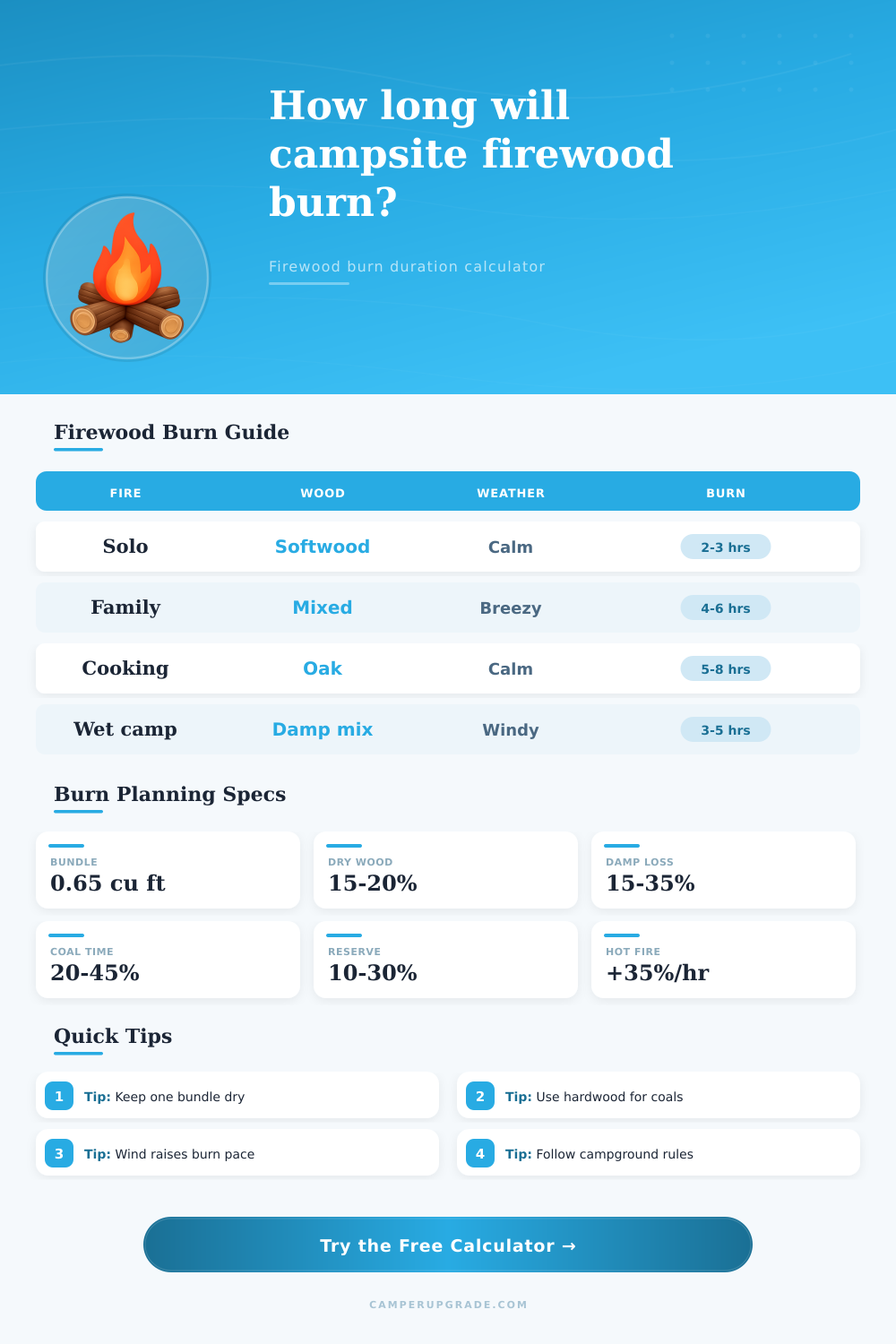
| Solo tent night | 1.5 dry bundles | 2.0-3.0 hours | Enough for one modest evening fire |
| Family campground ring | 4 mixed bundles | 4.5-6.5 hours | Usually covers two short evenings |
| Group basecamp | 10 mixed bundles | 9-14 hours | Needs careful feeding to avoid waste |
| Hardwood cooking fire | 5 oak bundles | 7-10 hours | Includes a long coal cooking window |
| Damp shoulder season | 5 damp bundles | 3.5-5.5 hours | Carry dry starter and reserve wood |
One practical aspect of planning a campfire is this: How do I make the wood I brought last as long as I want it to? The answer isn’t as simple as whether you brought enough into back of the truck. Many factors can swing result one way or another. These include type of wood, its dryness, how you build the fire, and even wind blowing during night. Get it right, and you’ll still have fuel when you need it. Get it wrong, and you’ll be burning more weight than you didn’t bring (or run out of fuel to soon).
Burn rate, on the other hand, is where it gets realy variable. Pine throws heat fast and lights fast (softwood), but dissapears before you think it will (faster then most folks realize). On the other hand, hardwoods like hickory or oak is slower to catch fire and keep a consistent coal bed, extending usable time after flames subside. Moisture also plays a factor. Seasoned wood sitting under a tarp can lose efficiency if its ends were rained on, because now it’s putting energy into boiling water rather than making heat. Fire style and split size is also important. Small ones go quickly, big ones hang around, making better coals. A bright teepee fire blazing across campsite consumes more wood than a low social fire where you add single log at a time.
How to Make Your Campfire Wood Last Longer
How much wind are blowing? More oxygen gets into the fire, which will raise consumption. This becomes much more dramatic if there is no protection for ring and it is set in an exposed area. Your style of tending; aggressive or careful, can affect whole thing by a large amount. These are the sort of factors that make up a planning tool that will match the pile to actual schedule. It’s where I type in number of sessions I wish to cover; the expected weather condition; the type and amount of wood; and the tool then shows how much coal time follows. The calculation then returns how long flames should of burn and how much usable time is left in the coals. It also shows if my reserve can handle a longer final night or a wet log. It makes useful margin out of an otherwise vague guess.
Damp wood can vanish that shoulder-season bundle in no time; an afternoon breeze can eat through that extra wood like there’s no tomorrow. Or someone brings nothing but quick-burnin’ softwood for a three-day outing and is baffled when those coals fizzle before dinnertime. Itll become obvious during the second night, when your so-called stash suddenly appears insufficient.
So the trick is not to treat each bundle of wood as identical but to match job to the wood. Softwood is fine if all you need is quick, warm heat for your solo tent. For late social fires or cooking, denser hardwood hold its heat when flames die down. A tiny stash of the good stuff separated from main pile guards against the only thing no calculator can predict: The log that proves wetter than it appeared. With good planning, you’ll be burning fewer splits, so you have more time by the fire and less time debating whether to ration final few splits.