Camp Water Container Count Calculator
Estimate total camp water, potable water, wash water, refill-window capacity, jug count, filled container weight, and reserve for car camping, RV dry camping, basecamps, and group camps.
🏕Camp Water Presets
📝Water Demand Inputs
Count everyone who drinks, cooks, brushes teeth, or washes hands from the camp supply.
Use half days for arrival or departure if water use is lighter.
Set this lower than trip length if you can reliably refill during the trip.
One gallon per person per day is a common baseline before heat, altitude, or activity adjustments.
Includes coffee, tea, oatmeal, rehydrated meals, pasta water, and soup.
Lower this for wipe-first dishwashing; raise it for full camp kitchen cleanup.
Add sponge baths, solar showers, foot rinses, or gear rinse water that happens once per trip.
Pet water is added separately so people and pet demand stay visible.
Large active dogs in heat may need more than this baseline.
Applies to drinking water only, then reserve is added later.
Reserve covers spills, delayed refills, hotter weather, and a dry source.
Use 100% when all water must be drinking-safe; use lower values if you carry separate wash water.
The calculator rounds up to whole containers after reserve.
Use the marked usable capacity, not the outside volume.
Enter how many main-container equivalents are already filled.
Used to flag whether the selected jug size is comfortable to lift and pour.
Accounts for container corners, leaky caps, priming filters, and water left below a spigot.
This calculator estimates carrying capacity from your inputs. Verify actual container markings, water source rules, sanitation needs, and safe lifting limits before leaving camp or the trailhead.
Camp Water Container Results
💧Common Water Container Specs
📊Water Use Reference
| Use | Low Camp Rate | Typical Camp Rate | High Demand Rate |
|---|---|---|---|
| Drinking water | 0.75 gal/person/day | 1.0 gal/person/day | 1.25-1.5 gal/person/day |
| Cooking and hot drinks | 0.15 gal/person/day | 0.35 gal/person/day | 0.6 gal/person/day |
| Dish and hand washing | 0.25 gal/person/day | 0.55 gal/person/day | 1.0 gal/person/day |
| Pet water | 0.1 gal/pet/day | 0.25 gal/pet/day | 0.5 gal/pet/day |
🧮Container Count Examples
| Camp Scenario | Estimated Water | 5 Gal Jugs | Filled Water Weight |
|---|---|---|---|
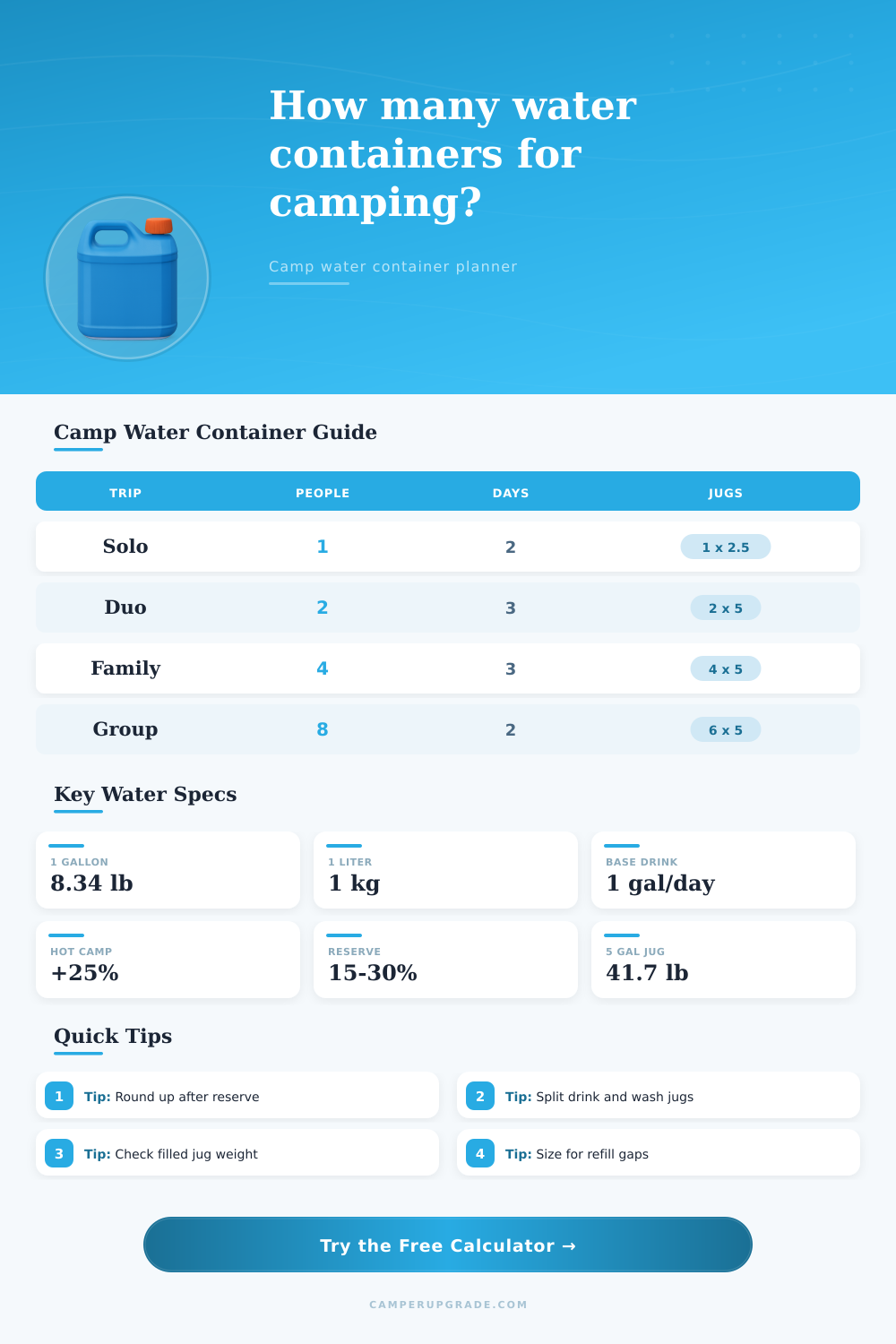
| Solo 2-day simple meals | 3.2 gal with reserve | 1 jug | About 27 lb of water |
| Duo 3-day trailhead camp | 10.5 gal with reserve | 3 jugs | About 88 lb of water |
| Family 3-day basecamp | 25 gal with reserve | 5 jugs | About 209 lb of water |
| Eight-person 2-day group | 32 gal with reserve | 7 jugs | About 267 lb of water |
🚚Container Size Tradeoffs
| Container | Capacity | Water Weight | Best Use |
|---|---|---|---|
| 1 gallon bottle | 3.8 L | 8.3 lb / 3.8 kg | Day use, children, drink-only separation |
| 2.5 gallon cube | 9.5 L | 20.9 lb / 9.5 kg | Small vehicles, easy pouring, short trips |
| 5 gallon jug | 18.9 L | 41.7 lb / 18.9 kg | Car camping, basecamp kitchens, RV backups |
| 7 gallon tank | 26.5 L | 58.4 lb / 26.5 kg | Stationary camp, trailer storage, long refill gaps |
📘Planning Notes
A great camping trip hinges on water planning, did you bring enough? Will there be a scramble to find more? Or will it feel comfortabley? Most of us make a crude guess, throw in a few more jugs just-in-case, pray that the weather isn’t too extreme, and that nothing get spilled.
The calculator above eliminate that guessing game. It takes the numbers you enter into a solid estimate of how much water you’ll need and what that look like in containers. Each input represents some facet of camp life, so let’s get into why the inputs matter. Length of time away from resupply isn’t the same as your longest refill gap, and person count is just one of the inputs you’ll use. Having access to a water spigot you trust every other day doesn’t mean you have to carries your whole trip’s worth of water all at once.
How to Plan Your Water for Camping
Activity and climate settings affect only the drinkable portion. Thirst responds far quicker to heat and exertion different than does dishwater demand. Reserve is there for extra-hot days, accidents, and when you underestimate how thirsty a dog will be. And those little percenters really start to add up as soon as you multiply them over multiple day and people.
Campers learn one thing too late: weight. When a five gallon jug are full it weighs about forty-two pounds. No matter how cleverly the shape is designed, it’s still going to be that much. The calculator will give you a list of containers filled, and then next to each one list its weight. You can choose 2 smaller jugs or something like that and see if they’d be easier to get in the truck, or to carry up to picnic table from the car.
There’s also an option called potable-split, where you treat some of your water as strictly for drinking and cooking. If you’re treating/filtering you might only want to filter/treat what you plan to drink, and use the remainder as utility water. When you plug in some rates, the page’s reference tables put it all into context. Before adjusting for any of that, people will typically drink about a gallon of water per day; washing and cooking will uses significantly less. Those baselines help you judge if your personal habits lean heavy, average, or light, before entering your own assumptions into equation.
Throughout the tool, there are examples showing how actual container counts equate to different trip styles and group sizes. Handy when debating basecamp vs. Weekend for two. The calculator also shows one thing, how much you plan to use versus how much of it will go into your pack.
The rounding up to full containers and spigot loss add a little bit of a buffer for those surprises that come up. And once on site, rounding up after the reserve percentage is applied tend to feel good, hence the cushion. However, that’s where it really pays off. An unexpected guest or a heat wave shifts the numbers, but being able to run the plan again in a minute with the same inputs lets you make quick estimates instead.
H20 is essential, limited, and heavy. Trying to get close to target number before leaving removes one or two decisions from an already long list. You should of tried it earlier.