Backpacking Snack Ounces Per Day Calculator
Estimate how many ounces of trail snacks to carry per hiker per day, with calorie targets, snack break spacing, food density, macro balance, and total trip weight.
🏕Backpacking Snack Presets
⚙Snack Planning Inputs
Use food-carry days, including partial first and last days if snacks are packed.
Results show both per-hiker daily snacks and total group carry weight.
Enter your full daily food target before splitting meals and snacks.
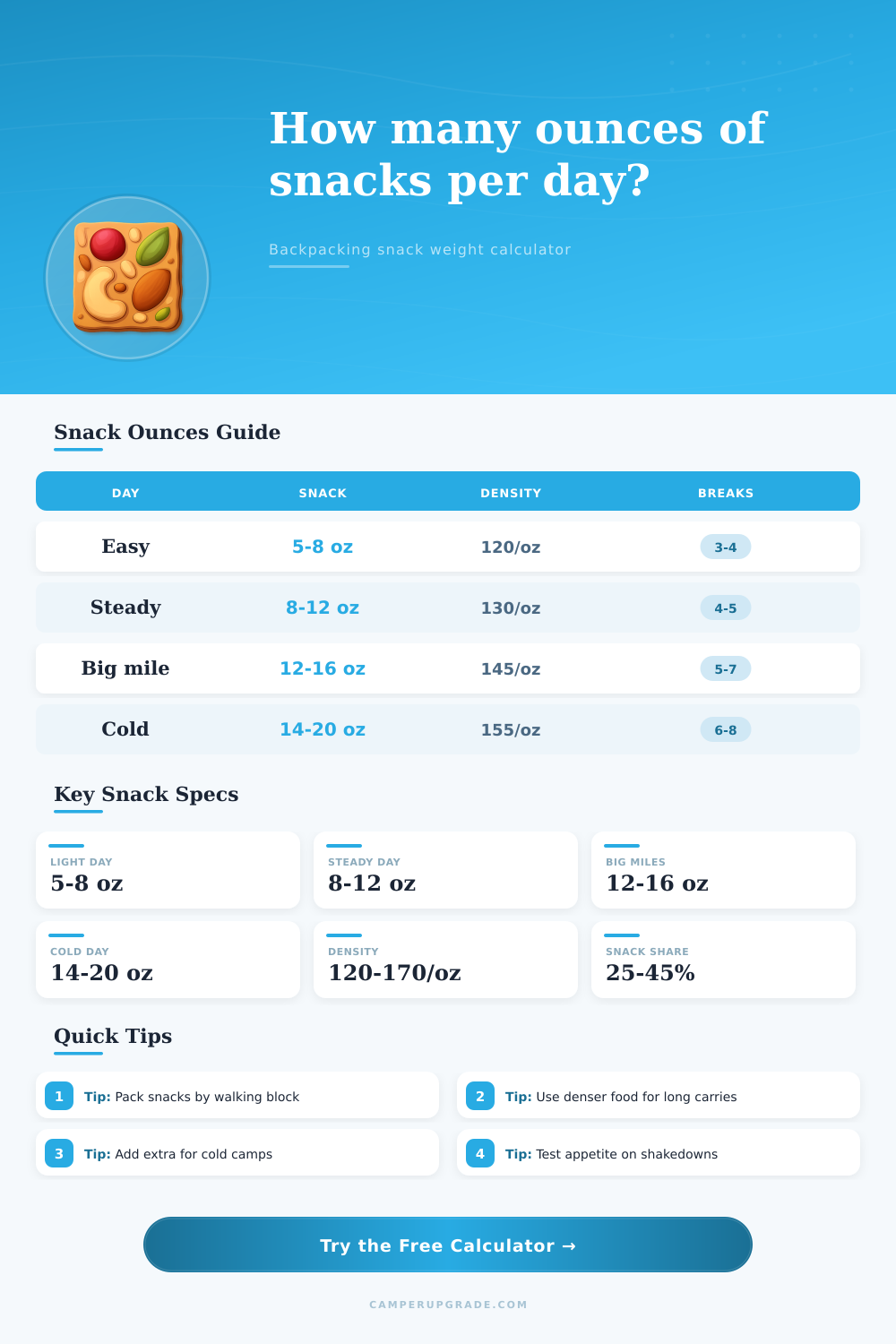
Many backpackers place 25% to 45% of the day in moving snacks.
Used to divide snack calories into practical trail eating blocks.
Distance helps flag days where nibbling frequency matters more.
Climbing days often need quicker carbs and a larger snack share.
Heavy carries increase fatigue and usually call for steadier fueling.
Adjusts the snack share when terrain demands frequent energy.
Cold can raise calories, while heat can reduce appetite for dry snacks.
Sets default calorie density and macro split for snack ounces.
Override if you know your snack bag average from labels or a scale.
The calculator turns daily snack ounces into per-break portions.
Changes bag count, packaging ounces, and portioning advice.
Use the weight of zip bags, labels, or tiny wrappers you will carry.
Adds a food margin for appetite spikes, delays, cold, or shared extras.
Compare your current snack bag against the calculated target.
This calculator estimates backpacking snack weight from your calorie plan and trail conditions. Adjust for your known appetite, food allergies, food storage rules, and real package labels.
Backpacking Snack Ounces Results
📊Calculated Planning Specs
🥜Snack Density Reference
| Snack type | Typical density | Best trail use | Portion note |
|---|---|---|---|
| Gels, chews, candy, dried fruit | 90 to 125 kcal/oz | Quick climb fuel and hot-day appetite | Easy to eat often, but less weight efficient. |
| Bars, granola, cookies, crackers | 110 to 145 kcal/oz | Balanced moving snacks | Useful default for daily ration bags. |
| Trail mix with nuts and chocolate | 140 to 170 kcal/oz | Long carries and steady grazing | Dense enough for most multi-day plans. |
| Nut butter, olive oil snacks, chips | 160 to 230 kcal/oz | Cold weather or very high calorie days | High density can reduce total snack ounces. |
| Jerky, meat sticks, protein bars | 80 to 140 kcal/oz | Protein and salty variety | Usually supplement rather than carry all snack calories. |
⏱Snack Timing Guide
| Moving time | Snack interval | Likely breaks | Planning use |
|---|---|---|---|
| 3 to 4 hours | 75 to 120 minutes | 2 to 4 snacks | Short overnight approach or easy first day. |
| 5 to 7 hours | 75 to 100 minutes | 4 to 6 snacks | Normal backpacking day with steady grazing. |
| 8 to 10 hours | 60 to 90 minutes | 6 to 9 snacks | Long mileage where small frequent portions help. |
| 10+ hours | 45 to 75 minutes | 8 to 13 snacks | Fastpack, thru-hike, winter, or pass day fueling. |
📦Packing Style Reference
| Packing style | Bag count effect | Packaging weight | Best use |
|---|---|---|---|
| One bulk snack bag per hiker | Lowest bag count | Very low | Simple grazing when portions do not need strict control. |
| Daily snack ration bags | One bag per hiker per day | Low | Best balance of structure and low packaging weight. |
| Pre-portioned break bags | One bag for each snack break | Highest | Useful for groups, kids, races, or strict calorie pacing. |
| Shared group snack bag | Few large bags | Low per person | Good for families if each hiker still gets enough food. |
| Bear-can compressed rations | Daily bags plus compact fill | Moderate | Controls volume and keeps each day easy to find. |
📝Common Backpacking Snack Examples
| Trip day | Daily calories | Snack target | Snack ounces at 140 kcal/oz |
|---|---|---|---|
| Low-mile overnight | 2400 to 3000 kcal | 650 to 950 kcal | 4.6 to 6.8 oz per hiker. |
| Typical three-season day | 3000 to 3800 kcal | 1000 to 1500 kcal | 7.1 to 10.7 oz per hiker. |
| Big-mile section day | 3800 to 4800 kcal | 1500 to 2200 kcal | 10.7 to 15.7 oz per hiker. |
| Cold or winter travel | 4200 to 5600 kcal | 1800 to 2600 kcal | 12.9 to 18.6 oz per hiker. |
| Thru-hike hunger day | 4500 to 6500 kcal | 2000 to 3200 kcal | 14.3 to 22.9 oz per hiker. |
💡Snack Weight Tips
Packaging snacking food carefuly for an extended hike will play a big role in your backpacking experience. How full of energy you will be vs. How tuckered out you’ll get really are determined by how many snack ounces you bring for your total daily calories and moving hours. How tired you get depends on how many ounce of snacks you bring per mile between meals.
Bring too few snacks, and you might begin nibbling in such a way that leaves you feeling hungry when there’s nothing left to eat. Pack too many snacks, and then you’re carrying more weight different than necessary for the mileage ahead. The distance between meals and a day’s worth of activity is filled with snack planning.
How to Pack Snacks for Hiking
When you’re resting at camp or taking an extended break, meals take care of you. But what about those hours spent on the trail? That’s where snacks comes into play. Once you enter your total daily calorie needs, how many hours per day you think you’ll be moving, what kind of weather and terrain you’ll encounter, and the percent of your day you want dedicated to snacking, the calculator will tell you how many ounces of snack to bring.
Why does it matter? Your body burns different amount of calories depending on these factors. Your food intake and how often you eat also change. Calorie density also matters. You have limited room in your pack. If some snacks has more calories per ounce, they’ll weigh less for the same calorie target. If you select snacks with a higher caloric density, then you get away with less weight, yet still get sufficient calories for your purpose.
The density figure you input tells the calorie calculator how many calories per ounce of snack you are carrying. That means you could carry ten ounces instead of fourteen for the same number of calories. This makes a big difference when you is trying to control your water and pack weight.
And then there’s weather and terrain. Long mileage days, steep climbs, cold nights, they all adds to how much it costs you in energy to move around. The calculator accounts for those things with its recommendation; what it spits out is based off a combination of what you’re planning to eat and how slow/hungry you get in certain conditions. If you’ve got experience with yourself in the past, you can override any (or all) of those tweaks.
There’s another practical application to the plan: break timing. By entering your moving hours and desired interval, the calculator tells you how many snack breaks it thinks you should of take. Instead of only thinking about total ounces for the day, this encourages you to consider portion size in the field. While some hikers want to carry one big snack bag and graze on it throughout the day, others prefer pre-portioned bags to avoid worrying with serving size. Both approaches work, as long as it fits what the day realy needs in terms of total weight.
In reality, the true litmus test is your first (or even second) day out on the trail. Weather, pace, and appetite will seldom align with the plan. Running short? You know one side of the equation. Having leftovers at day’s end? Then you’ll know the other. And then it tightens up the numbers you plug in the next time you fire up the calculator.
That takes a couple trip. No one is looking for exact math. Just bring as much food as you need to be fuelled and not have so much extra that it weighs you down with each step. Once you figure out where to start, all that’s left is listening to how your body reacts on the trail.