Backpacking Insect Repellent Trip Supply Calculator
Estimate how much insect repellent to pack for a backpacking trip by group size, exposed skin, trail hours, evening camp time, insect pressure, product format, reapplication interval, and reserve margin.
🏕Backpacking Trip Presets
🦟Trip And Repellent Inputs
Count people sharing the same supply bottle or wipes.
Youth are modeled at 65% of the adult exposed-skin amount.
Use total on-trail days, including partial first and last days.
Moving time in buggy areas, breaks, climbs, and water stops.
Camp chores often need smaller reapplications than hiking.
The calculator uses exposed skin area, not total body area.
Use this only when the custom exposed-area option is selected.
Camp applications are scaled because less skin is often exposed.
Higher pressure increases the practical use margin.
Moisture and abrasion shorten real-world supply duration.
Format changes the amount used per covered skin area.
Use the product label when it gives a different interval.
This is used only when custom interval is selected.
Shared bottles usually disappear faster than solo bottles.
This modestly reduces repellent demand on exposed skin.
Remote routes and shared bottles deserve a larger buffer.
Use your bottle size, wipe pack fluid amount, or decanted bottle size.
Small pump bottles often weigh about 0.4 to 1.0 oz empty.
Enter partial bottles or wipes you already plan to carry.
Spray drift, cap leaks, and uneven sharing add up quickly.
Use this as a packing estimate. Follow the label on your actual repellent, avoid eyes and damaged skin, and pack out used wipes or empty containers.
Trip Supply Estimate
📦Format And Carry Reference
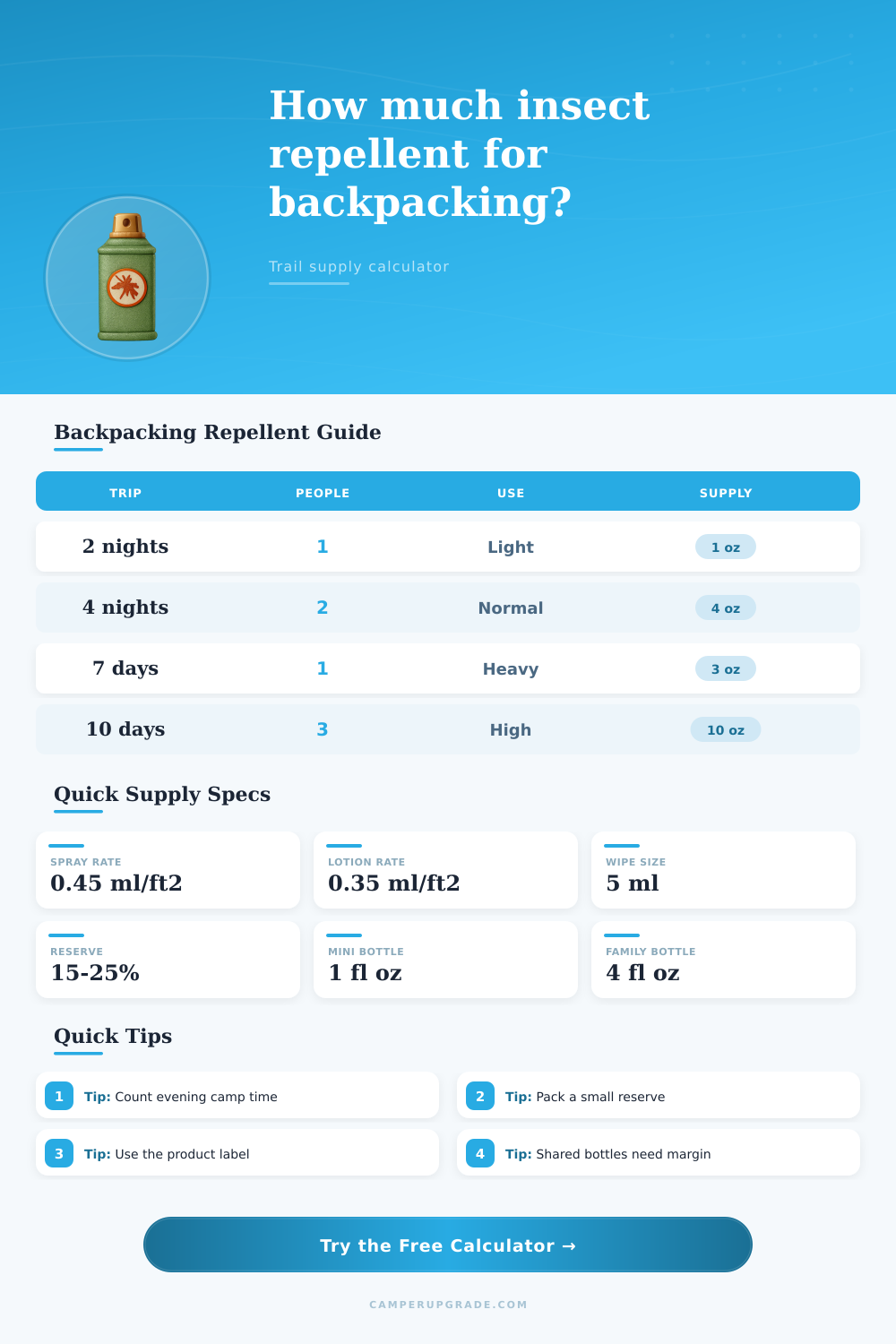
📊Backpacking Repellent Tables
| Product format | Planning rate | Best use | Calculator note |
|---|---|---|---|
| Pump spray | 0.45 ml per sq ft per application | Fast group use, arms, ankles, hat brim | Includes modest overspray but not strong wind drift. |
| Lotion or cream | 0.35 ml per sq ft per application | Controlled use on hands, neck, and ankles | Lower waste, but users may apply more slowly. |
| Aerosol spray | 0.60 ml per sq ft per application | Quick coverage when pack weight is less critical | Higher drift and heavier container assumptions. |
| Stick or balm | 0.25 ml per sq ft per application | Spot treatment, face perimeter, wrists | Efficient for small areas, slow for full limbs. |
| Wipes | 1 wipe per about 2 sq ft | Travel days, kids, clean sharing | Calculator converts wipes to 5 ml fluid equivalents. |
| Roll-on | 0.30 ml per sq ft per application | Ankles, neck, wrists, and precise zones | Low spill risk, but slower for larger groups. |
| Exposure clothing | Adult exposed area | Metric area | Common trip fit |
|---|---|---|---|
| Hands, face, neck only | 1.8 sq ft | 0.17 sq m | Cold mornings, bug shirt, long layers |
| Long sleeves and pants | 2.6 sq ft | 0.24 sq m | Tick routes, shoulder season, alpine wind |
| Short sleeves, long pants | 5.0 sq ft | 0.46 sq m | Typical three-season backpacking |
| Short sleeves and shorts | 7.0 sq ft | 0.65 sq m | Warm trail days and creek crossings |
| Hot weather high exposure | 9.0 sq ft | 0.84 sq m | Desert, humid summer, swim-heavy routes |
| Reapply interval | Trail apps in 8 hr | Typical label cue | Supply effect |
|---|---|---|---|
| 2 hours | 4 applications | Short-duration or heavy sweat plan | About double a 4-hour product estimate. |
| 4 hours | 2 applications | Common mid-duration planning setting | Good default when the label is not in front of you. |
| 6 hours | 2 applications | Long-duration product or lower pressure | Same 8-hour count as 4 hours, less extra margin. |
| 8 hours | 1 application | Extended duration label in mild conditions | Still add camp applications for dusk pressure. |
| Common supply size | Fluid amount | Metric amount | Planning use |
|---|---|---|---|
| Mini dropper or vial | 0.5 fl oz | 15 ml | Solo overnight, spot use, or emergency reserve |
| Small backpacking bottle | 1 fl oz | 30 ml | Solo weekend or careful thru-hike section |
| Medium travel bottle | 2 fl oz | 59 ml | Two people for a short trip or solo buggy week |
| Standard small bottle | 3 fl oz | 89 ml | Common group bottle for several trail days |
| Larger shared bottle | 4 fl oz | 118 ml | Small group, severe insects, or longer section |
| Scenario | Modeled people | Days | Typical calculated supply |
|---|---|---|---|
| Solo covered weekend | 1 adult | 2.5 | About 0.8 to 1.3 fl oz |
| Two hikers, summer forest | 2 adults | 4 | About 3 to 5 fl oz |
| Family lake route | 2 adults, 2 youth | 3 | About 5 to 8 fl oz |
| Severe mosquito section | 1 adult | 7 | About 4 to 7 fl oz |
| Shared thru-hike resupply | 2 adults | 6 | About 4 to 7 fl oz |
🧭Calculation Notes
Nothing looks better on a map than a backpacking trip, until it’s dark out, there are mosquitoes everywhere, and that long hill gets its own share of deer flies up your neck. So will you be carrying repellent? Yes. But then: How much? And how do you avoid making your pack into a chemistry set?
Letting you skip all that math (and guessing about how much buffer/when to reapply), this calculator take various inputs like group size, exposure hours, and product type to do the rest for you. Because the inputs represent real-world events: Trail hours capture the time spent moving through buggy zones, while camp hours reflect slower-paced activities like filtering water or cooking dinner (when bugs is in full force). Clothing choices affect exposed skin area, which is why youth input uses about two-thirds the adult amount (smaller bodies require fewer ounces). Adjustments for sweat and more insects increase totals due to evening swarm events or wet clothing (like sweaty sleeves that force reapplication every few minutes). The type of product also affects results, as lotion tends to spread more precisely than aerosol; and wipes has a bit of package weight to consider.
How to Pack the Right Amount of Bug Spray
Many people make the error of assuming that however long it says on the label is how much they’ll actualy have. That’s not true. Real life includes wind, shared bottles, and the possibility that your shirt might get soaked through. So there’s a reserve margin added to the calculator. It adjusts based off the amount you currently have and container sizes you want to use so that if you’re trying to decide between taking another small bottle, you can figure out if that will still put you over capacity or if you’ll be fine with what’s left in side pocket.
The result is a projected pack weight (which is important on longer trips where ounces count), number of containers, and overall volume of repellent you should of carry. In real life, things don’t quite go according to the clean models. One day it might be long sleeves and the next its shorts and no shirt due to an unexpected weather change. The person with the group who carries his own bottle will end up consuming as much or more then two others sharing a bottle. And nobody predicted those biting flies filling lake basin until you showed up.
But the thing about the calculator is that it provide you with a starting point that assumes some loss for “normal” and has some buffer on top so that instead of starting at the minimum, you start at a realistic place. What’s the best trick? Run the numbers as part of creating your gear list. Then run the numbers again at the end of that day one night out.
What is the biggest driver for using more than planned? It is camp time. The result gives you a sense for if your strategy is conservative or generous with that day’s ration. One such check will turn a fuzzy intuition of “this should be enough” into a concrete decision. You can then stand behind that decision when those bugs arrives exactly when expected.