Backpacking Hydration Per Mile Calculator
Estimate water per mile, hourly sipping pace, total liters, longest dry-stretch carry, refill count, and water weight from distance, speed, terrain, heat, humidity, sun, and pack load.
🏕Trail Hydration Presets
📝Route And Weather Inputs
Include side trips, water detours, and approach miles.
Per-mile water rises when the same miles take longer.
Climbing raises effort and sweat rate.
Use pack weight before adding the water calculated here.
Use the warmest expected hiking temperature.
Humid air reduces evaporative cooling.
Sets the starting liters per hour before route adjustments.
Rough footing raises time and heat production.
Exposure changes sweat loss even at the same temperature.
Use the longest section between reliable water sources.
Add water needed before the next refill, not the whole trip.
Reserve applies to total route water and dry gap carry.
Bladder plus bottles you can comfortably start with.
Used to estimate electrolyte support for the calculated water.
This calculator is a planning aid. Personal needs vary with acclimation, health, medications, altitude, pace, and real conditions.
Hydration Estimate
📊Hydration Snapshot
📘Reference Tables
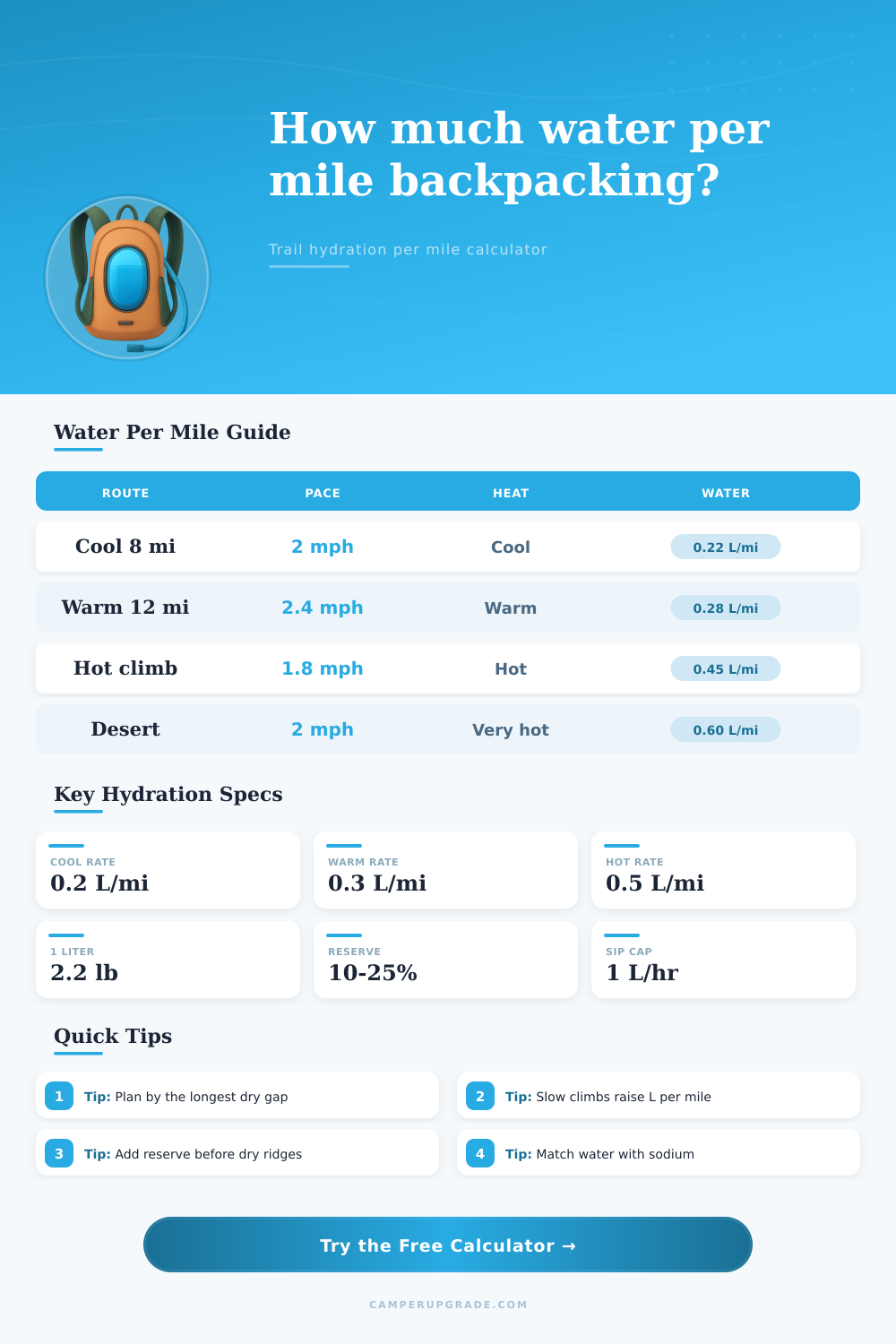
| Condition | Typical L/hr | At 2 mph | Planning note |
|---|---|---|---|
| Cool shaded trail | 0.30 to 0.45 | 0.15 to 0.23 L/mi | Often enough for relaxed shoulder-season backpacking. |
| Warm mixed terrain | 0.45 to 0.70 | 0.23 to 0.35 L/mi | Common range for steady three-season hiking. |
| Hot climb or humid forest | 0.70 to 1.00 | 0.35 to 0.50 L/mi | Needs steady sipping and sodium replacement. |
| Desert, sand, or exposed ridge | 0.90 to 1.30 | 0.45 to 0.65 L/mi | Plan by dry gaps and carry reserve. |
| Pace | 0.5 L/hr | 0.75 L/hr | 1.0 L/hr |
|---|---|---|---|
| 1.5 mph slow climb | 0.33 L/mi | 0.50 L/mi | 0.67 L/mi |
| 2.0 mph steady trail | 0.25 L/mi | 0.38 L/mi | 0.50 L/mi |
| 2.5 mph efficient pace | 0.20 L/mi | 0.30 L/mi | 0.40 L/mi |
| 3.0 mph fastpack | 0.17 L/mi | 0.25 L/mi | 0.33 L/mi |
| Dry gap | Moderate heat | Hot terrain | Capacity clue |
|---|---|---|---|
| 3 miles | 0.8 to 1.1 L | 1.3 to 1.8 L | Usually fits one bottle or small bladder. |
| 6 miles | 1.6 to 2.2 L | 2.7 to 3.6 L | Common two-bottle plus bladder range. |
| 10 miles | 2.7 to 3.8 L | 4.5 to 6.0 L | Capacity and route timing become critical. |
| 15 miles | 4.0 to 5.7 L | 6.8 to 9.0 L | Needs conservative heat planning or cache options. |
| Carry item | Usable water | Weight full | Best use |
|---|---|---|---|
| 500 mL soft bottle | 0.5 L | 1.1 lb / 0.5 kg | Quick-access sipping or electrolyte mix. |
| 1 L bottle | 1.0 L | 2.2 lb / 1.0 kg | Simple modular capacity for dry stretches. |
| 2 L bladder | 2.0 L | 4.4 lb / 2.0 kg | Common daypack and fastpacking size. |
| 3 L bladder | 3.0 L | 6.6 lb / 3.0 kg | Useful for long dry gaps and warm trail days. |
💡Planning Notes
When we’re hiking in a dry section, planning out our water is crucial. We’ll look at the map, identify the closest safe water source, and estimate how much water we’ll need between those point. But these estimates often feel close enough, until we hit a steep ascent or heat increases. Carrying all that extra weight burdens your shoulders and slows your progress.
Hydration by mile suddenly become the limiting factor different than overall mileage. Miles don’t get equal water demand. If you’re slowly climbing in full sun, you’ll burn twice as many liters per mile than when you’re on a shaded, flat trail. Why? Because you generate body heat for an additional amount of time on every mile. You’ll sweat more (which makes your pack feel even heavier) and the wind will probably take extra moisture from your exposed flesh.
Why You Need a Water Calculator
When you input your movement speed, distance, temperature, terrain, effort level, and elevation gain, the calculator crunches that data for you. It spits out how fast you should of be drinking (per hour), which it then translates into a rate of liters/mile based on your own pace. The longest dry gap matters more than you might think. Your total water for the entire day tell you how much you need to plan your camps, but how much will you have to carry initially? That’s the largest gap between refills. Add in any extra camp water and reserve, and the tool figures out what your carry will be.
Then it compares that against what you said you could carry. If it’s larger than you’re comfortabley carrying, it flags the shortage so you know whether to go lighter, adjust your time, or make an earlier refill stop. What many fail to account for is how carrying a heavier pack change those numbers. Sweat and work effort goes up and the calculator accounts for it with a multiplier. Moving fifteen pounds compared to thirty pounds is going to result in a higher per mile rate for the same terrain and temperature. That’s what most folks miss when they’re planning by temperature alone.
This principle is illustrated in the reference tables on the page. Desert / exposed ridge travel will push up on the high end of demand and cool shaded miles falls closer to the low end. They aren’t intended as a substitute for plugging in your own inputs. But if you want a quick idea of where your route falls, you can glance at the table before running your numbers.
Real conditions will always differ from any model. You will be different: you might be acclimated, medicated, recently sick, or drinking different amounts while movin. The calculator provides you with a baseline for planning with some safety reserve built-in, but has no way of knowing how your body perform on any particular day. Treat the output as a starting point for what to carry and how often to refill, then tweak it once you are on the trail and can see the difference between your plan and reality.
This isn’t about carrying just enough every time, but rather being sure you have enough margin so that at end of a dry stretch you aren’t rationing every sip.