Backpack Compression Strap Volume Calculator
Estimate pack volume after tightening side straps, front straps, roll-top straps, or stuff sack bands using pack dimensions, load softness, strap count, strap width, and material stretch.
🎒Backpack Compression Presets
📏Pack And Strap Inputs
Shape factor converts measured outside dimensions into usable internal volume.
The direction controls which final dimension changes most.
Measure the loaded pack from bottom seam to top closure.
For cylinders, use this as the filled diameter.
This is the front-to-back bulge before strap tension.
Use 0 unless the pack label is more reliable than outside measurements.
Soft loads can safely shrink more before pressure rises.
A practical field target is the visible squeeze you expect from tightening.
Count only straps that actually cross the loaded area.
Wider webbing spreads pressure and reduces seam stress.
Material stretch changes how much tension stays in the pack.
More contact area gives the strap better leverage on soft volume.
Heavier dense loads resist volume reduction more than light soft loads.
Use a lower value for light buckles, old seams, or ultralight fabric.
The calculator models practical field compression, not destructive testing. Stop tightening when seams distort, buckles twist, waterproof coatings crease sharply, or hard objects begin pressing through fabric.
Compression Strap Volume Results
🧵Strap Material Comparison Grid
📐Pack Shape Volume Factors
| Shape model | Formula | Factor used | Best for |
|---|---|---|---|
| Boxy travel pack | height x width x depth | 1.00 | Rectangular packs with square corners and flat panels. |
| Rounded hiking pack | height x width x depth x 0.78 | 0.78 | Most internal-frame trail packs with rounded side panels. |
| Tapered backpack | height x width x depth x 0.72 | 0.72 | Packs that narrow toward the bottom or collar. |
| Cylindrical stuff sack | pi x radius x radius x height | 0.785 | Dry bags, sleeping bag sacks, and barrel-shaped loads. |
| Custom listed volume | label volume entered by user | User value | When manufacturer volume is more reliable than measurements. |
🔗Compression Direction Reference
| Direction | Main dimension changed | Typical volume saved | Field read |
|---|---|---|---|
| Side straps only | Depth | 8% to 25% | Best for trimming pack bulge and improving balance. |
| Side plus front straps | Width and depth | 12% to 32% | Useful when the pack is soft and evenly loaded. |
| Circumference bands | Width and depth together | 18% to 42% | Works well on sleeping bags, quilts, and clothing sacks. |
| Roll-top closure | Height | 10% to 30% | Shortens unused collar space after food volume drops. |
| Uniform compression | Height, width, and depth | 10% to 28% | Use for packs with multiple balanced straps. |
⚖Strap Setup Reference
| Setup | Useful range | Calculator role | Watch for |
|---|---|---|---|
| Two side straps | 18 to 35 lb each | Common day pack and light weekend setting. | Top and bottom straps should feel similar. |
| Four side straps | 15 to 45 lb each | Balanced trail pack compression for mixed loads. | Overtight lower straps can push weight backward. |
| Front panel strap | 10 to 30 lb each | Stabilizes jackets, wet layers, or foam pads. | Panel pockets can block useful compression. |
| Stuff sack band | 20 to 60 lb each | High contact path around soft cylindrical loads. | Stop if the end caps bulge sharply. |
| Ultralight cord | 5 to 20 lb each | Light control for quilts or spare clothing. | Thin cord concentrates pressure on fabric. |
🏕Common Pack Loads At A Glance
| Load type | Starting volume | Normal compression | Likely result |
|---|---|---|---|
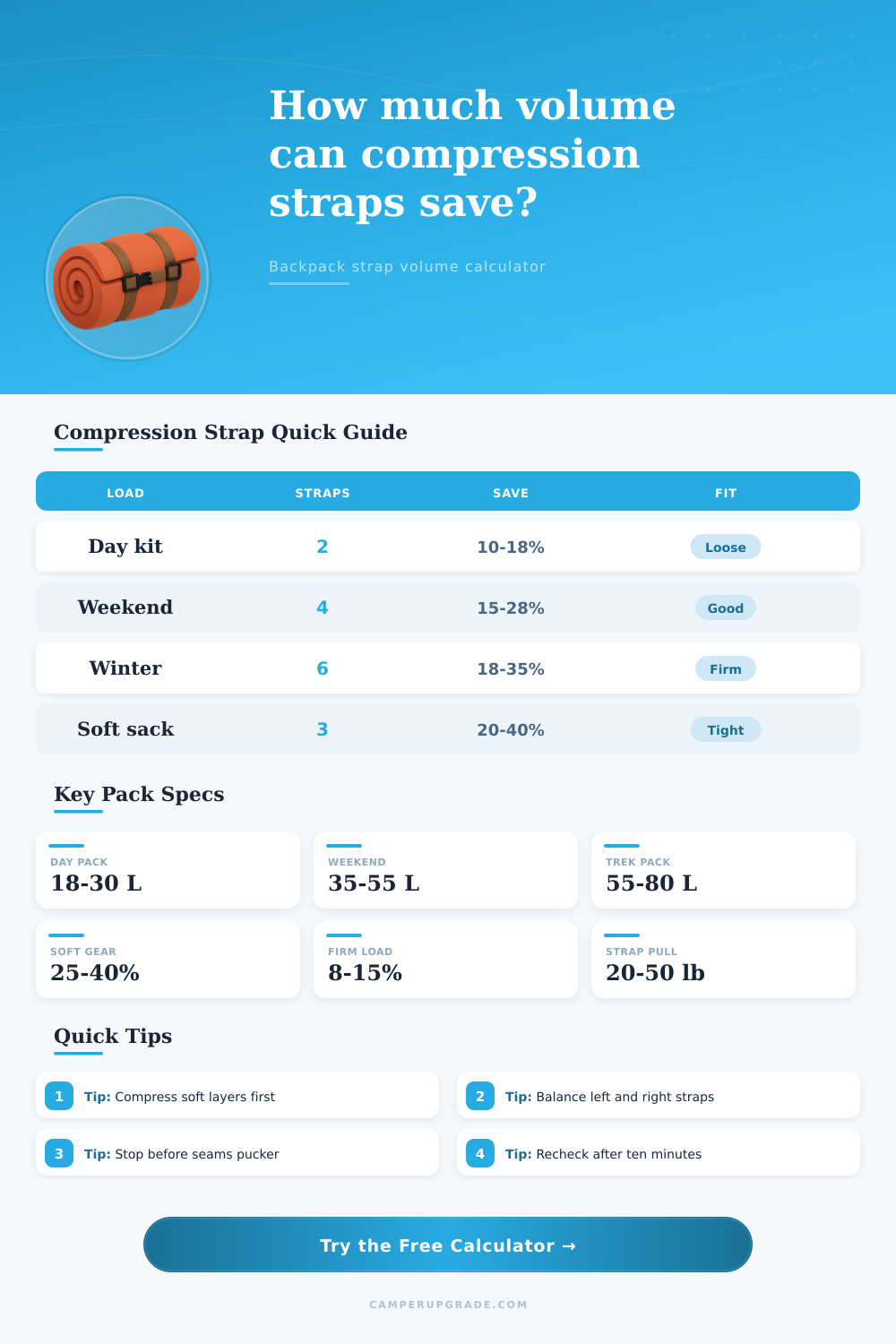
| Day hike rain and fleece load | 18 to 25 L | 10% to 18% | Small depth change, mostly stability gain. |
| Weekend backpacking mixed load | 35 to 55 L | 15% to 28% | Noticeable side profile reduction. |
| Winter clothing and quilt load | 50 to 75 L | 20% to 35% | Large volume savings if no hard items block straps. |
| Food-heavy thru-hike carry | 45 to 65 L | 8% to 18% | Dense food limits compression despite strap count. |
| Sleeping bag stuff sack | 12 to 30 L | 25% to 45% | Soft insulation compresses most, but rebounds over time. |
💡Backpack Compression Tips
The way the pack compresses and fits change depending on how you use compression straps. Compression makes it feel like part of you and creates a stable load where there had been a wobble. Front or side compression straps aren’t there for show, but to decrease amount of space your gear occupy. Knowing what volume to take out so as not to create pressure points or stress seams are important since both will cause discomfort later.
Load softness is more important then you might think. If you have a down quilt and fleece in a bag, it’s going to give way under steady tension. Water bottles and cook set push back. When you select the type of load that best describes yours, the calculator do the math.
How Compression Straps Work
The straps can only reduce pack weight so much before they starts pulling against your fabric. The amount of space moved depends on both contact area and number of straps. Four wraps going further around a section move more space then two wraps on smaller section. They just stretch the force out over more surface area. It is the same when moving from side straps to a full band: that last size will be different too; one more strap help settle pack, but changes its shape.
The result is also quietly influenced by material. Polyester retains its adjustment better than does nylon webbing; nylon stretch out a bit with dampness and recovers. Likewise, elastic cord grabs quickly but doesn’t hold its shape as well under long-term compression, which results in a higher or lower final volume. You can switch materials on the calculator to determine if it’s worth making the effort for your pack.
There is also a limit to how much compression can do given weight/density. For example, a heavy food load doesn’t compress as well because it’s already dense, but that same pack let me squeeze more out of lighter load of clothes. The reason this same pack with the same straps create different outcomes from trip to trip isn’t because they’re the same pack/straps; it’s because the content inside them isn’t the same. When planning your load, factor in these physical limits.
But it’s not always a full-on squeeze. Usually, hikers tighten until the pack sits comfortabley on their back and the straps pulls tight with ease for future loosening. Otherwise you risk damaging waterproof coating, or pinching hard object into fabric. But these problems usually appear after the pack has settled for a while. To catch any mishaps before it’s too late, check in every ten minutes during first walk.
With the calculator, you can play out combos at home before heading out the door. Enter measured dimensions, select your strap combo, and hit go. See where it lands. Then compare that number against the feel of your loaded pack. How close do they match? That’s the gap, and that gap will tell you if your straps are up to the task or if you should of reorganized the load.
You’ll find over time what works best with extra straps and what is close to its max. The numbers will help you hit the trail with fewer surprises.