Resupply Weight Calculator
Estimate how much a trail resupply will add to your pack after food calories, menu density, packaging, first-day fresh food, stove fuel, water carried out of town, and safety buffer are included.
🏕Resupply Leg Presets
📝Food, Fuel, And Carry Inputs
Resupply Weight Estimate
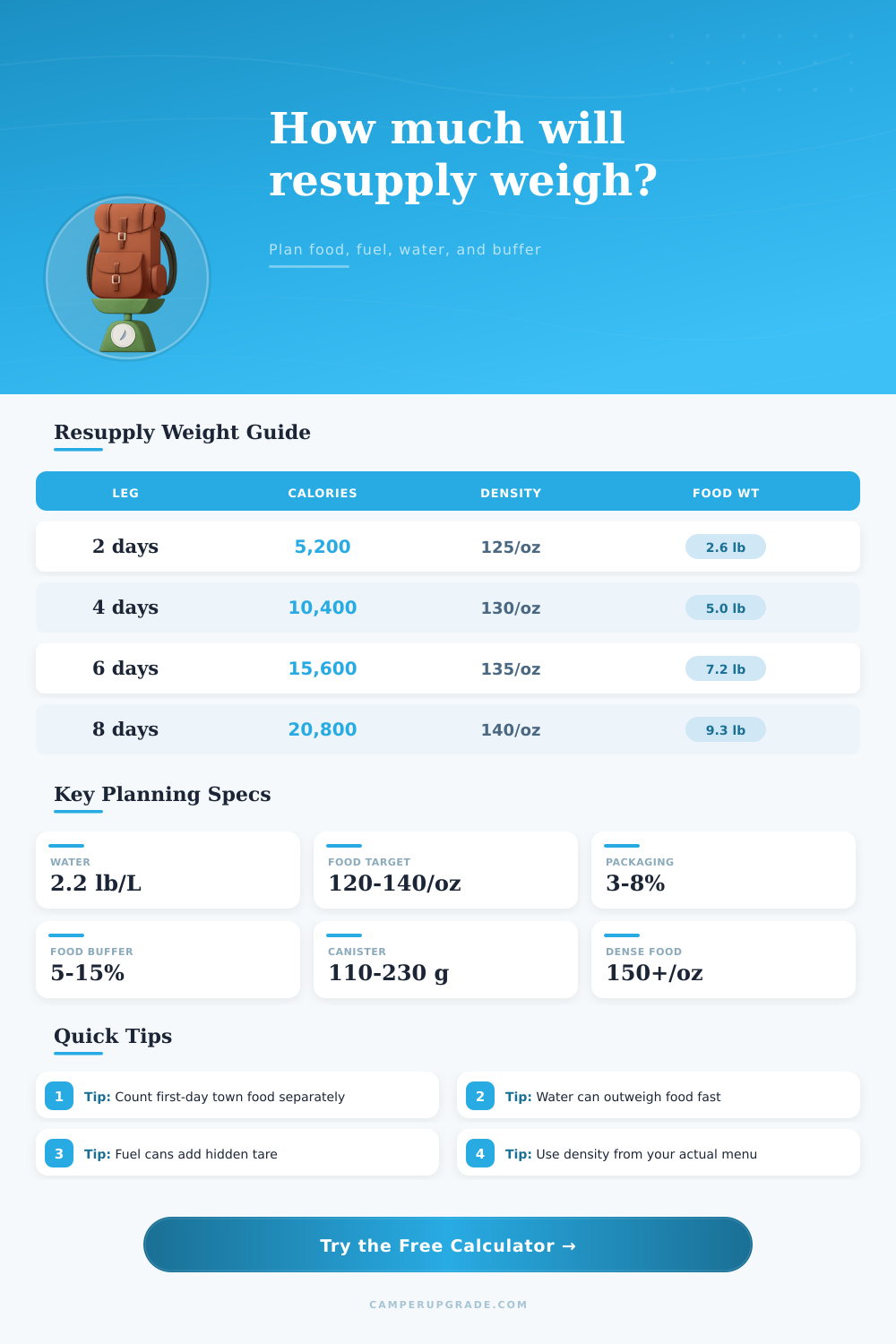
📌Quick Resupply Specs
🥜Food Density Reference
| Food style | Typical density | Weight for 3,000 cal | Trail note |
|---|---|---|---|
| Oats, rice, pasta, beans mix | 100-115 cal/oz | 1.6-1.9 lb | Filling, but bulkier for long carries. |
| Balanced grocery resupply | 120-135 cal/oz | 1.4-1.6 lb | Common mix of meals, bars, nuts, and snacks. |
| High-fat trail menu | 140-165 cal/oz | 1.1-1.3 lb | Nut butter, olive oil, chips, nuts, and chocolate. |
| Freeze-dried meal heavy | 105-125 cal/oz | 1.5-1.8 lb | Light before water, but packaging can add up. |
| Fresh town carry | 40-90 cal/oz | 2.1-4.7 lb | Great morale food, usually best eaten first. |
🔥Fuel Planning Reference
| Fuel option | Planning rate | Container effect | Best use |
|---|---|---|---|
| Small canister | 0.28 oz fuel per hot meal | Round to 110 g canisters plus tare | Solo or short legs with simple boils. |
| Medium canister | 0.28 oz fuel per hot meal | Round to 230 g canisters plus tare | Pairs, groups, cold mornings, or longer legs. |
| Alcohol stove | 0.55 oz fuel weight per hot meal | Fuel bottle adds small fixed weight | Known mild conditions and short resupply gaps. |
| White gas | 0.38 oz fuel per hot meal | Reusable bottle weight is counted | Cold, remote, or snow-melt style cooking. |
| Solid fuel | 0.50 oz tablet weight per hot meal | Round up to full tablet blocks | Backup boils and very simple menus. |
📊Food Weight By Leg Length
| Solo leg at 3,200 cal/day | 110 cal/oz menu | 130 cal/oz menu | 150 cal/oz menu |
|---|---|---|---|
| 2 days | 3.6 lb / 1.6 kg | 3.1 lb / 1.4 kg | 2.7 lb / 1.2 kg |
| 3 days | 5.5 lb / 2.5 kg | 4.6 lb / 2.1 kg | 4.0 lb / 1.8 kg |
| 4 days | 7.3 lb / 3.3 kg | 6.2 lb / 2.8 kg | 5.3 lb / 2.4 kg |
| 5 days | 9.1 lb / 4.1 kg | 7.7 lb / 3.5 kg | 6.7 lb / 3.0 kg |
| 7 days | 12.7 lb / 5.8 kg | 10.8 lb / 4.9 kg | 9.3 lb / 4.2 kg |
🗺Common Resupply Scenarios
| Scenario | Food and water profile | Hidden weight driver | Planning move |
|---|---|---|---|
| Town exit afternoon | 1-2 days, fresh food, 1 L water | Low-density fresh food | Eat the heavy items before camp. |
| Dry desert stretch | 3-4 days, 3-5 L water carried | Water dominates load | Separate food weight from water decisions. |
| Remote mountain leg | 5-8 days, higher calories, canister fuel | Food buffer and fuel tare | Raise density before cutting calories. |
| Two-person shared cook kit | 2 people, 1-2 hot meals daily | Rounded canister count | Check if one medium canister beats two small. |
| Cold-soak fastpack | No stove, dense snacks, minimal packaging | Food density only | Watch sodium, variety, and actual appetite. |
💡Resupply Packing Tips
Longer backpacking trips revolve around resupply, knowing what you will carry when you set out dictates your mileage until your next refill. Hikers tend to think only about the food itself, not accounting for other items like water carried into town, fuel, packaging, first day snacks in town, and a buffer for bad weather or slow hiking. This is where things get tricky: it’s the interaction of these elements that often makes the difference between carrying comfortabley or miserably.
After plugging in all those variables, days between towns, calorie target, menu density, etc.; the calculator do the math for you (above). It also takes into account that not all food weigh the same. A high-fat mix of chocolate, oil packets, and nuts will provide the same number of calories but weigh much less than same calories from a menu based off freeze-dried meals, rice, and beans. And it allows you to play with that tradeoff directly: adjust your menu’s “density” input and see if swapping out a couple of item would really make your pack lighter…or just shift the problems to something else entirely.
How to Pack Smart for Long Hikes
Food planning doesn’t help much with another set of limitations: those created by water. The weight of carrying water increases too quickly; it is soon much heavier then carrying food, and that number is tracked separately on the calculator so you can view the breakdown. Why is this important? Food calculations are based off calories, but water decisions depend more on reliable sources and how far you walk each day. So if the water part of the equation overwhelms the overall figure, then adjusting your caching plan or route is typically far smarter than trimming down food weight again.
And then there’s fuel, something many of us don’t think about till we’re days down trail, but it adds another layer. There is the round-up weight (canister), the tare weight of metal canisters themselves, plus the reserve you want to carry in case it gets cold or windy. All those will show up as ounces once you enter your fuel type and hot meal count. This calculator shows those hidden weights so you can compare carrying two smaller canister to one larger one. You can compare carrying two smaller canister against one larger one, or decide if an alcohol stove really saves weight on this leg.
That’s why there are percentages on packaging and buffers. You remove all the junky store wrap, but what about the zip bags, labels, and trash you’re going to haul out? What about a safety buffer in case you have a slower day or make an unplanned detour? Well, that bulks up your starting weight by including things like packaging and safety buffers from the very beginning. After calculating your base calories, the tool apply each percentage. This stops you from making the common error of thinking they are optional add-ons that won’t change your total weight.
In real life, resupplies is never as clean-cut as spreadsheet shows. What sounds like a great ration when sitting at home turns out to be too heavy or too light given changing temperatures and altitudes; the morale-boosting food purchased on day one in town prove heavier than anticipated. You should of planned for this. The calculator lets you check different water and food combination over and over before you go to store. It still allows for small changes that won’t be noticed until pack is on your back.