Section Hike Days Calculator
Estimate section hike days from route distance, elevation, daily hiking hours, trail surface, pack load, group pace, resupply time, zeros, and weather margin.
🧭Section Hike Presets
📐Route And Schedule Inputs
🥾 Section Hike Schedule Results
⚙Planning Spec Grid
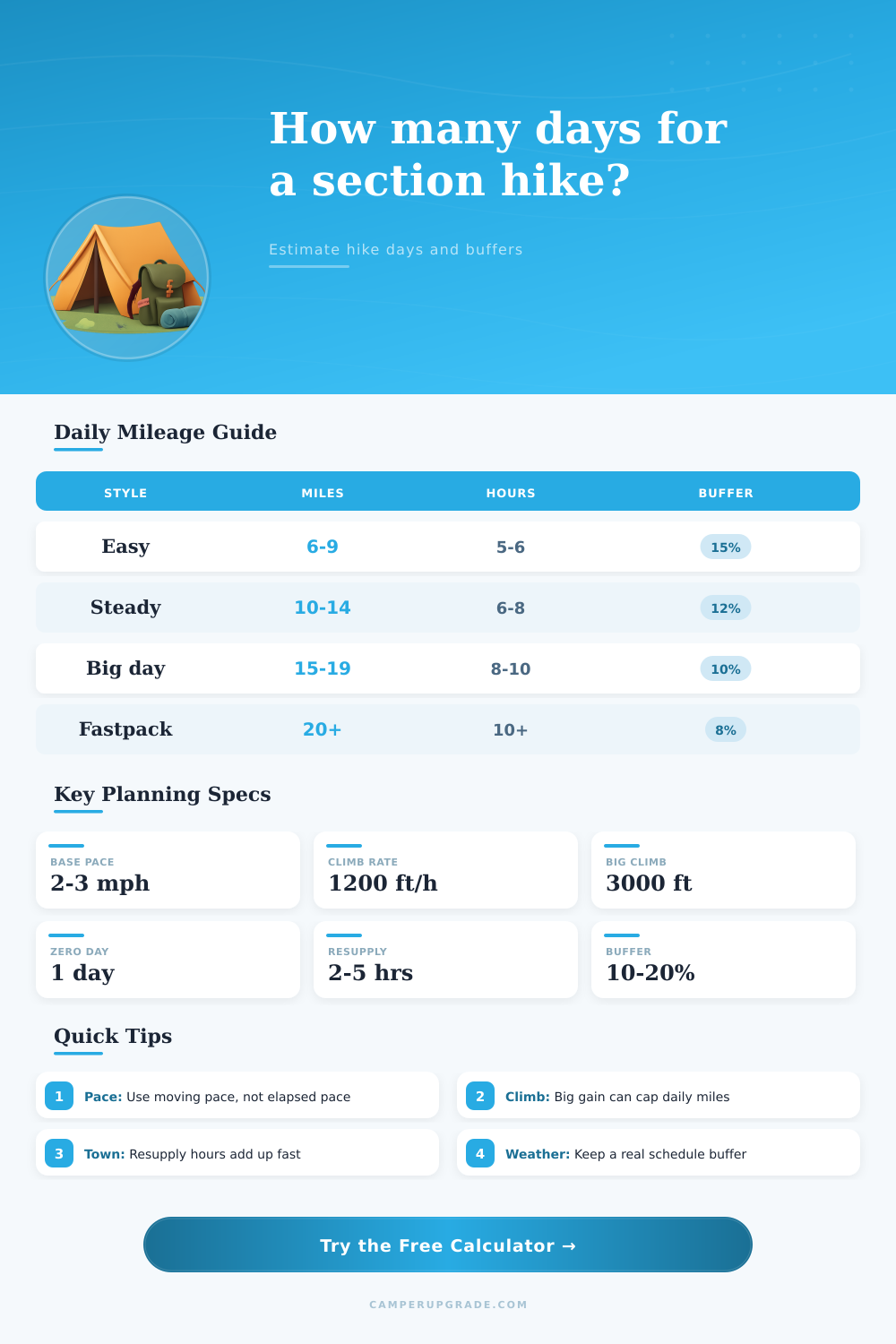
📊Daily Mileage Reference
| Section pace style | Typical daily miles | Moving hours | Best used for |
|---|---|---|---|
| First backpacking section | 6 to 10 mi | 5 to 7 hr | New gear, new feet, heavier pack |
| Steady section hiker | 10 to 14 mi | 6 to 8 hr | Normal trail with established camps |
| Big-mile backpacker | 15 to 19 mi | 8 to 10 hr | Long daylight and efficient breaks |
| Fastpack or thru-hike pace | 20 mi plus | 10 hr plus | Light kit, fitness, simple logistics |
| Technical mountain route | 5 to 9 mi | 7 to 10 hr | Talus, snow, passes, routefinding |
| Terrain factor | Speed effect | Buffer cue | Calculator setting |
|---|---|---|---|
| Graded path or rail-trail | Fastest planning pace | Low route uncertainty | 5% to 10% buffer |
| Normal singletrack | Moderate pace loss | Use campsite spacing notes | 10% buffer |
| Rocky roots and steps | Large foot-placement cost | Protect descents and knees | 10% to 15% buffer |
| Desert sand or heat | Speed varies by exposure | Water carries control the day | 15% to 20% buffer |
| Alpine talus or snow | Often mileage-limited | Weather windows matter | 20% plus buffer |
| Resupply pattern | Typical delay | Schedule impact | Planning note |
|---|---|---|---|
| Trailhead food cache | 0.5 to 1 hr | Usually no extra day | Good for short sections |
| Small store near trail | 1 to 3 hr | May shorten that day | Add snack and sorting time |
| Hitch or shuttle into town | 3 to 6 hr | Often a nero day | Transport wait can dominate |
| Full rest and laundry stop | 1 day | Zero day | Count it separately from hiking days |
| Remote food drop | 1 to 2 hr | Low but not zero | Include detour and repack time |
| Example section | Distance | Elevation gain | Common schedule |
|---|---|---|---|
| Short ridge weekend | 24 mi | 4200 ft | 2 to 3 days |
| Forest gap to gap | 48 mi | 8500 ft | 4 to 5 days |
| Dry desert traverse | 62 mi | 5200 ft | 4 to 6 days |
| Mountain pass section | 76 mi | 15000 ft | 6 to 8 days |
| Two-week trail segment | 160 mi | 28000 ft | 11 to 15 days |
💡Section Planning Tips
A section hike planner is a way to transform a line on a map into series of days on a calendar. It’s a way of figuring out how long it’ll take you to complete the hike, taking into account the weather, food stops and terrain. It lets you plug in variables to see if your timing match your plan.
You should of have some idea about what goes into it and which variables make a big impact and which don’t matter as much. The second factor is trail distance. Miles traveled isn’t always everything. Elevation gain and loss can be even more important. For example, a 12-mile day with 4,000 feet of climb will feel very different to 12 miles on flat terrain. The calculator include speed adjustments for vertical change.
How to Plan Your Hike
Similarly, type of terrain matters. Linger snow or rocky trails slow you down, but those miles won’t reflect this through pure miles alone. Choosing the right surface setting ensure the estimated time remains honest. Not optimistic. These limits are realistic. You get daily mileage limits and movement time (how many hours you can move every day). After accounting for time setting up camp, filtering water, breaks etc, most folks underestimate their walking time.
The group pace factor account for that fact of life. Solo hikers tends to maintain a solid pace. In a mixed group, there is typically someone who take lots of pictures or stops often. This person slow everyone down to the pace of the slowest hiker. That’s why the calculator accounts for it, because you shouldn’t have to estimate the adjustment.
Schedules can quietly fall apart. There are always zero days. And resupply stops. You spend three or four hours at that quick pit stop in town for food. Over the course of a long section, it all adds up. Zero days give you some honest rest time but they also move your finish date back. When you need to close a weather window or have a ride waiting on you, this make a difference.
That’s why we build a weather buffer too. A 10 or 15 percent cushion, rather than just extra padding, keeps you from being forced to press on during a storm because you ran out of spare days.
As a reminder, the reference tables reflects average miles per day hikers typically hike in their style. These are not goals but checkpoints. For instance, if you have planned 18 mile days on technical trails carrying a heavy load, the table reflect that you’re atypical. You are outside of what’s typical. That doesn’t imply it won’t be possible. It implies that the inputs must match the expected conditions.
It’s impossible to convey through just numbers what happens to your pace along the trail. You’ll be slower in the early days when carrying a full food load. Your legs will strengthens within the first week. A good starting point come from the calculator. It’s up to you to decide if it allows for day where plans don’t exactly work out.