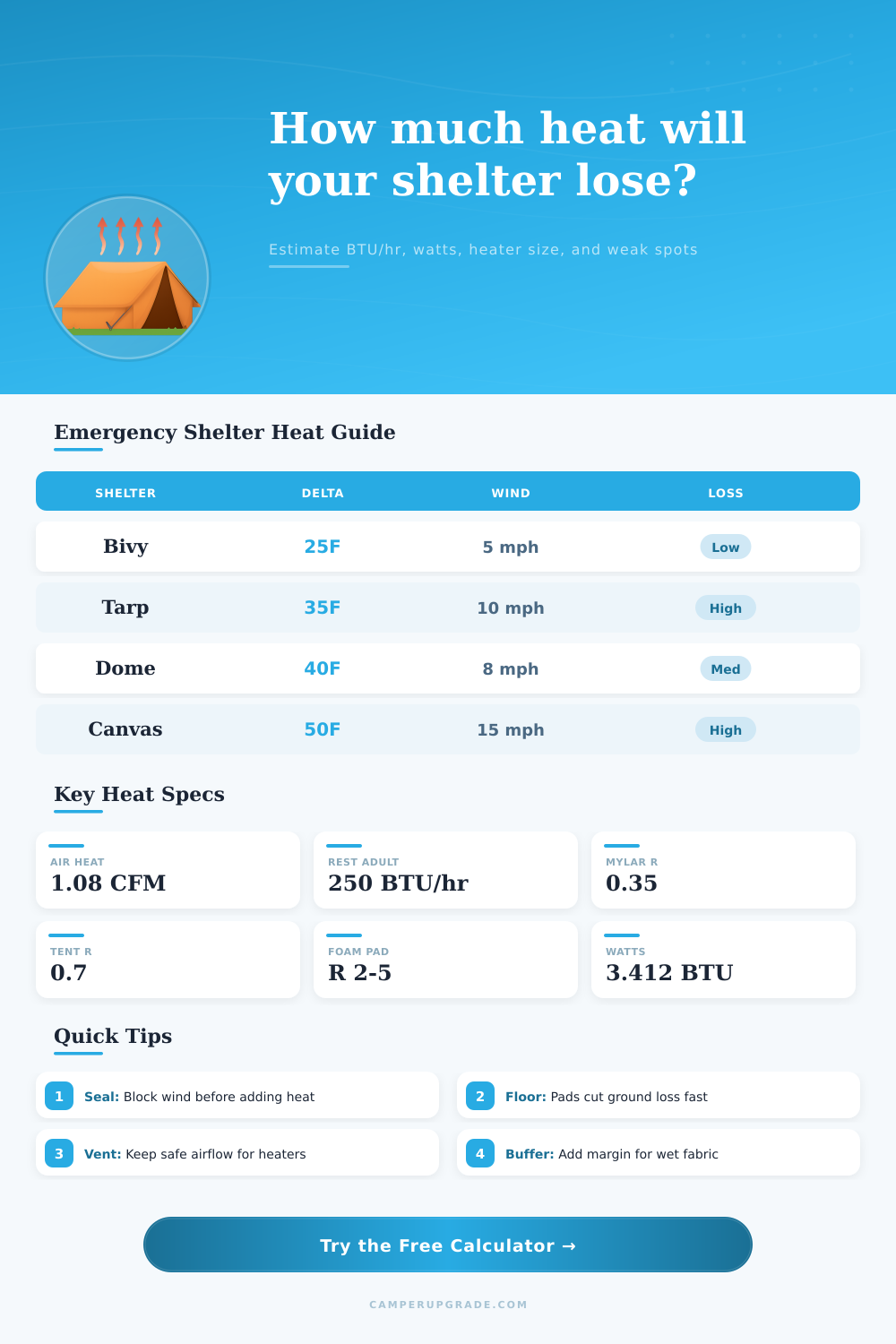
Emergency Shelter Heat Loss Calculator
Estimate shelter heat loss through fabric, floor contact, wind leakage, ventilation, and occupant heat so you can size a safe emergency warmth plan.
Core formulas: fabric loss = area × temperature difference ÷ R-value; ventilation loss = 1.08 × CFM × temperature difference; ground loss = floor area × ground temperature difference ÷ floor R.
🔥 Emergency Shelter Heat Results
| Material setting | Planning R-value | Best match | Calculator note |
|---|---|---|---|
| Emergency mylar sheet | R-0.35 | Bivy wrap or reflective liner | Wind gaps dominate quickly |
| Silnylon tarp | R-0.45 | Ridge tarp, lean-to, fly sheet | Mostly blocks rain and wind |
| Single-wall nylon tent | R-0.70 | Backpacking or dome tent | Use with normal leakage setting |
| Canvas wall tent | R-1.00 | Hot tent or camp shelter | Stove sizing still needs ventilation |
| Insulated fabric shelter | R-2.20 | Ice shelter or lined emergency hut | Lower fabric loss, watch floor loss |
| Snow wall with tarp roof | R-4.00 | Snow trench, quinzee wall estimate | Roof and openings can dominate |
| Leakage setting | Base ACH | Typical shelter | Heat-loss behavior |
|---|---|---|---|
| Very tight | 0.4 | Controlled vents, sealed edges | Lowest air exchange; monitor condensation |
| Normal tent | 0.9 | Zipped tent with roof vents | Balanced planning default |
| Drafty pitch | 1.8 | Loose tarp, gaps, old fly | Wind can exceed fabric conduction |
| Open tarp | 3.5 | Lean-to or open group shelter | Most added heat escapes rapidly |
| Large vent gap | Wind flow | Door crack, stove vent, open end | Opening area adds direct CFM |
| Inside target | Outside air | Temperature difference | Planning read |
|---|---|---|---|
| 45°F | 35°F | 10°F | Small gap sealing may be enough |
| 45°F | 20°F | 25°F | Floor pad and wind control matter |
| 50°F | 10°F | 40°F | Heater sizing becomes sensitive |
| 55°F | 0°F | 55°F | Use a strong buffer and backup plan |
| 60°F | -10°F | 70°F | Emergency fabric shelters struggle |
| Shelter example | Size basis | Likely weak point | Calculator preset to start |
|---|---|---|---|
| Emergency bivy | 7 ft by 3 ft by 2 ft | Ground and breathing vent | Mylar bivy in light wind |
| Open tarp lean-to | 8 ft by 7 ft by 4 ft | Air exchange | Open tarp lean-to |
| Two-person dome tent | 7 ft by 5 ft by 3.5 ft | Floor contact | Two-person nylon tent |
| Canvas hot tent | 12 ft by 10 ft by 7 ft | Vent and wall area | Canvas wall tent stove |
| Snow trench | 7 ft by 3 ft by 3 ft | Roof tarp and entry gap | Snow trench with tarp roof |
How does that translate to heat loss from your shelter? What’s the heat gain? The calculator lets you know. It allow you to enter variables like fabric (type, amount), floor pad (insulation value, surface area), wind (exposure), shape, and people inside. All those factor have their own channel for heat loss.
Insulation value and surface area describes fabric loss. Body heat drains into the ground making floor loss match your body heat levels. This means a small pad can change overall result more than adding layers to the walls. Unsealed seams cause air exchange, this is multiplied by wind which rips off your warm boundary layer. Air and floor leaks are overlooked while most of us obsess over fabric ratings. With wind added in the equation, the calculator explains why this is only half the picture: a tiny hole can actualy pass more heat then the whole wall’s surface area.
How The Calculator Helps You Save Heat
Ground conduction is dramatically reduced by a good sleeping pad which keeps difference between your body and ground large. Tables of normal leakage rates and R-Values let you estimate whether your set up is closer to a tarp or a tight tent. Many of these calculations don’t account for occupant heat until it becomes mathematically impossible.
A single human lying down has roughly as much heat output as a small lamp. Two or three will make big difference in what you need to add. That’s when you see the occupant heat credit; you tell the calculator how many bodies there is and what they’re doing. Without adding a heater or changing the fabric, four people will find a shelter far more comfortable than just one person would of.
Instead of accepting one outcome it’s far more useful to run multiple scenarios. Seal the edges, then adjust leakage setting and see how much that reduces air loss. Raise floor R-value and observe what happens to required heater input. Comparison shows where any given adjustment give the greatest benefit. Buffering the result recognizes that wind gusts happen, and fabric will become damp; you size up a bit to prevent being out of fuel in the dark.
It won’t take into account humans and their quirks, such as how much time you spend tightening the shelter or fiddling with vents. How much time do you spend wiping down condensation? That’s still your call. But it eliminates the guessing game so that once you’ve figured out what direction transfers the most heat, all other choices is now narrower, and thus easier to make. Rather than one huge question, there are lots of little ones.