Inverter Surge Watt Calculator
Estimate the starting watt surge, recommended inverter rating, battery peak amps, and usable headroom for RV appliances, tools, pumps, fans, and campsite power loads.
| Load type | Typical running watts | Starting multiplier | Power factor range | Surge note |
|---|---|---|---|---|
| Resistive heater or kettle | 700-1800 W | 1.0x-1.1x | 0.98-1.00 | Almost no start surge |
| Microwave oven | 900-1500 W | 1.3x-1.8x | 0.85-0.95 | Nameplate input watts matter |
| Compressor fridge | 60-250 W | 3x-7x | 0.60-0.85 | Hardest at warm restart |
| Water pump | 50-180 W | 3x-5x | 0.70-0.90 | Pressure start can spike |
| Fan or blower motor | 100-700 W | 2x-4x | 0.65-0.90 | Blower load rises quickly |
| Power tool motor | 400-1500 W | 2x-3.5x | 0.75-0.95 | Blade load can add surge |
| AC surge watts | 12V bank at 90% | 24V bank at 90% | 48V bank at 90% | Why it matters |
|---|---|---|---|---|
| 1000 W | 93 A | 46 A | 23 A | Small inverter surge |
| 2000 W | 185 A | 93 A | 46 A | Common RV microwave start |
| 3000 W | 278 A | 139 A | 69 A | Large tool or compact A/C assist |
| 4000 W | 370 A | 185 A | 93 A | Battery BMS peak becomes critical |
| 6000 W | 556 A | 278 A | 139 A | Large inverter and short DC cables |
| RV load | Running watts | Likely start watts | Suggested buffer | Typical inverter note |
|---|---|---|---|---|
| Compact microwave | 900-1200 W | 1300-2000 W | 20% | Check input watts, not cooking watts |
| 12V compressor fridge on inverter | 60-120 W | 250-700 W | 25% | Usually better direct on DC |
| Residential mini fridge | 100-250 W | 500-1500 W | 25% | Restart pressure can raise surge |
| RV water pump | 60-120 W | 240-600 W | 20% | Pressure switch starts abruptly |
| Coffee maker | 700-1500 W | 700-1650 W | 15% | Mostly resistive heating load |
| Induction cooktop | 900-1800 W | 1000-2200 W | 20% | Electronics may pulse power |
| Inverter class | Continuous rating | Common surge rating | Best fit | Watch item |
|---|---|---|---|---|
| Compact campsite | 600-1000 W | 1200-2000 W | Laptops, small chargers, fans | Not for microwaves |
| Light RV kitchen | 1500-2000 W | 3000-4000 W | Microwave or coffee maker alone | 12V battery amps are high |
| Full RV inverter | 2500-3000 W | 5000-6000 W | Kitchen plus small steady loads | Transfer switch and cables |
| High-demand system | 4000-6000 W | 8000-12000 W | Multiple large AC loads | Battery bank must support peak |
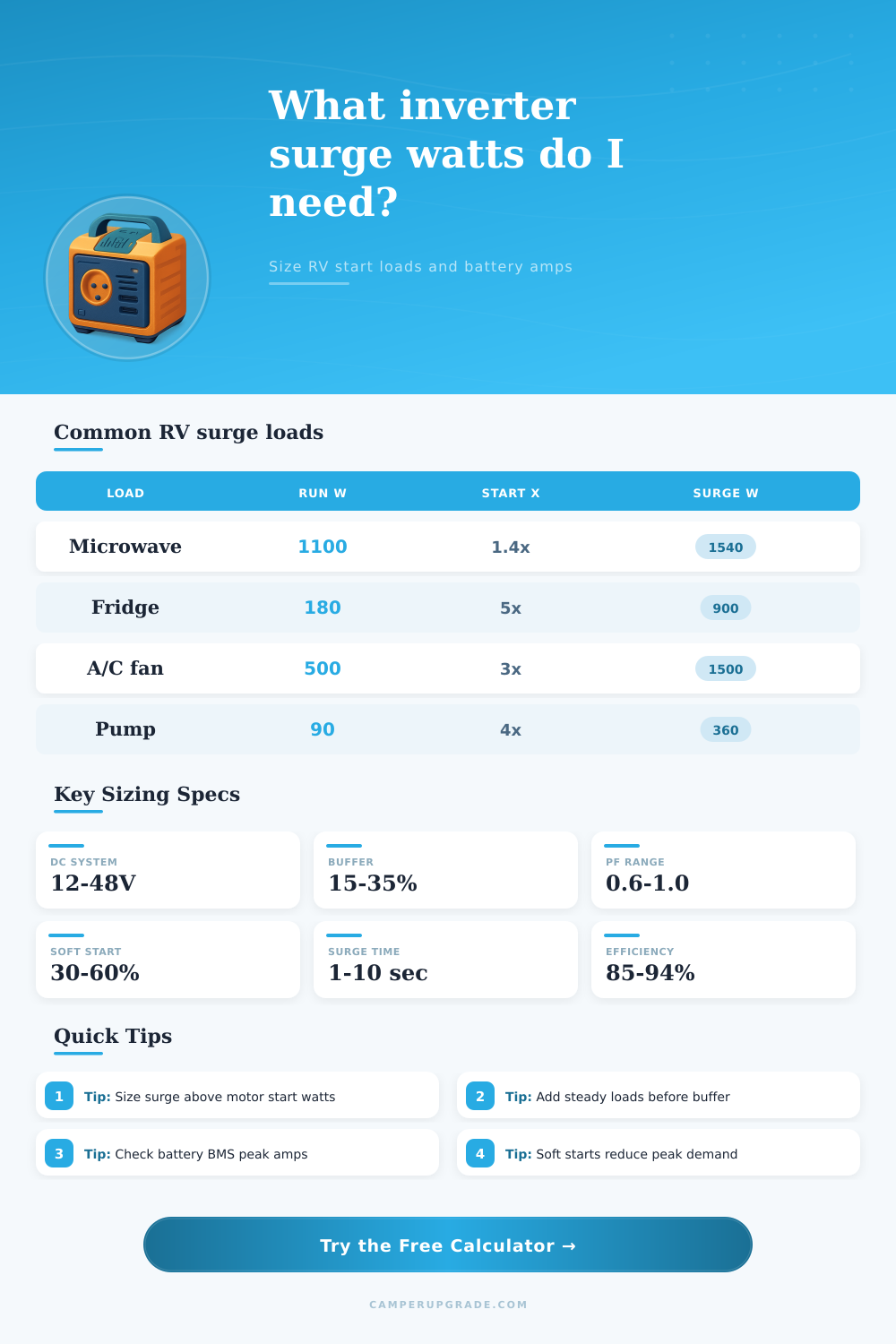
Understanding that motors require significantly greater startup power than running power are the key to selecting the appropriate inverter for an RV. Starting or surge watts refers to the momentary burst of current needed for an appliance at start-up. If the inverter is not enough to meet the surge requirement, it will fail and could trip a circuit breaker or leave you with a dead battery. In order for the inverter to successfully start up, all components (battery bank, wiring, inverter) must has been properly rated for those first few seconds.
Appliance labels show only their running watt rating; most folks don’t go further. “Oh, the microwave is rated for 1100 watts.” But then what? The transformer will pull nearly fifty percent more power before it stabilize. Water pumps, fridge compressors and such are far worse: Sometimes they requires three to seven times their continuous output for a second or two. When the inverter can’t provide that pulse, you have voltage drop. You risk your battery management system shutting down; and you has everything else on the circuit going dark.
Why You Need Surge Watts for Your RV Inverter
After you input your ratings and loads, the calculator does all the math for you. It takes factors such as battery voltage, existing inverter ratings and soft-start devices. Then it calculates the apparent power from the load’s power factor. Finally it incorporates a safety buffer to account for things like voltage drop in cables and warm electronics in real world. The result is whether your existing inverter will handle the surge. Does your battery bank have enough capacity to provide matching DC current without going past its BMS limit?
This refers to battery voltage. Depending on your system voltage, the same number of surge watts equals a different amp draw. To minimize resistance loss, you need heavier gauge cables for the lower voltage (e.g., a 12-volt bank) as well as stronger fuses. Higher voltage banks like 48 volts has less such losses but demand inverters capable of handling higher voltages. The calculator reflects both sides of this tradeoff. So it could of help you decide if the upgrade in voltage is worth the cost of re-wiring.
One more note about surge rating: For how long is it realy good? Lots of compressor boast a very large number for just a second or two. Then you realize the time to get up to operating speed on your compressor is four or five seconds. That small window is all that counts. Consider a unit rated for a longer period. Or add a soft-start module. One or both can prevents the need for an inverter many times the size.
The page includes reference tables that lay out typical loads found in an RV and their multipliers. Use them as a way to double-check your input. The reference tables is a good sign of which class of inverters matches your everyday need. For example, maybe just a few lights and a coffee maker will work with a 1500-watt continuous unit. Add a little air conditioning or even a microwave and you’re going to have problems. You don’t want the largest inverter. Match the size of the system to the load you actualy have. If the calculator indicates there is enough extra capacity for battery and surge amps, then you can be sure it will start your stuff without any drama. Because there is plenty of extra capacity compared to your actual usage, the power setup is something you can just use without worrying about it.