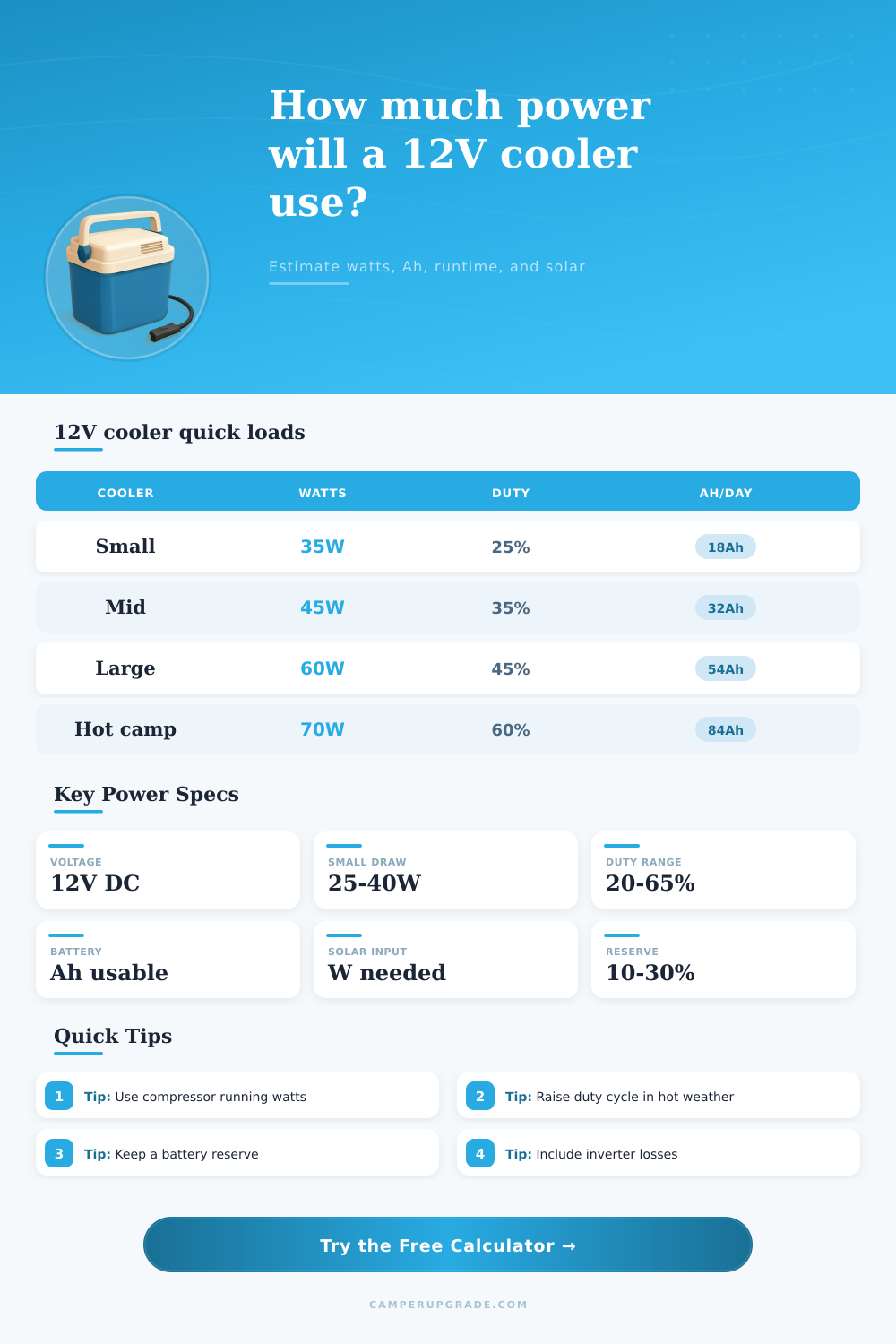
12V Cooler Power Draw Calculator
Estimate daily watt-hours, amp-hours, usable battery runtime, and solar panel size for a portable 12V compressor cooler or fridge.
⚡Quick Cooler Presets
🔋Cooler, Battery, and Solar Inputs
Calculation Breakdown
📊Cooler Specification Comparison
📘Reference Tables
| Cooler type | Typical running watts | Typical duty cycle | Estimated 12V Ah/day |
|---|---|---|---|
| 18-25 qt compressor cooler | 25-40 W | 20-35% | 10-28 Ah |
| 35-45 qt compressor fridge | 35-55 W | 25-45% | 18-50 Ah |
| 55-65 qt large fridge | 45-70 W | 35-55% | 38-77 Ah |
| 70-80 qt dual-zone fridge | 55-85 W | 40-65% | 53-110 Ah |
| Thermoelectric cooler | 45-75 W | 80-100% | 72-150 Ah |
| Battery type | Common usable limit | Usable Wh from 100Ah at 12V | Best calculator setting |
|---|---|---|---|
| Flooded lead acid | 50% | 600 Wh | 50% |
| AGM deep cycle | 50-60% | 600-720 Wh | 50% or 60% |
| Gel deep cycle | 50-60% | 600-720 Wh | 50% or 60% |
| LiFePO4 conservative | 80% | 960 Wh | 80% |
| LiFePO4 typical | 90% | 1080 Wh | 90% |
| Daily cooler use | 12V Ah/day | Solar at 4 sun hours | 100Ah LiFePO4 runtime |
|---|---|---|---|
| Light insulated use | 15 Ah | 60 W | 6.0 days |
| Typical camper fridge | 35 Ah | 140 W | 2.6 days |
| Warm campsite | 55 Ah | 220 W | 1.6 days |
| Freezer or dual zone | 75 Ah | 300 W | 1.2 days |
| Thermoelectric all day | 110 Ah | 440 W | 0.8 days |
| Scenario | Assumption | Why it changes draw | Calculator adjustment |
|---|---|---|---|
| Parked in shade | Cool cabin | Compressor cycles less often | -10% heat adjustment |
| Vent blocked | Warm compressor bay | Heat cannot leave the condenser | +10% to +20% |
| Freezer setpoint | Lower internal temp | Longer compressor runtime | +20% to +50% |
| AC adapter | Inverter in use | Conversion losses add draw | 85% to 92% efficiency |
| Frequent lid opens | Warm food added | Cooler must remove added heat | +10% to +25% |
💡Calculation Tips
Depending on whether you leave lid closed or open frequently, what temperatures outside are, etc., a 12V cooler will pull different amounts of current. First time someone runs one off their small battery bank, they sees the difference. They monitor voltage and see it dropping quicker than expected. So what’s the deal?
How many watts does it say on the box? That’s not really the question. How do all those watts translate into a day’s worth of energy consumption as compressor kicks on/off?
How To Calculate Battery And Solar Needs
The calculator above does the math if you input all of this stuff: Battery voltage, desired running time (in hours), watts drawn by the cooler (while it’s running) and how frequently that cooler runs each day (i.e., the duty cycle). That way it show your battery’s amp-hour draw. It also shows how long you will last before hitting your desired reserve percentage. And it spits out daily watt-hours, too.
Battery chemistry matters because not all amp-hours is created equal. You’ll typically only be able to use half your flooded lead-acid bank’s capacity if you want to stay within a safe depth of discharge. Lithium iron phosphate packs can safely gives up ninety percent. The tool has a field for usable limit where you can plug in your actualy chemistry. This makes the math work for the batteries you’re carrying, meaning this one decision can change the bank size requirement more different than any other setting.
The numbers also include heat and ventilation, a cooler parked out in the hot sun or left in a hot engine bay has to work harder to reject heat from its condenser. The ambient adjustment field adds a percentage to that extra work, which can allow it to run noticeably less if you tuck your unit away in some shade with good air flow. It’s one of those real world variables that the reference tables on the page helps you estimate when you’re planning a trip.
That also applies to solar sizing. This is based off how many panel watts will be needed to offset the energy used by the cooler per day. To calculate this, divide daily energy use by peak sun hours and system efficiency. Efficiency takes into account that panels produces far less than their rated output during all daylight hours, as well as wiring and controller losses. If your cooler is plugged into a converter/inverter instead of running straight 12-volt DC then the efficiency number gets even lower and solar sizing goes up.
Most folks take the watt rating of their cooler, multiply by 24 hours, and go from there: sizing for a constant load. But this calculation are wrong for both extremes, as it underestimates usage on hot days and overestimates usage on cool days. This is exactly why we have heat adjustment and duty cycle fields: to not make that mistake.
When you realize that this is an average not a constant, it makes it easier to plan because you can see if the size of the battery you have will support the trip length you desire. And you could of decide whether you should add some extra solar. Or change the cooler profile to match what you expect the conditions will be.
The remainder is simply matching the inputs to the actual conditions you will encounter while traveling.