Battery State of Charge Calculator
Estimate RV battery state of charge from measured bank voltage, chemistry-specific curves, optional flooded-cell gravity, temperature, load correction, and usable reserve settings.
Formula Breakdown
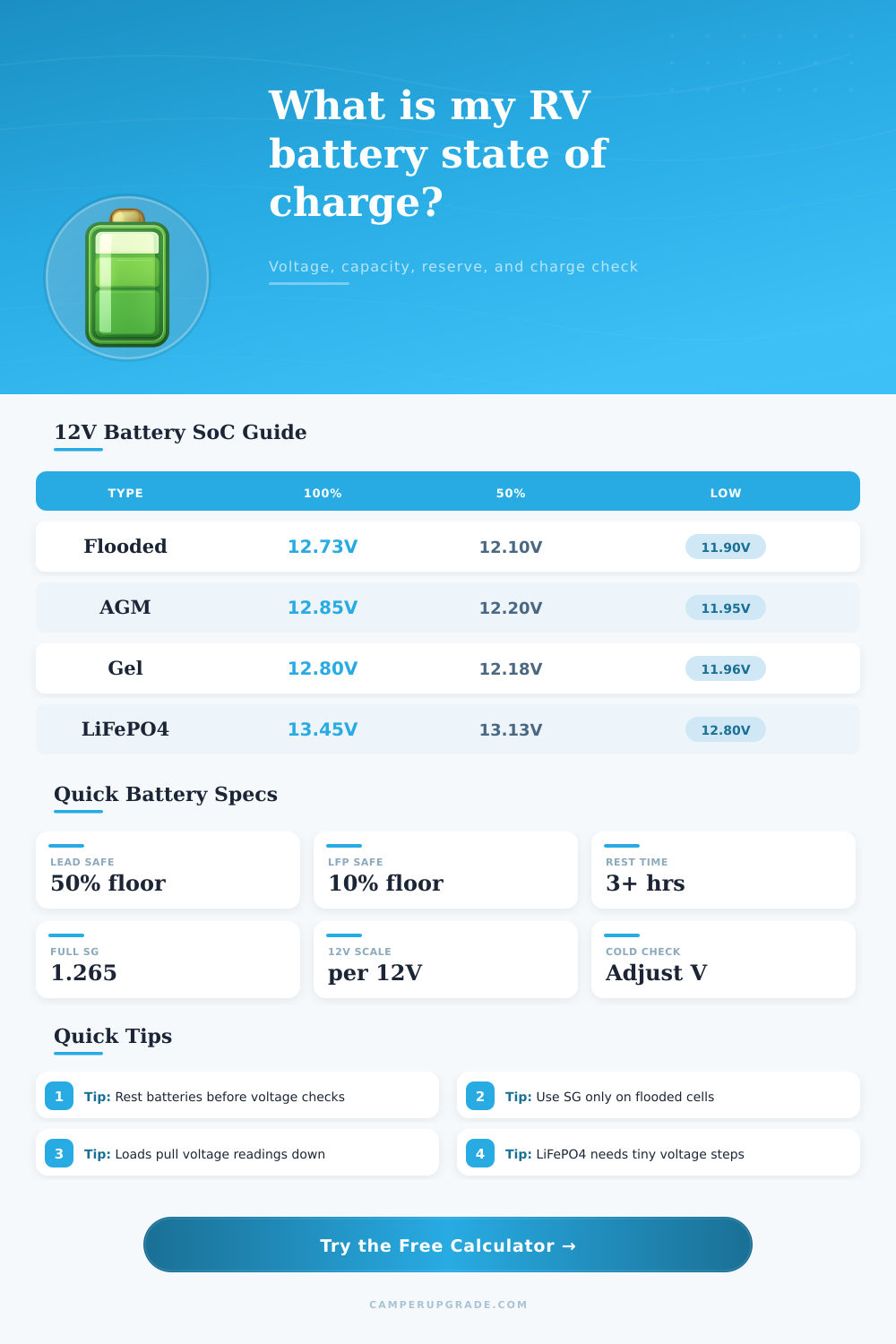
| SoC | Flooded 12V | AGM 12V | Gel 12V | LiFePO4 12V |
|---|---|---|---|---|
| 100% | 12.73V | 12.85V | 12.80V | 13.45V |
| 90% | 12.62V | 12.75V | 12.70V | 13.35V |
| 80% | 12.50V | 12.60V | 12.58V | 13.30V |
| 70% | 12.37V | 12.47V | 12.45V | 13.25V |
| 60% | 12.24V | 12.32V | 12.31V | 13.20V |
| 50% | 12.10V | 12.20V | 12.18V | 13.13V |
| 40% | 11.96V | 12.05V | 12.05V | 13.05V |
| 30% | 11.81V | 11.90V | 11.92V | 12.95V |
| 20% | 11.66V | 11.75V | 11.78V | 12.80V |
| 10% | 11.51V | 11.60V | 11.62V | 12.00V |
| Condition | Calculator Treatment | Why It Matters | Confidence Impact |
|---|---|---|---|
| Under load | Adds voltage sag estimate | Loads depress terminal voltage | Medium |
| Charging | Subtracts charge lift estimate | Charging raises terminal voltage | Medium |
| Cold lead bank | Temperature-normalizes voltage | Cold batteries read lower | Low to medium |
| Short rest | Adds uncertainty band | Surface charge may remain | High |
| Flooded gravity | Blends SG and voltage | SG tracks electrolyte charge | Lower |
| Bank Setup | Total Ah | Nominal Wh | Usable to Floor | Common RV Fit |
|---|---|---|---|---|
| Single 100Ah AGM | 100Ah | 1,200Wh | 600Wh at 50% | Weekend trailer |
| Two GC2 flooded | 225Ah | 2,700Wh | 1,350Wh at 50% | Travel trailer |
| Two 100Ah LFP | 200Ah | 2,400Wh | 1,920Wh at 20% | Solar camper |
| Three 100Ah LFP | 300Ah | 3,600Wh | 3,240Wh at 10% | Van conversion |
| Four 100Ah LFP | 400Ah | 4,800Wh | 4,320Wh at 10% | Boondock rig |
| Corrected SG | Approx SoC | Cell Reading Note | Use In Calculator |
|---|---|---|---|
| 1.265 | 100% | Fully charged flooded cell | Enter 1.265 |
| 1.225 | 75% | Good reserve remains | Enter 1.225 |
| 1.190 | 50% | Recharge soon for cycle life | Enter 1.190 |
| 1.155 | 25% | Deeply discharged lead bank | Enter 1.155 |
| 0 | Ignored | AGM, gel, lithium, or unknown | Enter 0 |
Knowing what level of usable power is in your RV batteries has altered my day planning. I know for sure now whether our fridge and lights will make it all the way until morning. I know if I try using the inverter with the coffee maker that it should of be okay. I know when to fire up the generator. And finally, I know when we need to pull into town for some juice.
Now, voltage doesn’t always tell the whole story; recent charging history, load, temperature, these things factor in to the reading. This is where knowing how to properly calculate your state of charge comes into play. The same voltage on different batteries are not the same. While all of these batteries is at 12.4 volts, the discharged flooded lead-acid bank is further along its curve than an AGM pack. Lithium chemistries is even higher.
How to Check Your RV Battery Power Level
When the actual remaining energy hasn’t changed significantly, cold weather will pull those readings down. An active charge session will push that number up (as will heavy loads). Terminal voltage can hides what is really happening under the hood.
After you enter your measured voltage, chemistry, temperature, and rest/working status, the calculator above do the math for you. You can also set a reserve floor where it will show only how much you’re comfortabley using before needing recharge. Most folks don’t appreciate the importance of the reserve setting. Constantly pulling lead acid batteries down to less than half charge will greatly shorten their cycle life. The lithium iron phosphate banks can takes deeper draws. They also has some kind of safety margin to protect them from being drawn too low by the inverter/battery management system.
Using the calculator correctly forces you to think about what your actual draw is on the bank and not to consider all of the amp-hour as fair game.
Flooded batteries have another dimension: a hydrometer reading. When you have one, it combines the two (voltage if present) to track the electrolyte itself via specific gravity. This adds a little refinement that removes some of the guesswork of short-term resting battery or the impact of surface charge. The option simply remains set to zero in this case and voltage-only are used for an estimate.
The same applies to temperature compensation: When you read a cold bank, the voltage will appear lower then its true state of charge, and the calculator corrects for this when looking at the curve. This adjustment alone accounts for why your battery may have appeared dead yesterday but now look better warmed by the sun. Temperature is one of the fastest ways to misinterpret what’s going on.
But in the real world, nothing is that simple. Turn on a light, or start a fan and the voltage immediately decreases. To account for this, the tool checks the current draw at that moment to adjust based off how much of the reading is caused by voltage drop rather than actual state of charge. It’s never going to be perfect but better than assuming every voltage number is gospel.
Practical payoff: By knowing (roughly) how much juice is left beyond your chosen level of reserve, you’re able to pair that amount of remaining, useable amp-hours to the load(s) you intend to run. Match those numbers up and you have a decision. The calculator takes away the math, making it easier to see. You’ll treat the battery more like a limited resource with known rules and less like a black box.