Headlamp Battery Trip Calculator
Plan headlamp cells, spare sets, usable runtime, cold-weather loss, reserve margin, and USB recharge before your camping trip.
Calculation breakdown
| Mode | Typical draw | Approximate output | Best camping use |
|---|---|---|---|
| Moonlight | 5 to 15 mA | 1 to 10 lumens | Tent tasks, map reading, preserving night vision |
| Low | 25 to 70 mA | 15 to 60 lumens | Camp chores, walking inside a site, late bathroom runs |
| Medium | 90 to 220 mA | 80 to 200 lumens | Trail walking, cooking checks, setting guy lines |
| High | 350 to 800 mA | 250 to 600 lumens | Route finding, rough ground, searching around camp |
| Turbo | 900 mA plus | 700 lumens plus | Short bursts only; heat and voltage sag limit runtime |
| Battery | Typical capacity | Usable planning factor | Cold-weather note |
|---|---|---|---|
| AAA alkaline | 900 to 1200 mAh | 45% to 65% | Voltage drops hard in cold or high-drain modes. |
| AAA NiMH | 750 to 950 mAh | 80% to 90% | Stable voltage, rechargeable, reliable for camp routines. |
| AAA lithium primary | 1100 to 1300 mAh | 85% to 95% | Lightweight and strong in freezing conditions. |
| AA NiMH | 1900 to 2500 mAh | 80% to 90% | Great for longer headlamp bodies and lantern hybrids. |
| CR123A lithium | 1400 to 1700 mAh | 85% to 95% | High voltage cell with excellent shelf life. |
| 18650 Li-ion | 3000 to 3600 mAh | 85% to 95% | Warm-pocket storage helps preserve winter output. |
| Scenario | Mode pattern | Battery example | Planning note |
|---|---|---|---|
| Two-night campground | Mostly low, brief medium | 3 AAA NiMH | One installed set plus one spare set usually covers casual use. |
| Five-night backpack | Low every night, little high | 3 AAA lithium | Carry enough full sets for no-recharge independence. |
| Winter dawn starts | Medium travel, high bursts | 18650 Li-ion | Add cold loss and keep a backup cell warm. |
| Fishing or boat camp | Medium task light | AA NiMH | Moisture and long task sessions justify extra reserve. |
| Recharge source | Planning energy | Headlamp refill estimate | Calculator entry idea |
|---|---|---|---|
| Small 5000 mAh power bank | About 12 to 15 Wh usable | Three to four 1000 mAh lamp refills | Enter 500 to 1000 mAh per night if shared. |
| 10,000 mAh power bank | About 24 to 30 Wh usable | Six to eight 1000 mAh lamp refills | Enter expected nightly recharge, not bank rating. |
| Vehicle USB while driving | Trip-dependent | Often enough for one lamp per travel day | Credit only the charge time you reliably have. |
| Solar panel at camp | Weather-dependent | Uncertain in trees or short winter days | Use conservative mAh values unless measured. |
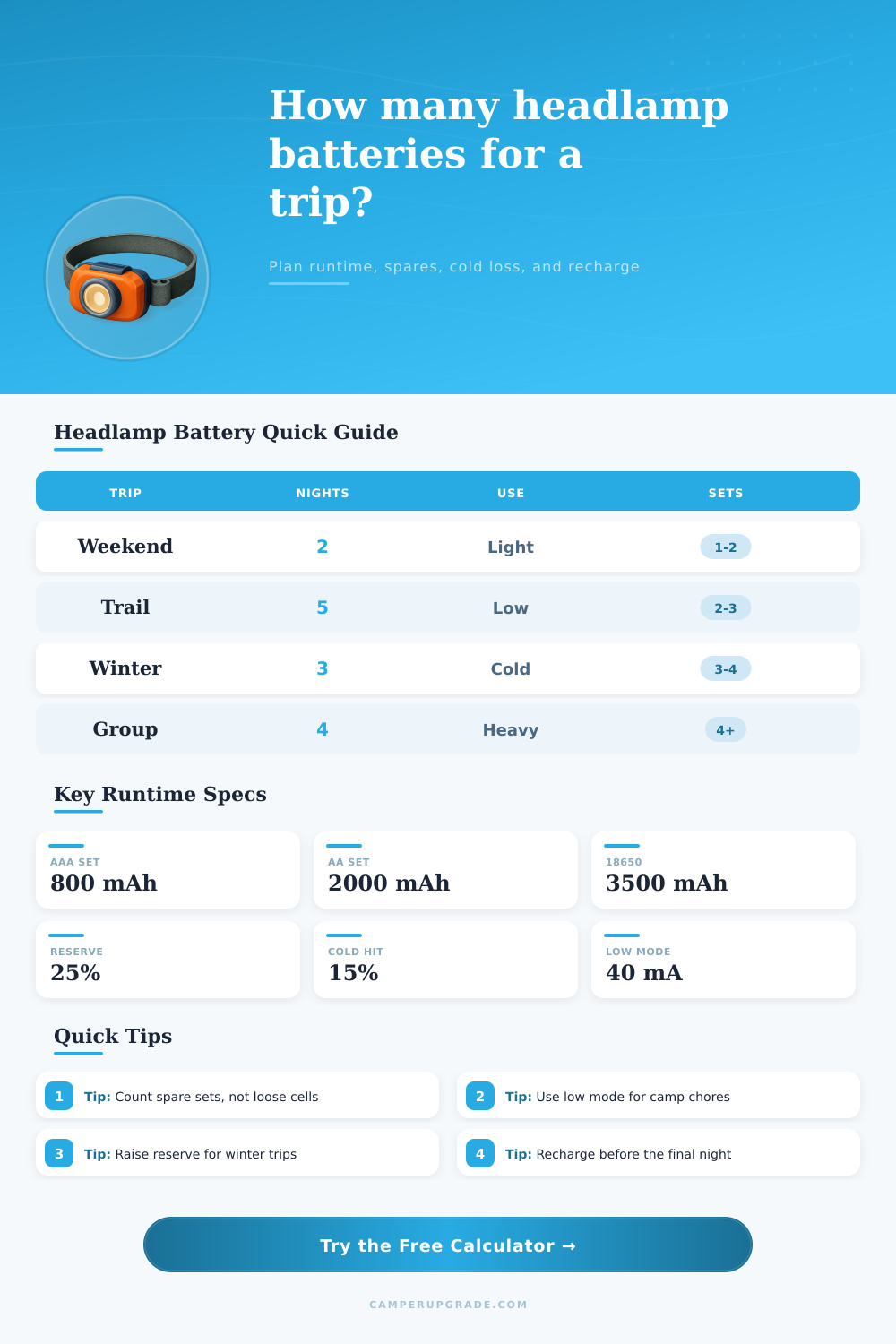
Build your headlamp strategy around what lights you use at night, not what batteries you think will last. First estimate: how much do you expect to use your light on low? Medium? High? Next include some reserve for sharing chores in camp, delays or cold weather.
After you plug that into the calculator above and select your battery type, it does the math for you, so you don’t have to guess at cold loss and usable capacity. People tend to count out cells rather than entire operating sets when packing. Having only a single loose AAA doesn’t help if you’re using three and they’re all depleted.
Plan Your Headlamp Batteries
Switching to think in terms of full sets of cell will impact how you tally up spare batteries. It’ll also influence whether you want to pick up an additional pack before heading out. This applies equally to built-in batteries or lithium packs. You’re not carrying individual units; you’re carrying useful energy.
What throws people off is the reserve margin. It sounds good to have a 25% buffer. Then you remember the long hike in the evenings, the cold night camping, and lending gear to your fellow camper. All of these comes out of the same bucket. The reserve margin are accounted for in the output of the calculator so you can bump it up if you’re heading out in winter or drop it down if this is just a casual weekend jaunt.
That’s often the difference between having two sets left at the end of the trip versus one set. The same is true for cold weather loss. Below freezing, alkaline cells will lose voltage quickly and lithium stay constant. So if there are going to be freezing nights, it automatically applies that penalty too. That means what you get out matches what you really get out, not some kind of rated capacity. It’s more evident on multi-night trip when you can’t recharge each day.
Another useful input is Recharge credit. You can bring a small power bank to recharge your rechargeable headlamp every night, so long as you remember to plug it in! If you enter a reasonable amount into this field, then you’ll avoid the all-too-common error of thinking that batteries will last forever on-trail. Setting this value to 0 means the calculator assumes cells are one-shot deals, and displays the full spare charge need.
On the page are reference tables with typical draw in each mode. So you can tell if your time is reasonable or not. Chores at camp take much less time than trying to find a route. That means low mode use far less energy than high mode. Change those hours and total at night will change. That then alters how many sets you need to haul.
Most trips end up being mostly low mode with occasional bursts of medium. That is why they begin their presets from there. Things get realy interesting when it’s tight on the numbers. What if the numbers feel tight? Then adding one extra set are the practical option, or simply cutting some of the higher modes. That tradeoff becomes clear with the calculator.
So you should of not need to crunch the numbers yourself. This kind of planning helps turn battery decisions into an exercise of known variables, rather than guesswork. You still choose the amount of margin that suits your comfortabley level. But now the math isn’t hiding in the pack.