Calorie Carry Weight Calculator
Estimate trail food calories, edible food weight, packaging weight, reserve calories, starting carry weight, and real calorie density for backpacking, car camping, canoe trips, and long resupply legs.
🎒Food Carry Presets
⚙Trip Calories, Density, Packaging, and Reserve Inputs
📋Calculation Breakdown
📊Food Carry Spec Grid
📘Reference Tables
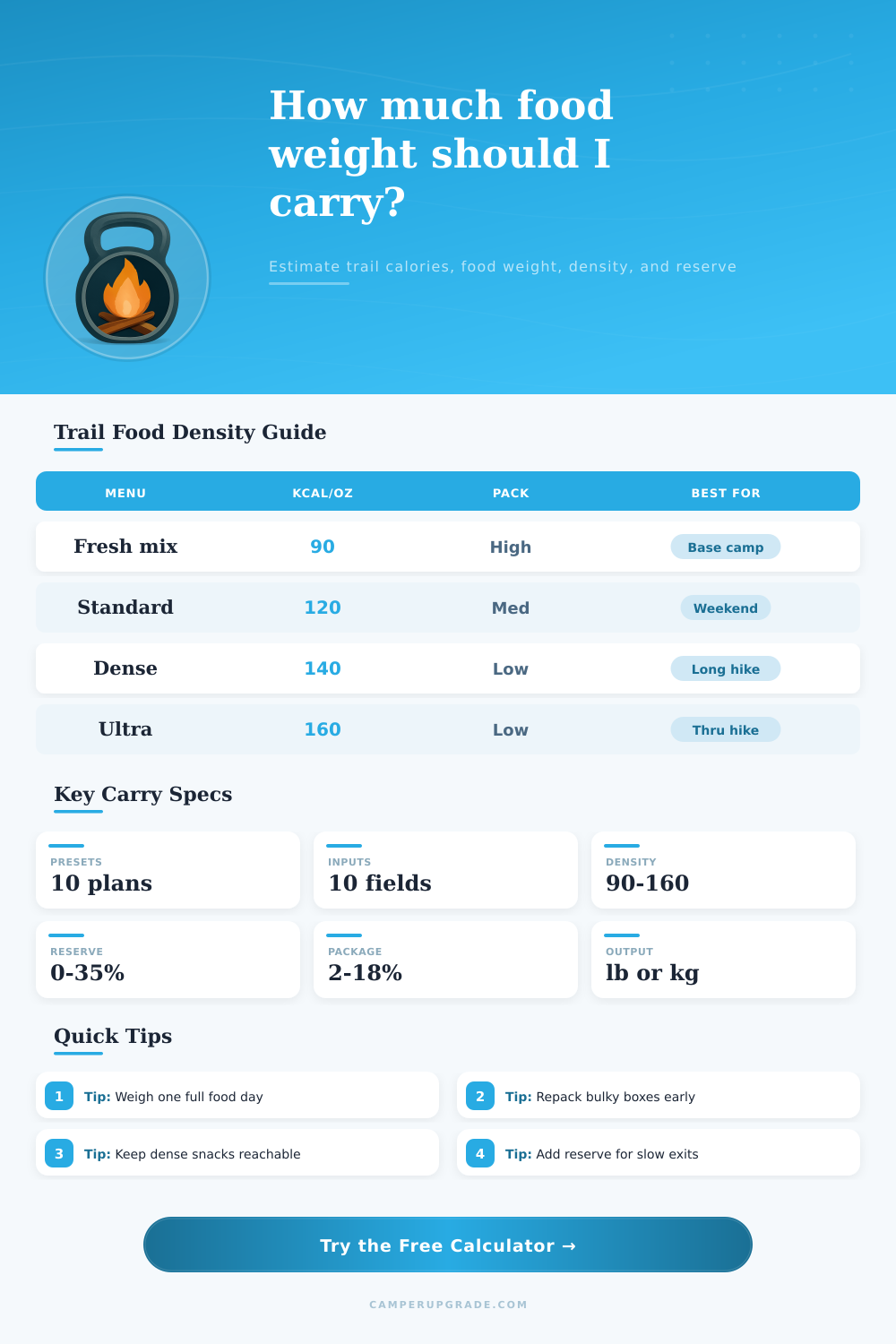
| Menu profile | Density | Typical foods | Carry note |
|---|---|---|---|
| Fresh heavy base-camp mix | 90 kcal/oz | Fruit, tortillas, cans, wet meals | Comfortable but heavy per calorie. |
| Standard trail grocery mix | 122 kcal/oz | Oats, rice sides, bars, jerky, cheese | Good default for weekend packing. |
| Dense backpacking menu | 142 kcal/oz | Nuts, oil, nut butter, dehydrated meals | Strong balance for long carries. |
| Ultralight high-fat menu | 162 kcal/oz | Olive oil, macadamias, powdered meals | Very compact but needs appetite testing. |
| Trip style | Daily kcal | Factor | Planning note |
|---|---|---|---|
| Camp or short hikes | 1,800-2,400 | 0.90x | Good for relaxed camp days. |
| Normal backpacking | 2,600-3,400 | 1.00x | Common three-season baseline. |
| Long climbs or big miles | 3,300-4,400 | 1.12x | Use for sustained elevation gain. |
| Cold or expedition load | 4,000-5,800 | 1.22-1.35x | Reserve becomes more important. |
| Reserve level | Add calories | Best use | Tradeoff |
|---|---|---|---|
| 0% | None | Known exit, short trip | Lowest weight, no delay margin. |
| 10% | Light buffer | Weekend trails and easy shuttles | Usually one snack layer. |
| 20% | Strong buffer | Weather or uncertain mileage | Noticeable extra weight. |
| 35% | Emergency buffer | Remote route or slow exit risk | Best split across packs. |
| Example carry | Calories | Density | Food weight |
|---|---|---|---|
| Solo 2 days | 6,000 kcal | 122 kcal/oz | 3.1 lb edible |
| Pair 3 days | 18,000 kcal | 122 kcal/oz | 9.2 lb edible |
| Solo 6 days | 21,600 kcal | 142 kcal/oz | 9.5 lb edible |
| Group 4 days | 48,000 kcal | 132 kcal/oz | 22.7 lb edible |
💡Carry Planning Tips
When planning a three-day trip, calculating the total weight of the food that will be consume on the trip require more than just the food itself. Many people make mistakes in calculating the weight of they food for a trip because they only consider the calorie that are in the food, but do not consider the weight of the food packaging or the weight of any additional snacks that may be consume on the trip. The weight of these snack and packaging will increase the total weight of the food that the individual must carry on their trip.
Thus, it is important to account for the weight of the food packaging when calculating the total weight that will be carry on the trip. The number of calories that an individual need for a trip will vary according to the terrain, the temperature of that terrain, and the amount of physical work that they will perform during that trip. For instance, an individual will burn fewer calories on a day when they are simply camping versus an individual that is climbing to higher elevations all day.
How to Calculate Food Weight for a Three-Day Trip
Thus, an individual should use a calorie calculator that allow for adjustments to the amount of calories that will be burned during the trip to create a more accurat shopping list for the trip. Furthermore, a person should separate the daily calories target that they require from the calorie layer for their food reserve, as the reserve will prevent them from having no food on the trip in the case of weather delays in which they must travel on foot. Food density is another factor to consider when calculating the total weight of the food that will be consume during the trip.
Food density will determine the amount of weight that will be carried for the number of calories that are to be consumed. Foods that contain a high amount of fat and dehydrated ingredients will have a high food density and will weigh less than foods that contain a high amount of water. An individual should use a calorie calculator that incorporate food density settings to determine how many ounce of food they will have to carry during the trip; knowing this will help them to determine whether the weight of heavy meals is worth the extra weight that they will have to carry on their trip.
The weight of the food packaging will also play a crucial role in the total weight that will be carried on the trip. The packaging, whether it is zip bag, labels or bulk sacks will add to the total weight of the food that is to be carried. Thus, an individual should use a calorie calculator that include the weight of the food packaging in the calculation of the total weight of the food.
Such a calculation will provide a number that is more close related to the actual weight of the food packages as measured on a digital scale. Another factor to consider for the food that is to be taken on a trip is the inclusion of a reserve food layer. In the instance that an individual must cross a river or access food at a resupply location that is close, the individual will use the reserve food to provide food; however, the reserve food should not be too large in relation to the rest of the food that is to be consumed.
A person should use a food calorie calculator that display the weight of the reserve food separately from the weight of the daily food that is to be consume. One way of determining the total weight of the food that is to be consumed on the trip is to weigh one complete day’s food at home. The food should be weighed while in its complete state with every wrapper and drink mix.
Each of these item will add to the total weight of the food. Furthermore, by weighing the food, an individual can determine whether their actual food density match the density that they have selected for their food preparation. If it does not match, then they can swap one bulky food item for a denser food item to reduce the total weight of the food that they have to carry on their trip.
These same consideration for the weight of the food will apply to the food that is consumed on a trip with other individuals. Each individual may have different appetite for the food, but you can calculate the total number of calories and weight for each individual by running the trip food calculation for the group as a whole, and dividing that total number by the number of individual that are going on the trip. The goal for calculating the total weight of the food that is to be consumed on a trip is not to establish a total weight that is as low as possible.
Instead, the total weight that is selected for consumption should feel correct to the individual after the long day of travel. It should provide food that taste good to the individual, but also provide some weight to allow for weather changes. Once an individual has used a calorie calculator to determine the best style of kitchen for their trip, the kitchen scale will become the tool that they use to determine the total weight of the food that is to be consumed on their trip.