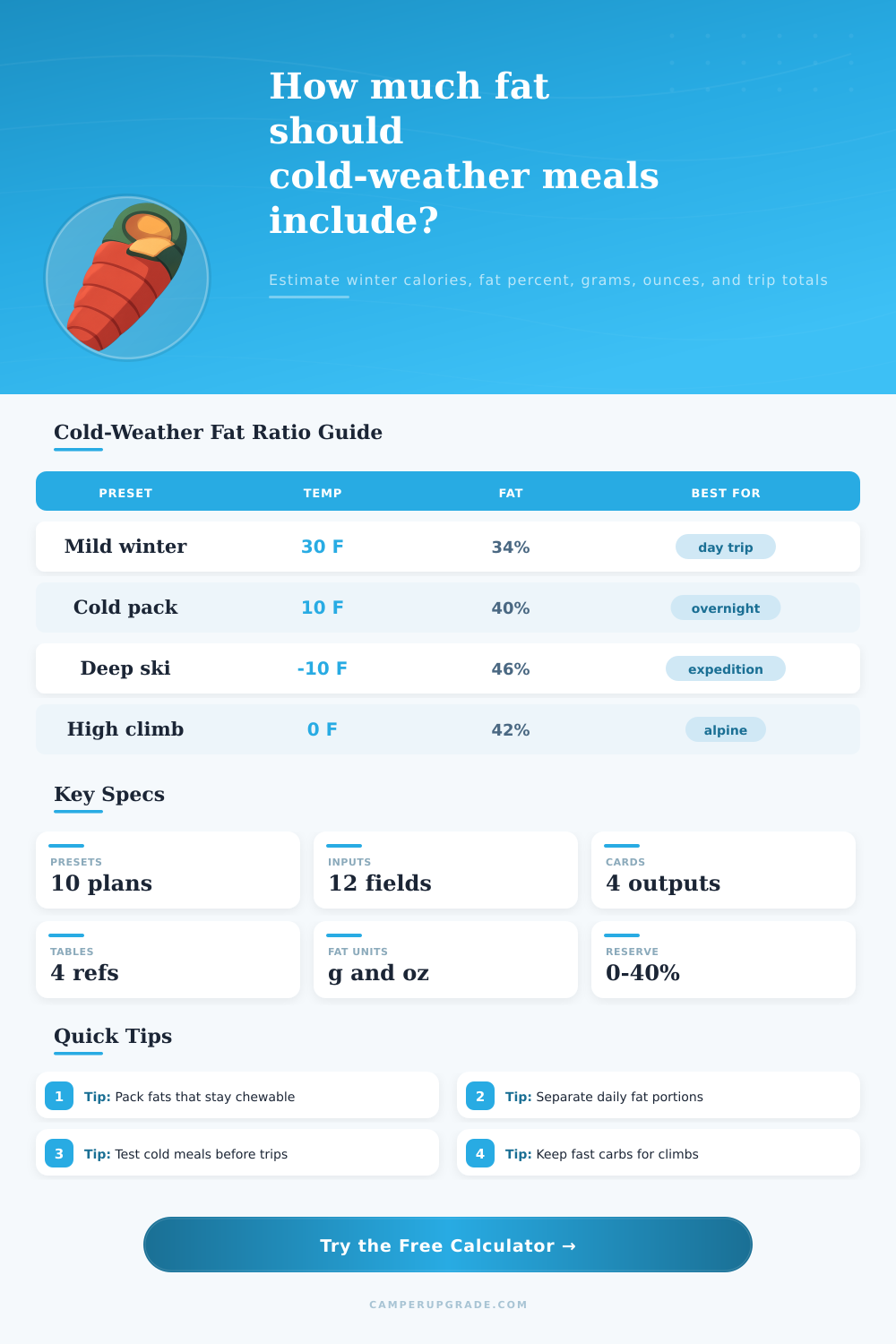
Fat Ratio Cold Weather Calculator
Estimate winter food fat ratio from temperature, exertion, calorie targets, trip length, reserve margin, meal count, and fat energy density, then convert the plan into grams and ounces.
⛺Cold-Weather Fat Presets
⚙Calculator Inputs
📊Detailed Breakdown
🧪Spec Grid
📘Reference Tables
| Temperature | Calorie Lift | Fat Ratio Nudge | Use |
|---|---|---|---|
| 35 to 50 F | 0-4% | 0-1% | Cool shoulder season |
| 20 to 34 F | 4-10% | 1-3% | Freezing camp |
| 0 to 19 F | 10-18% | 3-6% | Regular winter travel |
| -20 to -1 F | 18-28% | 6-9% | Deep cold |
| Below -20 F | 28-35% | 9-12% | Expedition margin |
| Exertion | Calorie Factor | Fat Nudge | Example |
|---|---|---|---|
| Light | 0.92 | -2% | Camp chores |
| Moderate | 1.00 | 0% | Packed trail |
| Hard | 1.16 | -1% | Trail breaking |
| Very hard | 1.32 | -3% | Sled hauling |
| Fat Food | Approx Fat | Cold Note | Pack Role |
|---|---|---|---|
| Olive oil packet | 14 g/tbsp | May thicken | Dinner boost |
| Nut butter | 16 g/oz | Knead warm | Snack or oats |
| Hard cheese | 9 g/oz | Chewable cold | Lunch anchor |
| Macadamias | 21 g/oz | High fat density | Trail snack |
| Chocolate | 9 g/oz | Can freeze hard | Quick morale |
| Fat Ratio | Best Fit | Watch For | Field Cue |
|---|---|---|---|
| 25-32% | Fast output | Bulky food | More carbs |
| 33-40% | Most winter trips | Snack variety | Steady warmth |
| 41-48% | Deep cold | Slow digestion | Smaller portions |
| 49-55% | Expedition reserve | Low quick energy | Add sweet drinks |
These tables are planning ranges, not medical advice. Cold appetite, digestion, altitude, medical conditions, and trip intensity can all change the right macro mix.
💡Tips
The effects of winter travel upon the human bodies relate to the fuel that the body use. Winter travel require a focus upon the type of fuel that comes from fat, as fat provide more energy per ounce than the other types of fuel that the body can utilize. The amount of fat that an individual should consume relate to the amount of fat that the individual carries, the efficiency of fat as a fuel, and the importance of fat if the individual is on the move with a heavy load.
If an individual consumes too little fat, they may feel cold and hungry; if they consume too much fat, they may not have enough fuel for sudden efforts with there body. The amount of fat that an individual should consume is related to the temperature at which they will be traveling; the colder the temperature, the more fuel that the body will burn to maintain their body heat. Thus, the percentage of fat calories that the individual should consume increase at lower temperatures.
How to Plan Food and Fat for Winter Travel
Fat remain in the body longer than other fuel, and the body does not need to stop consuming fuel as often if it utilizes only fat as its fuel source. Therefore, the individual should enter the expected average temperature into the calculator, rather than the high temperature that may be displayed on a weather report. The exertion levels that an individual will experience while traveling will also affect their fuel need; however, their exertion levels will have a different effect upon their total calories to be consumed compared to the way that temperature affect the percentage of fat calories that they should consume.
When an individual performs high levels of exertion of tasks, such as hauling a sled, their body will require more total calories. However, their need for fat do not necessarily increase at the same rate. An individual need carbohydrates to fuel bursts of energy, and to aid in the digestion of their food while traveling in the cold.
Therefore, the exertion settings will slightly reduce the amount of fat that is required of the individual. Individuals will also need to consider the length of their trip and the amount of margin for error with their travel. For instance, an individual planning a short trip can consume leaner fuel than an individual taking a longer journey.
This is because an individual can more easily adjust their food consumption for a shorter journey. Additionally, individuals must plan for inclement weather and unexpected detour. Thus, an individual should include a percentage of extra fuel in their travel plan.
This extra fuel ensure that an individual does not ration their food on the last day of there trip; additionally, their appetite may increase after spending several days in the cold. For the fat percentages that the calculator has calculated for an individual, there are still additional considerations of the type of food and texture of that food that must be made. Some types of fat may become hard to consume when the temperatures are below freezing; other types of fat may be difficult to open if the individual is wearing gloves while on the journey.
Many types of nut butter and chocolate bar can become too hard to eat when consumed in temperatures below freezing; these foods must be kept in an inside pocket of an individual’s pack. The calculator will provide the individual with the weight of the food that they should consume in grams and ounces; however, they must also ensure that the type of food selected for consumption is test and proven to be edible in the cold temperature. Finally, an individual can use their body weight and the load that they will be traveling with to test the calculation from the calculator.
The calories per pound that the calculator calculates can help an individual to determine if the fat and fuel percentage that are entered into the calculator are still accurate. The calculator is not a way to experience the trip that an individual will take, but it can provide an individual with consistent arithmetic that can be used to compare the fuel needs of different type of travel plan. The goal of this calculator is to provide an individual with a target for the fat that will be contained in their meal each day.
Therefore, an individual will know how many gram of fat that they should consume with each meal each day, and the total load that the food will have on there pack. Additionally, the calculator will allow an individual to know how many calories will remain for the carbohydrates and protein that will balance out their meal. Thus, an individual will be aware of the fuel requirement of each meal prior to beginning their journey.
While this calculator will determine the fuel needs of an individual traveling in the winter month, the individual is still in control of the food that they eat. An individual must still choose the fuel, test the fuel for edibility in the cold temperature, and provide extra fuel in the case that their travel plan may change. Thus, an individual can use the calculator to determine the target fuel need for each day of travel.
It should of been used to help plan for many cold days. This moddern tool works better then older methods. Youll find it quite comfortaly to use.