Energy Bar Daily Count Calculator
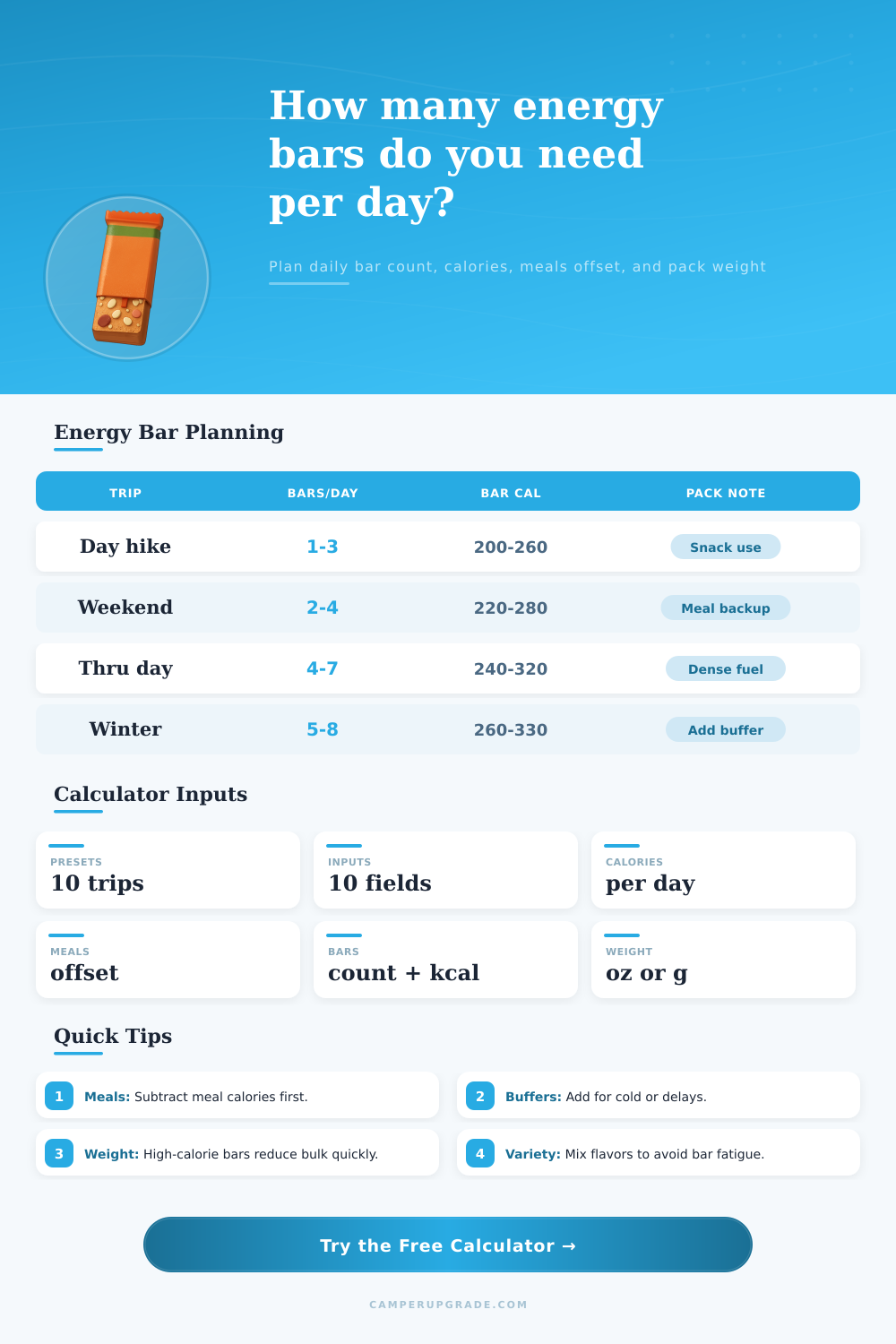
Estimate how many energy bars to pack per day after meal calories, appetite factor, trip length, group size, buffer, bar calories, and bar weight.
🎒Energy Bar Presets
⚙Daily Bar Inputs
Formula logic: adjusted calories/day = target calories/day x conditions factor. Bar calories needed = adjusted calories/day - meal calories offset. Bars/day = bar calories needed / bar calories, then buffer and round up for real packing.
📊Energy Bar Spec Grid
📋Energy Bar Reference Tables
| Bar style | Typical kcal | Typical weight | Best use |
|---|---|---|---|
| Light snack bar | 120 to 180 | 1.2 to 1.8 oz | Short hikes, kids, coffee breaks |
| Standard energy bar | 200 to 260 | 1.8 to 2.4 oz | Normal day hikes and backpacking snacks |
| Meal replacement bar | 300 to 420 | 2.8 to 4.0 oz | Fast lunches and simple resupply boxes |
| High fat dense bar | 280 to 360 | 1.9 to 2.8 oz | Cold weather and compact calories |
| Protein-heavy bar | 180 to 250 | 2.0 to 2.6 oz | Recovery or evening snack, not only climb fuel |
| Meal offset/day | What it means | Bars fill | Planning note |
|---|---|---|---|
| 0 to 800 kcal | Bars are most of the menu | Large calorie gap | Watch variety and digestion. |
| 1200 to 1800 kcal | Meals plus bar snacks | Moderate gap | Common for simple backpacking menus. |
| 2200 to 3000 kcal | Full meals do most work | Snack and backup gap | Bars cover climbs, delays, and quick breaks. |
| 3200+ kcal | Food bag already calorie dense | Small gap | Pack bars for convenience instead of primary fuel. |
| Conditions factor | Multiplier | When to use | Effect |
|---|---|---|---|
| Light snack use | 0.85x | Short route, full meals, easy pace | Fewer bars |
| Normal trail day | 1.00x | Typical day hiking or backpacking | Baseline count |
| Long climb | 1.12x | Big ascent, heavy pack, high output | One more bar on many plans |
| Cold or high mileage | 1.20x | Hard weather, long hours, wet layers | Meaningful calorie bump |
| Winter or very hard | 1.32x | Snow travel, long winter days, remote route | Strong buffer needed |
| Example trip | People x days | Bar target | Weight cue |
|---|---|---|---|
| Solo summit day | 1 x 1 | 2 to 4 bars | About 4 to 10 oz |
| Pair weekend | 2 x 3 | 18 to 30 bars | About 2.5 to 5 lb |
| Family basecamp | 4 x 2 | 16 to 32 bars | Best split by person |
| Five-day section | 1 x 5 | 20 to 35 bars | Use dense bars or resupply |
| Winter pair | 2 x 2 | 24 to 40 bars | Cold makes wrappers and bulk add up |
💡Energy Bar Packing Tips
To plan a trips and determine how many energy bars to carry, one must first determine how many calories is needed throughout the day. Energy bars are used to help fill the caloric gaps between meals, but dont intend to replace meals altogether. The number of energy bars that are needed can be calculated by considering the target number of calories that is needed for the individual during the trip, and the number of calories that the meals provide during the day (the meal offset).
If an individual eat large meals, the meal offset will be high, indicating that fewer energy bars will be needed. If an individual eats smaller meals, the meal offset will be more lower, indicating that more energy bars will be needed to meet the individuals caloric needs. The calculator can calculate the number of energy bars that is needed by taking the target calories for the individual and subtracting the meal offset for that individual, then dividing that number by the number of calories containing in each energy bar.
How Many Energy Bars to Pack for a Trip
In addition to considering the variables describe above, you should also consider the environmental conditions that will be experienced during the trip. For instance, cold weather or steep terrain will increase the number of calories that an individual need to burn during the trip. These conditions should be adjusted for prior to calculating the number of energy bars needed, as this will ensure that the energy bar calculation is based off the individual’s actual physical effort for which they are to be compensate.
An individual’s appetite can also vary, which may lead to different energy bar need within a group of individuals. For instance, one individual may require more energy bars due to having a more high appetite than other members of the group. Thus, it is important to account for these difference between individuals, and to use the energy bar calculator to ensure that the number of energy bars calculated for each individual within the group reflect the actual energy needs for that group.
Additionally, the weight of each energy bar should be consider. For instance, an energy bar that contains more calories per ounce of weight is a denser energy bar than bars with fewer calories per ounce. Thus, using a denser energy bar will reduce the total weight of the energy bars that is needed for the trip.
These different types of energy bars can be compared using the reference tables included within the calculator, which will assist in the decision of whether the denser energy bars are the best choice for the trip. The calculator also incorporates various buffer setting for the number of energy bars needed for the trip. For instance, a ten percent buffer will provide for a small excess of energy bars for the trip, but a twenty-five percent buffer provide for a larger excess of energy bars, which may be needed if the individual is to travel to cold areas or if there is uncertainties regarding resupply dates.
These buffers are applied to the total number of energy bars that are calculate for an individual, and the total number of energy bars are rounded up to the nearest whole energy bar. Thus, providing a buffer prevents any mistake that may arise in providing for an individuals energy needs, such as having too few energy bars for that individual. It is also important to ensure that the number of energy bars provided for each individual is not the same as the number of energy bars provided for each individual on previous trips.
For instance, the number of energy bars may have been sufficient for another trip if the individual had a different appetite for those trips or if the individuals was to travel for shorter periods of time. Thus, by running these number through the energy bar calculator for each trip, the number of energy bars can be ensured to not be too light for the individual to have sufficient energy, nor too heavy for the individual to become overweight from having to carry those bar. Thus, by planning a trip with these energy bar calculations, individuals will be able to determine the correct energy bars to take on the trip, and the correct number of those energy bars.