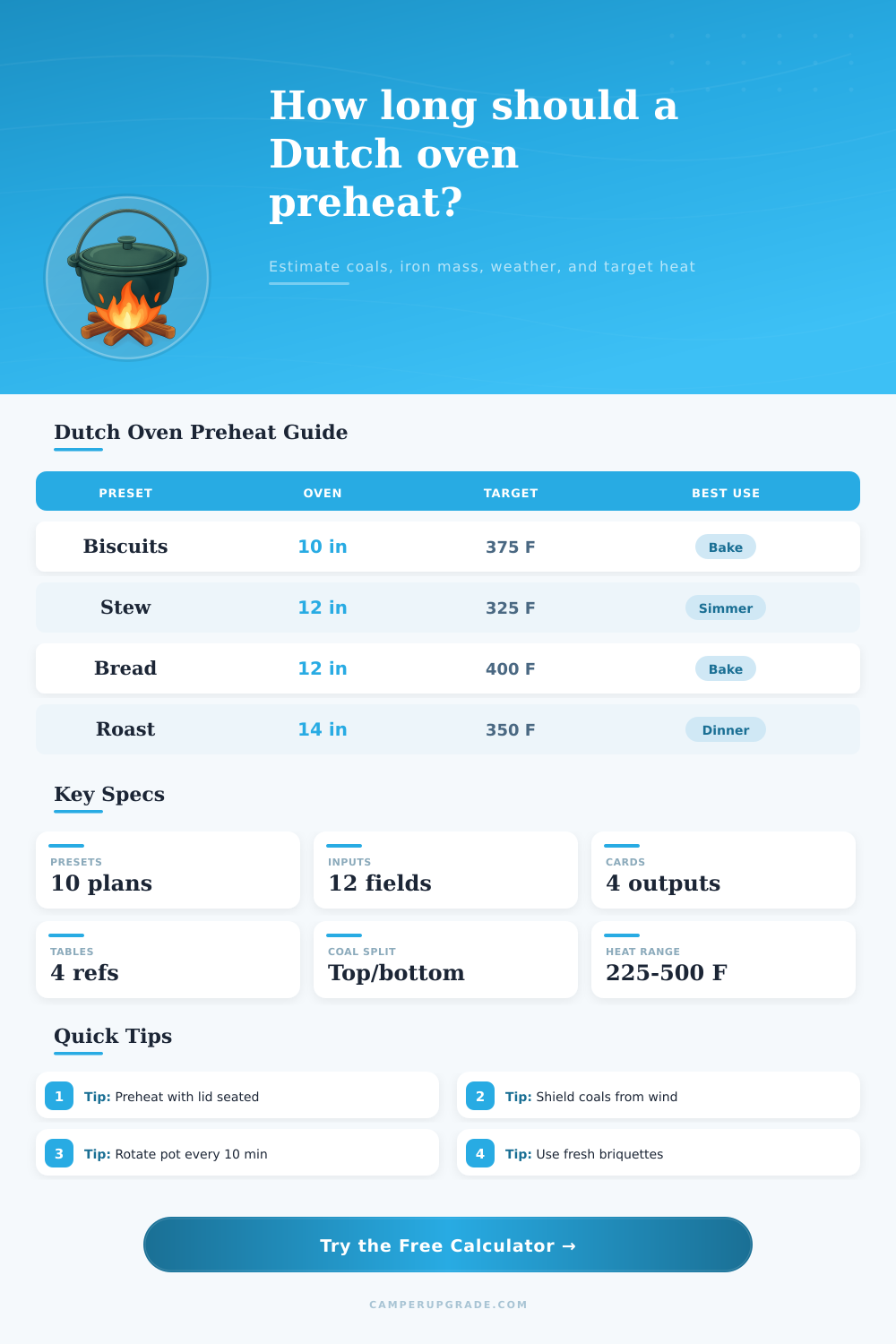
Dutch Oven Preheat Time Calculator
Estimate Dutch oven preheat time from oven size, cast iron mass, coal count, coal split, ambient temperature, wind, starting iron temperature, and target cooking temperature.
⛺Camp Cooking Presets
⚙Calculator Inputs
🧮Detailed Breakdown
⚙Spec Grid
📘Reference Tables
| Oven | 325 F | 350 F | 375 F |
|---|---|---|---|
| 8 inch | 13 coals | 15 coals | 17 coals |
| 10 inch | 17 coals | 19 coals | 21 coals |
| 12 inch | 21 coals | 25 coals | 27 coals |
| 14 inch | 25 coals | 29 coals | 31 coals |
| 16 inch | 29 coals | 33 coals | 35 coals |
| Size | Capacity | Typical Mass | Preheat Note |
|---|---|---|---|
| 8 inch | 2 qt | 8-11 lb | Fast dessert pot |
| 10 inch | 4 qt | 12-15 lb | Small bake |
| 12 inch | 6 qt | 18-22 lb | Common camp oven |
| 14 inch | 8-10 qt | 26-32 lb | Large dinner |
| 16 inch | 12 qt | 36-45 lb | Group oven |
| Condition | Heat Factor | Time Effect | Field Move |
|---|---|---|---|
| Calm shelter | 0.98 | Baseline | Use normal count |
| Light breeze | 0.90 | Add 5-10% | Rotate oven |
| Moderate wind | 0.80 | Add 12-20% | Use wind screen |
| Gusty site | 0.68 | Add 25%+ | Move fire pan |
| Cold iron | varies | Add 5-15 min | Warm gradually |
| Use | Top Share | Bottom Share | Why |
|---|---|---|---|
| Baking | 65-70% | 30-35% | Top browning |
| Bread | 70% | 30% | Lid spring |
| Roasting | 58-62% | 38-42% | Even heat |
| Simmering | 45-55% | 45-55% | Gentle floor |
| Searing | 25-35% | 65-75% | Hot bottom |
💡Tips
This calculator estimates practical field preheat time. Charcoal brand, coal age, fire pan distance, lid fit, ash buildup, and wind shielding can shift the real oven temperature.
To determine how long it will take for a Dutch oven to heat up, an individual must consider several different variable. The temperature of the metal of the Dutch oven is dependent upon both the temperature of the ambient air around the Dutch oven, as well as the effect of the wind and the types of coals that is used to heat the Dutch oven. For instance, if the air temperature are low, the Dutch oven will take longer to heat up to the target temperature.
Additionally, if the wind exposes the Dutch oven, it will take longer to heat up due to the way in which the wind cools the Dutch oven. The mass of the Dutch oven is another variable to consider. For instance, if the Dutch oven is very heavy, it will be able to hold and retain more heat, but it will take longer to heating the Dutch oven to the target temperature.
How Long It Takes a Dutch Oven to Heat
Additionally, if a person has stored the Dutch oven in a location that is exposed to cold temperature, such as a cold vehicle, the Dutch oven will take longer to heat up than if it were warmed to the air temperatures of the cooking area. The type of coals that are used will impact the amount of heat that is provided to the Dutch oven. For instance, standard briquettes will produce less heat than lump charcoal, but the lump charcoal will last for a shorter period of time.
Additionally, the placement of the coals will impact the way in which the Dutch oven heat its contents. If baking items, the Dutch oven should be heated with more coals on the lid of the Dutch oven to allow the food to brown on the top. If searing foods, however, the cook should place more coals on the bottom of the Dutch oven to expose the bottom of the food to more heat.
Another variable to consider is the effect of the wind. The wind will cool both the coals and the Dutch oven, thus reducing the efficiency with which the Dutch oven can heat its contents. As such, an individual can account for this variable by employing a timing reserve.
A timing reserve is an amount of time that is added to the estimated time necessary to heat the Dutch oven to the target temperature. This added time accounts for the way in which the Dutch oven and the coals can lose heat to the wind. Additionally, using a timing reserve can account for the drop in temperature that occurs when the lid to the Dutch oven is place on the Dutch oven.
Individuals often make mistake in heating their Dutch oven. For instance, an individual may always use the same number of coals to heat the Dutch oven, but the number of coals that is used can change depending upon the ambient air temperature and the wind. Additionally, another mistake that individuals make is frequently lift the lid of the Dutch oven to check the temperature of the food within the Dutch oven.
By lifting the lid of the Dutch oven, heat will escape from the Dutch oven. Thus, more time will be required to heat the Dutch oven to compensate for the heat that escaped. Finally, an individual must remember that the coals also need to heat up to the same temperature as the Dutch oven, and that the Dutch oven will not reach the target temperature until the coals have reached that target temperature.
One way of determining the length of time that will be required for the Dutch oven to heat up to the target temperature is by utilizing a calculator. The calculator will ask the individual for variable related to the Dutch oven, such as the size of the Dutch oven, the number of coals that will be used, the exposure of the Dutch oven to the wind, and the starting temperature of the Dutch oven. The Dutch oven calculator will provide the length of time that is required to preheat the Dutch oven to the target temperature based off these variables.
Additionally, if the calculator calculates a long preheat time, this indicates that either the Dutch oven needs to reach a large gap in temperature to the target temperature, or that the coals produces less heat than expected. Conversely, if the time is short, this indicates that the conditions within the Dutch oven are similar to the standard conditions included in reference tables for Dutch oven temperatures. Thus, the calculator allow an individual to determine the length of time necessary to preheat the Dutch oven, rather than guessing the length of time that will be required for heating up the Dutch oven to the target temperature.