Trip Stove Fuel Grams Calculator
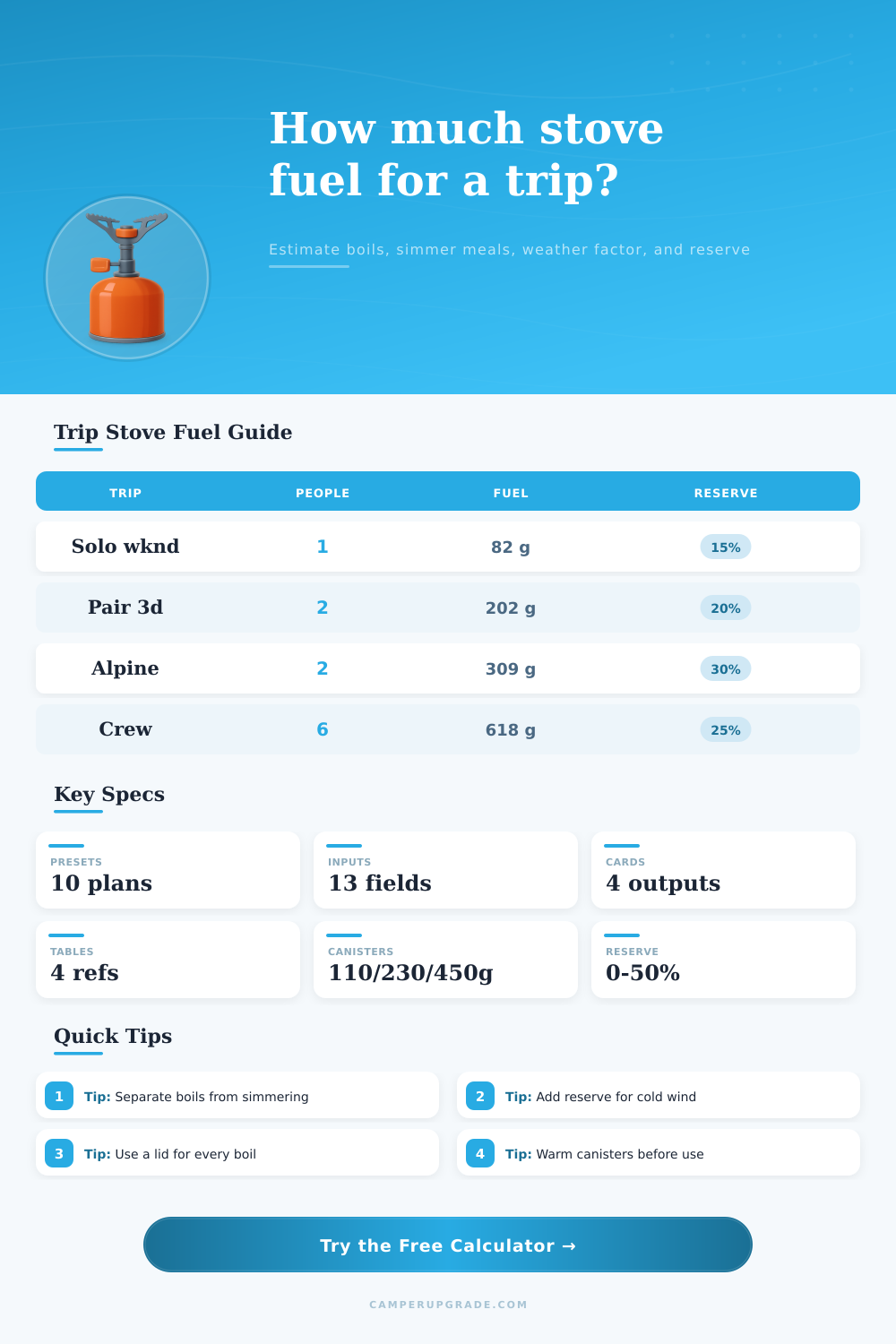
Plan stove fuel by separating water boils, simmer meals, group size, trip length, altitude, cold, wind exposure, stove efficiency, and canister reserve.
⛺Trip Fuel Presets
⚙Calculator Inputs
🧮Fuel Breakdown
📊Spec Grid
📘Reference Tables
| Cooking Style | Boils/Person/Day | Simmer | Planning Note |
|---|---|---|---|
| No-cook coffee only | 0.5-1 | 0 min | Small canister can last several days |
| Freezer-bag meals | 1.5-2.5 | 0-2 min | Most fuel goes to water boils |
| One-pot dinners | 2-3 | 6-12 min | Simmer time becomes the swing factor |
| Hot drinks all day | 3-5 | 0-4 min | Count every mug and thermos fill |
| Winter melting add-on | 4-8 | 0-10 min | Use a separate snow fuel estimate if melting all water |
| Fuel Type | Energy | Typical Efficiency | Field Note |
|---|---|---|---|
| Isobutane canister | 46 MJ/kg | 40-60% | Fast and common, weaker when cold |
| Propane | 46 MJ/kg | 42-58% | Cold capable but container weight rises |
| White gas | 44 MJ/kg | 45-62% | Strong for cold and group cooking |
| Alcohol | 27 MJ/kg | 25-40% | Quiet, slower, less efficient in wind |
| Kerosene | 43 MJ/kg | 40-55% | High energy with priming care |
| Solid tablets | 30 MJ/kg | 25-38% | Best for simple boils and backup kits |
| Condition | Factor | Why It Changes Fuel | Adjustment |
|---|---|---|---|
| Sheltered summer | 0.94-1.00x | Warm water and low losses | Use normal reserve |
| Cool shoulder season | 1.06-1.16x | Cold water and pot losses | Add 10-20% |
| Windy exposed camp | 1.20-1.40x | Flame heat misses the pot | Improve wind shelter |
| High alpine camp | 1.08-1.20x | Longer rehydration and steam loss | Simmer with a lid |
| Winter canister use | 1.25-1.55x | Pressure drops and snow handling | Carry a larger reserve |
| Canister Size | Net Fuel | Typical Use | Reserve Check |
|---|---|---|---|
| Small canister | 110 g | Solo weekend or backup | Leave 15-25 g margin |
| Medium canister | 230 g | Pair weekend to short week | Good default size |
| Large canister | 450 g | Group kitchen or basecamp | Check stove stability |
| Two small cans | 220 g | Redundancy for two stoves | Better than one nearly empty can |
| One medium plus small | 340 g | Cold or uncertain routes | Flexible reserve split |
Reference values are planning estimates. Weigh partly used canisters at home when possible and treat stove tests in your own pot setup as the best calibration.
💡Tips
When packing for a trip, people must consider the weight of the pack. The weight of the stove fuel that will be used on the trip is one of the major factor in the total weight of the pack. Packing too little stove fuel will result in meals that are too cold or not fully cooked.
Packing too much stove fuel will result in excesive weight for the pack. The weight of the stove fuel will play a vital role in the weight of the pack when the hiker lifts the pack at the trailhead. Many individuals will attempt to calculate the amount of stove fuel that they will need for the trip by making guesses about the amount of fuel necessary for boiling the water for each person on the trip.
How to Decide How Much Stove Fuel to Pack
These guesses can be inaccurate because there are a variety of factor that play into the amount of stove fuel that will be used on a trip. The initial temperature of the water that is to be boiled will impact the amount of fuel that is necessary to bring the water to a boil. The length of time that each meal simmers will impact the amount of fuel that the stove uses.
The amount of wind that blow on the campfire will impact the amount of fuel that the stove uses. Finally, the altitude at which the individual camp will impact the amount of fuel that the stove uses. Because each of these factor can change, the factor of stove fuel must be considered individually.
The calculator for the weight of stove fuel separates each of these individual factor to allow individuals to see how each factor impacts the total weight of the stove fuel. The calculator asks for the individual amount of water that will be boiled for each person on the trip. It also asks for the length of time that the flame will remain on after the water has boiled and for the amount of adjustment for the weather condition at which the trip will occur.
If individuals change the starting temperature of the water to be boiled, the total weight of the stove fuel will change immediate. If individuals change the amount of wind that is blowing on the stove flame, the total weight of the stove fuel will change immediate. Cold weather is one of the factors that is easy to ignore when calculating the amount of stove fuel that will be necessary for a trip.
Nevertheless, if the water to be boiled is initially colder than room temperature, the stove will use more stove fuel to bring that water to a boil. Furthermore, if the fuel canister is experiencing cold weather, the fuel will lose pressure out of the canister. If the fuel that is released from the canister is cooler than the fuel that is released on a warm summer evening, the flame that the stove produces will be more smaller than if it were burning hotter fuel.
To accommodate for the colder weather, individuals can increase the factor of cold weather in the calculator. Doing so will reveal to individuals the additional gram of fuel that will be necessary to ensure that each individual can finish cooking their dinner before it becomes too dark to see what is being prepared on the stove. Another of the factors that will impact the amount of stove fuel that will be used will be the amount of wind that is blowing on the stove flame.
This factor is often one that is not recognized until after the stove fuel has begun to be consume. Depending on the strength and the length of the wind on the stove flame, heat will be carried away from the sides of the pot that are exposed to the wind. If the stove fuel is heating the pot, carrying the heat away from the pot means that the stove fuel is not as efficient in boiling the water for the meal.
Using a lid on the pot can reduce the amount of heat that is lost to the outside of the pot. To be effective, though, the lid will need to be used every time that the stove fuel is on. The amount of wind in the stove can be set on the calculator to a percentage.
This percentage allows individuals to determine if they will require a windscreen around the stove or if they will need to change the location where they will set up their campsite. An additional fuel that can be included in the stove is the reserve fuel. This additional fuel is used in addition to the base amount of fuel that is calculated for each individual on the trip.
The amount of reserve fuel can be set as a percentage of the base amount of fuel that is required. If an individual is a solo fastpacker, the amount of reserve fuel will likely be low. A group of six individuals that will be on the trip will require more reserve fuel because the group will use more fuel for cooking meals.
This additional reserve fuel acts as insurance for any accident that may happen with the stove fuel that could result in the stove fuel being used beyond the calculated amount. The reference tables allow individuals to compare the stove fuel that will be used for their trip to other common examples. The reference tables include examples of the amount of fuel that will be used for different cooking style.
For instance, cooking stews will require less fuel than sautéing vegetable. Additionally, the reference tables include the amount of fuel that will be used for different sizes of fuel canisters for different length of camping trips. While individuals do not have to memorize these reference tables, they can be used to compare the scenario that each individual has create to the examples described in these tables.
The value of the calculator is that individuals can discover which factor has the most impact on the weight of the stove fuel. For instance, the length of time that the flame remains on the stove and the amount of wind that is affecting the flame have more impact on the weight of the stove fuel than the amount of water that will be boiled for the trip. If individuals understand how each of these factor can impact the weight of the stove fuel, their decisions for the amount of fuel will be based on the science of physics rather than on their trip habit.
Furthermore, if individuals understand how each of these factor can impact the weight of the stove fuel, the weight of their pack will be accurate and the meals will be prepared for each individual throughout the trip.