Stove Simmer Fuel Calculator
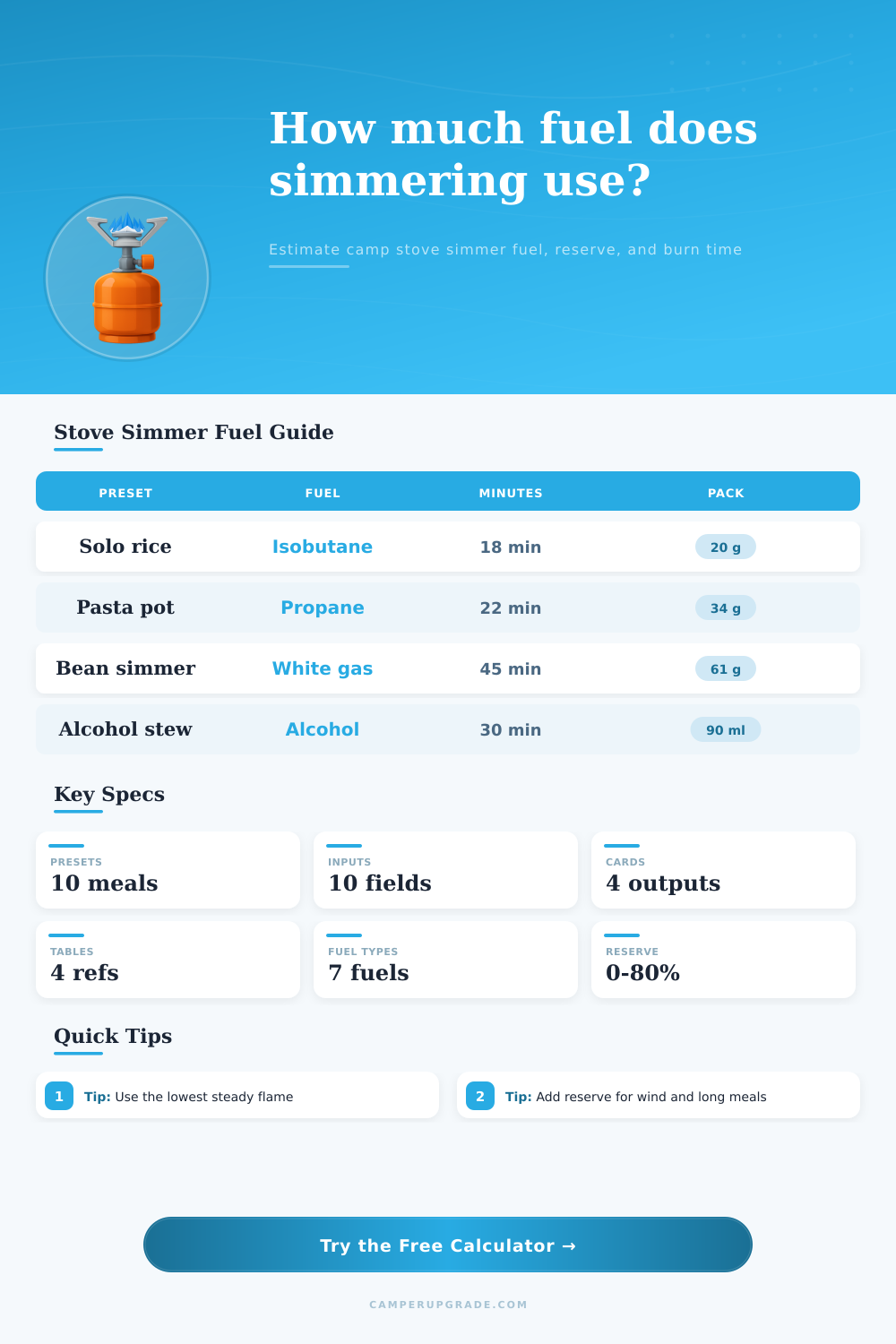
Estimate fuel for low-flame camp cooking by simmer minutes, flame level, fuel type, burner size, lid use, wind exposure, efficiency, batch count, and reserve margin.
⛺Meal Presets
⚙Calculator Inputs
📊Detailed Breakdown
🧪Spec Grid
📘Reference Tables
| Fuel Type | Energy | Density | Best Simmer Use |
|---|---|---|---|
| Isobutane canister | 46 MJ/kg | gas canister | Fast, adjustable backpacking meals |
| Propane | 46 MJ/kg | gas cylinder | Cold-friendly base camp cooking |
| White gas | 44 MJ/kg | 0.74 g/ml | Winter trips and long simmer meals |
| Alcohol | 27 MJ/kg | 0.79 g/ml | Quiet small pots, slower simmering |
| Kerosene | 43 MJ/kg | 0.81 g/ml | Expedition stoves with priming |
| Solid tablet | 30 MJ/kg | tablet mass | Short controlled heats, backup cooking |
| Flame Level | Output Share | Typical Use | Watch For |
|---|---|---|---|
| 1 to 2 | 9% to 15% | Hold warm, rice finish | Can blow out in wind |
| 3 to 4 | 22% to 30% | Gentle simmer | Good default for covered pots |
| 5 to 6 | 40% to 52% | Thick stew, wide pot | More stirring needed |
| 7 to 8 | 66% to 78% | Windy cooking, big meals | Fuel use rises quickly |
| 9 to 10 | 90% to 100% | Near boil, recovery heat | Usually too high for simmer |
| Meal | Minutes | Flame | Reserve Note |
|---|---|---|---|
| Instant rice | 12 to 18 | 2 to 3 | Small reserve if using a cozy |
| Pasta sauce | 15 to 25 | 3 to 5 | Add reserve for stirring time |
| Beans or lentils | 35 to 60 | 3 to 5 | Long cooks need a larger margin |
| Group stew | 30 to 75 | 4 to 6 | Wind and pot width matter |
| Dehydrated meal | 5 to 12 | 1 to 2 | Often better in a cozy |
| Reserve | Use When | Fuel Behavior | Practical Note |
|---|---|---|---|
| 10% | Short solo meal | Predictable canister simmer | Fair weather only |
| 20% | Normal camp cooking | Allows small timing drift | Good default |
| 30% | Cold or windy kitchen | Offsets heat loss | Use with a windscreen when safe |
| 40%+ | Long stew or winter group | Covers relights and delays | Plan a spare fuel source |
💡Simmer Tips
The calculator estimates fuel from burner rating, flame output, time, pot efficiency, lid use, wind exposure, ambient temperature, meal volume, and reserve. Real stove performance changes with regulator design, pot width, windscreen safety, canister temperature, and how often the lid is lifted.
When planning what kind of camp meal you will cook for yourself, it is important to consider an amount of fuel that will be used in the simmering of the food. Many people considers the amount of fuel that will be used to boil the water for the food, but they do not consider the fuel that will be used to maintain the simmering of the food. If you only calculate the amount of fuel that is necessary to bring the water to a boil, it is possible that you will run out of fuel prior to being able to finish the meal.
The fuel consumption of a meal can depend on several factor, including the flame level of the stove, the type of pot used in which to cook the meal, and the weather conditions at the site where the meal is prepared. The calculator included on this page will allow you to calculate the amount of fuel that will be used for simmering versus boiling your food. In order to calculate the fuel use for simmering, you will need to enter the number of minutes that you will simmer your food, the number of batches of food that you will simmer, and the flame level that you will use while simmering your food.
How to Calculate Fuel for Camp Cooking
The calculator will use these variables to calculate fuel use for simmering your food, in addition to other factors like the size of the burner on the stove, the heat retention of the pot, and the presence of a lid over the pot. Additionally, the fuel calculator will also consider whether or not there is wind at the site where the food is simmered, because the presence of wind will impact the amount of fuel that are required to simmer the food. Wind can have a major impact upon fuel consumption.
If there is wind at the site where the food is simmered, the wind will remove heat from the pot of simmering food. Depending upon the strength of the wind, this can lead to the stove burn more fuel in order to retain the heat within the pot. Additionally, cold air will remove heat from the pot of simmering food.
The cold air can have the same effect as the wind in that the stove will burn more fuel to retain the heat within the simmering pot. Finally, the volume of the food that is to be simmered can also impact fuel consumption. For instance, simmering a large pot of food will require more fuel then simmering a smaller amount of food.
Another factor to consider is the flame level at which the food will be simmered. Even a low flame level will still consume fuel if set on a camping stove. The fuel that will be consumed at a given flame level will depend upon the total output of fuel from the burner on the camping stove.
The fuel calculator will convert the flame level that you intend to use to a percentage of the total output of the burner. If you do not take into consideration the flame level that is to be used while simmering the food, it is possible that you will under-estimate the amount of fuel that will be consumed during that simmering stage. Another consideration for campers is to always include a reserve of fuel in their calculation.
A twenty percent reserve is commonly used to provide for potential unexpected change in the simmering of the food. For instance, a reserve of fuel can account for potential difficulties in the weather conditions at which they may arise during the camping trip. The fuel calculator will incorporate this reserve into the total fuel calculation for simmering food.
Once you have calculated the total fuel requirement for simmering food, you can compare that fuel to the amount of fuel that you have available to the stove. Some variables cannot be accounted for in the fuel calculator, so the camper must manage fuel. For instance, the fuel pressure of the canister of fuel can change when the temperature of the canister is cold.
The fuel pressure impact the amount of fuel that is burned by the stove. Additionally, the more often that the lid of the pot is removed from the stove in order to stir the food, the more fuel will be lost due to the cold air that escapes the pot. It is important for campers to simmer food during the first night of a camping trip to observe the amount of fuel that is consumed in order to prepare meals for camping.
Using such measurements of fuel consumption during the simmering stage will allow campers to plan the fuel use for their camping trip more accurately. Wait, I should of mentioned that some furnitures might act different than expected. Actually, the fuel pressure impact the amount of fuel that is burned by the stove.
The stove burn more fuel if the canister is cold. To be more comfortabley, you should of checked teh fuel levels before you leave. It is alot of work to manage the fuel, but the pot’s size matter too.
The stove’s performance depends on the weather, and the wind will remove heat from the pot. You’ll need to recieve plenty of fuel. Dont forget the reserve.
The fuel consumption depends on the flame level. If the wind is strong, the stove should steers towards higher fuel use. It is a moddern way to camp.
You can calculate the amount of fuel that you will need. The calculator helps you. You will find it easy.
Many people dont realize how much fuel is used. The amount of fuel depends on the stove. It’s important to be careful.
The fuel will be used by you. The food will be simmered by you. You should check the lid.
The pot will be used. The stove will be used. You will be happy with the results.
Your camping trip will be great. The fuel is necessary. The stove is important.
The wind is a factor. The weather is a factor. The pot is a factor.
The food is a factor. The flame is a factor. The fuel is key.
Use the calculator. Plan your meal. Cook your food.
Enjoy your trip. Be prepared. Stay warm.
Eat well. Happy camping.