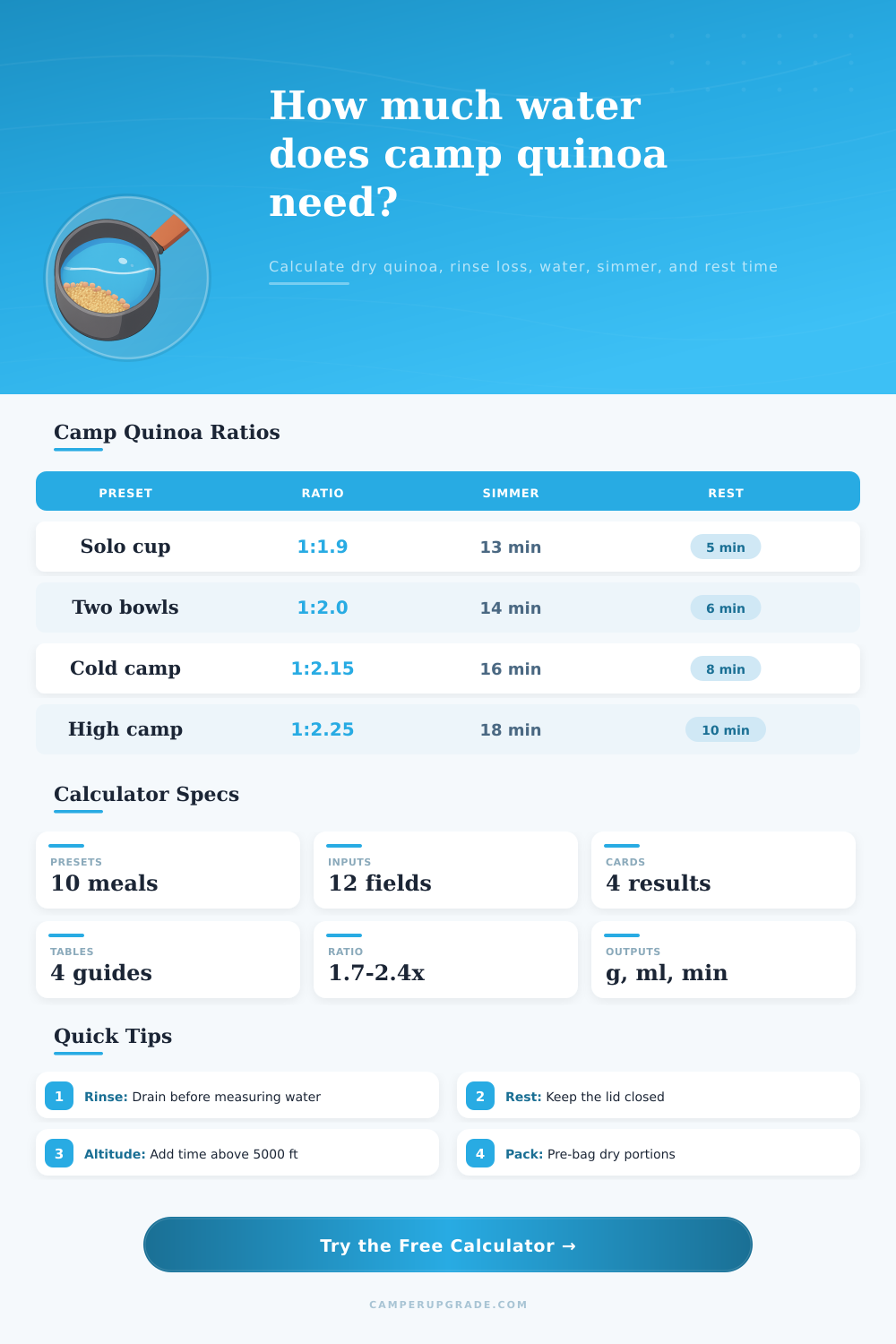
Quinoa Camp Water Ratio Calculator
Size a camp quinoa batch from real trail constraints: dry grain, rinse loss, absorption ratio, altitude, wind exposure, simmer time, covered rest, servings, and pot headroom.
⛺Camp Quinoa Presets
⚙Quinoa Cooking Inputs
Formula: edible dry quinoa = target cooked mass / cooked yield. Packed dry quinoa = edible dry / (1 - rinse loss). Total water = edible dry x adjusted ratio. Added water = total water - rinse carryover. Simmer time and rest time adjust by quinoa type, texture, altitude, and exposure.
📊Current Batch Spec Grid
📘Camp Quinoa Reference Tables
| Quinoa type | Base ratio | Simmer | Rest |
|---|---|---|---|
| White quinoa | 1:1.9 to 1:2.0 | 13 to 15 min | 5 to 7 min |
| Tri-color | 1:2.0 to 1:2.1 | 14 to 16 min | 6 to 8 min |
| Red quinoa | 1:2.05 to 1:2.15 | 15 to 17 min | 7 to 9 min |
| Black quinoa | 1:2.1 to 1:2.25 | 17 to 20 min | 8 to 10 min |
| Quinoa flakes | 1:1.6 to 1:1.8 | 2 to 4 min | 2 to 4 min |
| Dry quinoa | Low water | Normal water | Soft water |
|---|---|---|---|
| 50 g | 90 ml | 100 ml | 115 ml |
| 100 g | 180 ml | 200 ml | 230 ml |
| 150 g | 270 ml | 300 ml | 345 ml |
| 250 g | 450 ml | 500 ml | 575 ml |
| 400 g | 720 ml | 800 ml | 920 ml |
| Camp condition | Add water | Add time | Reason |
|---|---|---|---|
| Sheltered lid | 0% | 0 min | Minimal steam loss. |
| Normal stove | 4% | 1 min | Typical camp simmer. |
| Windy stove | 8% | 2 min | More heat loss. |
| Loose lid fire | 12% | 3 min | More evaporation. |
| High camp | 6-20% | 2-8 min | Lower boil temperature. |
| Meal use | Cooked serving | Dry per person | Texture |
|---|---|---|---|
| Side scoop | 90 to 120 g | 30 to 40 g | Firm or fluffy |
| Trail bowl | 170 to 220 g | 55 to 75 g | Fluffy |
| Breakfast pot | 220 to 280 g | 70 to 95 g | Soft |
| Soup add-in | 80 to 140 g | 25 to 45 g | Loose |
| Crew side | 130 to 170 g | 45 to 60 g | Fluffy |
💡Camp Cooking Tips
Quinoa is a food that can be cooked while camping for wilderness adventures. Quinoa do require preparation to ensure that the water is adjusted to the environment in which the quinoa is being prepared. Quinoa is a light food that can easly be carried in a backpack on a camping trip.
Furthermore, quinoa is a food that can easily be cooked in a single pot. However, factors like altitude, wind, and type of quinoa all play a role in adjusting the amount of water that is needed for proper cooking. If the amount of water isnt correct when preparing quinoa while camping, the quinoa may burn in the pot or become too waterily to eat.
How to Cook Quinoa While Camping
The type of quinoa that is used will impact the amount of water that is needed. For example, white quinoa is prepared faster then red or black quinoa. White quinoa also absorbs less water than red or black varieties.
Quinoa flakes absorbs water at a faster rate than whole grains of quinoa. Furthermore, the texture that is desired will play a role in the amount of water that is added to the quinoa prior to cooking. For instance, an individual may want the grains of quinoa to remain intact when added to a cold meal yet desire the same grains to have a soft texture when cooked for inclusion into a hot meal.
Thus, the texture of the quinoa affects the amount of water that should be added. Another step in the cooking process is to rinse the quinoa prior to cooking. While it is necessary to rinse the quinoa, this step may introduce some variable to the cooking process.
For example, rinsing the quinoa may result in some loss of the quinoa to the rinse water. In addition, the quinoa that has been rinsed will contain some extra water upon the grains of quinoa. This extra water adds to the weight of the quinoa that is to be transported and also uses additional fuel to heat the water that is to cook the quinoa.
Thus, the extra water that is contained in the rinsed quinoa should also be accounted for when measuring the ingredients. Using a calculator to determine how much quinoa will be lost during rinsing and how much extra water will land on the rinsed quinoa eliminate the need for guessing at the measurements of the ingredients. Factors in the camping environment, such as elevation and wind, will impact the cooking of the quinoa.
For instance, water boils at a lower temperature at higher elevations. Thus, if camping at a high elevation, the water will take more longer to cook the quinoa. Additionally, the wind will impact the heat that is transferred to the metal walls of the pot.
Thus, some fuel may be lost to the wind, requiring additional fuel to ensure that the water simmers proper. Reference tables can be used to determine the amount of water that should be added to the pot. However, individual judgment can be used to determine if the amount of wind or the elevation of the campsite require an adjustment to the amount of water.
Timing is crucial to preparing quinoa. Quinoa need time to absorb the water while resting in the pot after the heat has been removed from the stove. The water continues to simmer, allowing the quinoa to absorb the water.
This resting period occurs with the lid on the pot of quinoa. During this resting phase, the lid should not be removed. If the lid is removed from the pot, the quinoa may not fully cook.
However, if the lid is left on the pot, the ingredients will fully cook without using any additional fuel. By following these steps, an individual can ensure that the quinoa will be cooked the same way every time it is prepared for camping adventures. The amount of dry quinoa that will be used is known, the amount of water to be measured is known, and the amount of time that the stove will be used is also known.
Regardless of the elevation or the wind at the camping site, the cooking process will remain the same. Due to the consistent way that this recipe can be prepared, quinoa can be counted on as a staple food for camping adventures.