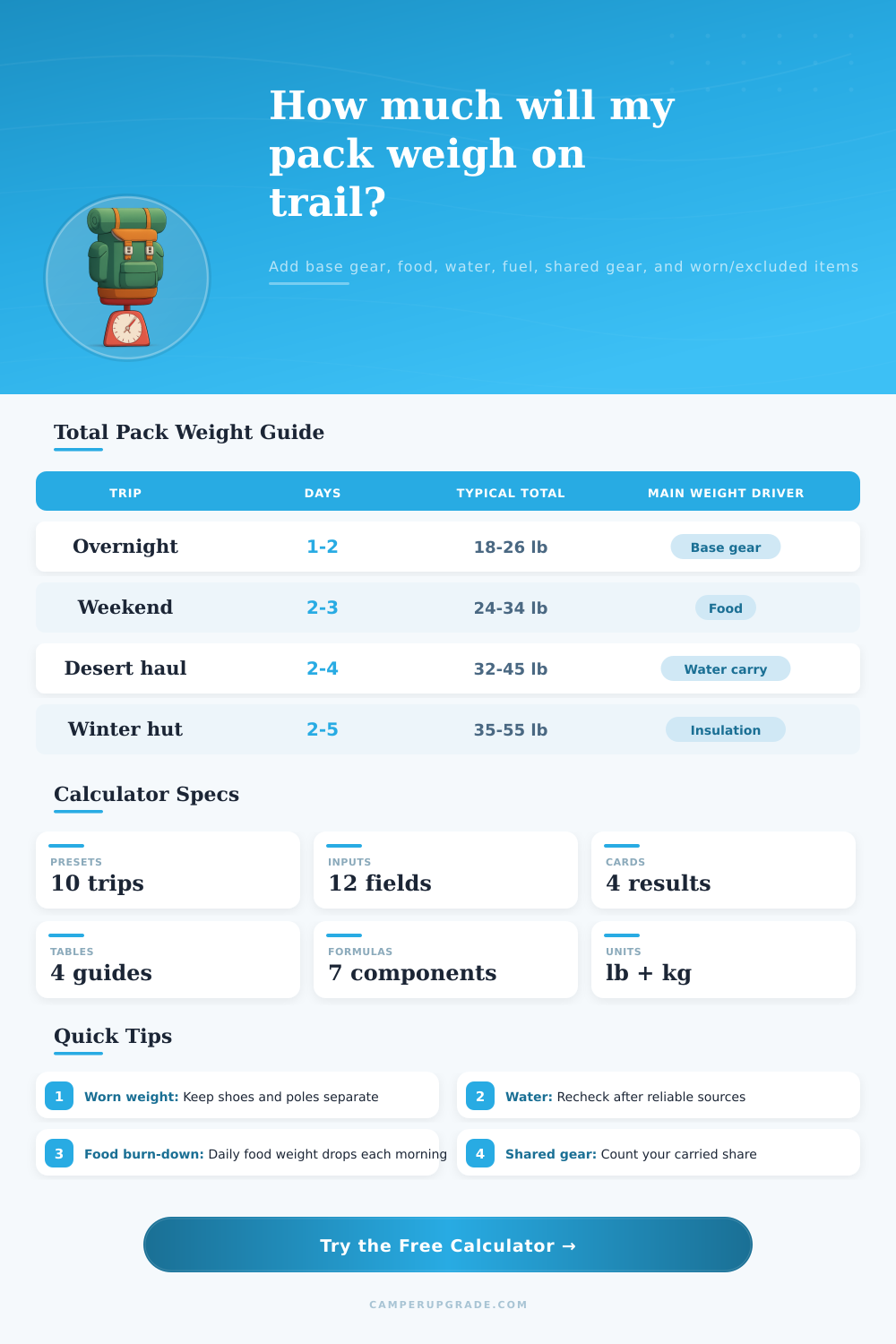
Total Pack Weight Calculator
Estimate starting trail pack weight from base gear, food, water, fuel, shared gear, body weight target, worn items, and excluded items.
🎒Real Trip Presets
⚙Pack Inputs
Formula logic: carried pack = base gear + food per day x days + extra food + water liters x 2.2046 lb + fuel per day x days + fuel container + shared gear. Worn and excluded items are reported separately so they do not inflate pack weight.
📊Pack Spec Grid
📋Breakdown and Planning Tables
| Component | Weight | Formula |
|---|---|---|
| Base gear | -- | Input |
| Food | -- | Per day x days |
| Water | -- | Liters x 2.2046 lb |
| Fuel | -- | Per day x days + container |
| Threshold | Weight | Use |
|---|---|---|
| 15% | -- | Cautious target |
| 20% | -- | Common backpacking |
| 25% | -- | Strong adult load |
| 30% | -- | Expedition ceiling |
| Trip type | Food/day | Water carry | Typical note |
|---|---|---|---|
| Summer weekend | 1.5-2.0 lb | 1.5-3 L | Water source spacing usually drives swings. |
| Long section hike | 1.7-2.3 lb | 1-4 L | Resupply spacing changes starting pack fast. |
| Desert or ridge route | 1.7-2.4 lb | 4-8 L | Water dominates the first climb. |
| Winter approach | 2.0-2.8 lb | 1-3 L | Fuel, insulation, and safety gear climb together. |
| Exclude type | Count in pack? | Examples |
|---|---|---|
| Worn weight | No | Shoes, worn layers, hat, watch. |
| In-hand items | No | Trekking poles carried in hand. |
| Shared gear share | Yes | Only the portion actually in your pack. |
| Cached or vehicle gear | No | Trailhead box, car kit, partner-carried items. |
💡Total Pack Weight Tips
Total pack weight refer to the total amount of weight that a person will be carry on their back on a trip. The total pack weight will determine how dificult the walking will be for the person that is traveling with the pack. In order to calculate the total pack weight, the calculator will enter all of the gears, food, water, and fuel weights, and the calculator will perform the mathematical calculations to determine the total pack weight that a person will be carrying on their trip.
Base gear include items such as shelter, sleep systems, clothing, and camping supplies. Base gear is important because it will not lose weight during the hike. Therefore, the weight of the base gear will remain the same from the beginning to the end of the trek.
How to Use a Pack Weight Calculator
The calculator display this information in a separate category in order to allow individuals to view the impact that the weight of the base gear will have upon the total pack weight. Food and water will change in weight during the trip due to the consumption of these items by the backpackers. As a result, the number of days that a person will be traveling, as well as the amount of food and water that will be consume each day, must be entered into the calculator.
The length of the trip will impact the total weight, as the longer that the individual will be on the hike, the more weight that will be create by the consumption of food and water. For instance, if an individual is on a five-day trip and consumes 2 liters of water per day, there will be 10 liters of water that will be consumed during that trip. Furthermore, the calculator will also automatically include the buffer food that may be need for delays in the trek.
The calculator will also display the weight of the pack on day two of the trip. The weight of the pack on day two will be less than the total weight of the trip due to the consumption of food and water. Therefore, the weight of the pack on day two can be considered a more realistic measurement of the weight that will be experienced during the trek.
Shared gear is gear that multiple individuals will share on the trip, such as a tent that three people will share for example. The weight of shared gear is to be calculate only according to the portion of the gear that will be within an individual pack, as others on the trip will share the gear. Worn items, such as shoes, clothing, or trekking poles, will not be within the pack.
However, the calculator will record the weight of these items separately from the items that are within the individual pack. The pack percent is a figure that compare the total weight of the individual pack to their body weight. Many backpackers aim for a percent of 20%, but some may aim for 25% for instance.
The calculator will indicate how close the individual is to their target percent. If the total weight of the individual pack is heavy at the start of the trip, it will remain heavy throughout the trip. Fuel will add to the total weight of the individual pack.
Furthermore, the calculator will track the fuel weight separately, as the fuel canister does have weight even when it is not filled with fuel. If the trip is to be conduct when it is cold outside, the weight of fuel will increase the total weight of the trip. This is due to the fact that more fuel will be require to melt the snow.
Based off the results of the calculator, the individual can determine which category of item may best be changed. For instance, an individual may decide that they would like to change to a lighter shelter, or they may wish to consume less water if water is available on the trip. While the calculator does not make such a decision for the individual, it will provide information regarding these potential changes.
The weight of the pack will be different at the beginning of the trip than it will be at the end of the trip. The weight of the individual pack will be less on day two of the trek than it was on day one, since the food and fuel have been consume. However, the individual should of plan the number of days that they will be on the trip according to the weight of the pack at the beginning of the trip.
This is because the weight of the pack at the beginning of the trip is the heaviest that the individual will experience during the trek.