Group Gear Split Calculator
Split shared camping gear by trip style, group size, body weight, personal pack weight, target pack percent, fairness mode, consumables, and bulky item allocation.
🎒Real Group and Trip Presets
⚙Group, Body Weight, Pack Percent, and Shared Gear Inputs
Formula logic: shared load = hard gear + daily shared consumables x trip days. Fairness mode creates target shares, then item allocation assigns bulky categories to Carrier A, Carrier B, and the middle group while tracking final pack percent.
📊Split Spec Grid
📋Allocation and Reference Tables
| Carrier | Shared share | Final pack | Pack percent |
|---|---|---|---|
| Carrier A | -- | -- | -- |
| Middle carrier avg | -- | -- | -- |
| Carrier B | -- | -- | -- |
| Item group | Weight | Primary assignment | Why |
|---|---|---|---|
| Shelter | -- | -- | -- |
| Kitchen | -- | -- | -- |
| Safety | -- | -- | -- |
| Preset | Group | Typical shared gear | Split note |
|---|---|---|---|
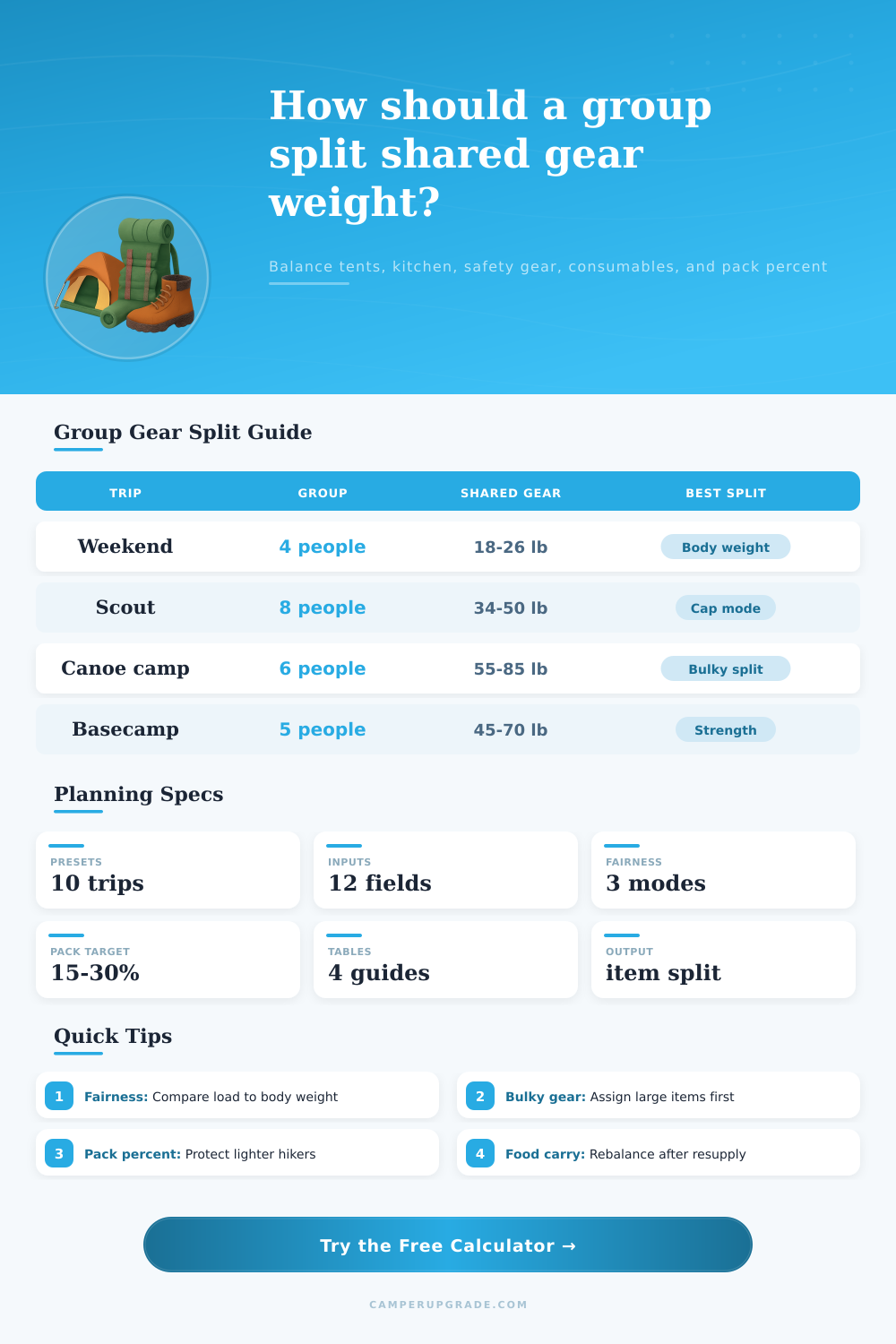
| Weekend backpack | 3-5 | 18-32 lb | Body-weight split keeps tents and cook kit fair. |
| Scout patrol | 6-10 | 34-55 lb | Use capacity mode and cap youth pack percent. |
| Canoe camp | 4-8 | 55-95 lb | Weight matters less than bulky item placement. |
| Winter hut | 4-8 | 45-85 lb | Safety and insulation gear should be distributed redundantly. |
| Pack percent | Trip use | Planning note |
|---|---|---|
| 15% | Youth, injury return, cautious trips | Keep shared gear very light or move it to stronger adults. |
| 18-20% | Comfortable backpacking target | Good default for mixed groups with varied fitness. |
| 25% | Strong adult carriers | Reasonable for short trips if terrain is not extreme. |
| 30% | Expedition ceiling | Use only with training, boots, and realistic terrain assumptions. |
💡Gear Split Tips
Distributing the shared gear to each person correctly is an important part of planning a group trip. The way that the shared gear is distributed to each group member will determine the way that each group member experiences teh trip. If one person carry a larger amount of shared gear than another person in the group, then that one person will experience more physical strain than the other members of the group.
If the person experiences more physical strain than the other members of the group, then that person may experience fatigue and even frustration due to that physical strain. Such negative emotion can impact the overall mood of the entire group. Many groups attempt to distribute shared gear to each group member in a way that is considered fair for each individual in the group.
How to Share Gear Fairly on a Group Trip
However, most groups do not account for the body weight of each individual in the group when distributing the shared gear. Many groups attempt to use an equal method of distributing the shared gear to each member. Many believe the equal method of distribution of shared gear is fair for each member of the group.
However, the equal method may not be fair for each individual if each individual has a different body weight; a lighter individual will feel the same number of pounds differently than a heavier individual in the group. For example, an individual that weighs 130 pounds will feel the same number of pounds more differently than an individual that weighs 190 pounds. For example, a few extra pound may be a large percentage of the total weight of the 130-pound individual’s pack, but may be a small percentage of the total weight of the 190-pound individual’s pack.
A calculator can be used to determine a better method of distributing the shared gear based off the body weights of the individuals in the group and the weights of the gear that each individual will carry on the trip. There are various modes for distributing the shared gear to each individual in the group, and each mode will create different result for each individual. One mode for distributing the shared gear is body-weight based weighting.
With this mode, individuals with higher body weights will have to carry more shared gear than individuals with lower body weights. Another mode is known as the capacity mode. With this mode, each individual will have to carry shared gear based upon how much remaining room is in their individual pack.
A third mode is the equal mode. With this mode, each individual will receive an equal portion of the shared gear, regardless of body weight or amount of gear that each individual already has for the trip. A gap can be created between the percentage of the shared gear that each individual is to carry; a gap between the highest and lowest percentage indicates whether or not the shared gear is balance among the individuals in the group.
The length of the trip can also impact the way that shared gear is distributed to each individual in the group. Shared consumable items include items like food, fuel, and water treatment gear. The shared gear for these consumable items increases in weight in relation to the number of days that the group will be on the trip.
Thus, the longer the trip, the more shared food and fuel will be required. While shared gear can be distributed for a short trip without any major problems, the long trip will highlight the problems that may result from the distribution of shared gear that is currently distributed to each individual in the group. Thus, the group can enter the number of days for which they will be on the trip into a calculator to determine the growing weight of the shared consumable gear.
The specific items that will be shared among the group is also important. Item assignment is just as important as determining the total weight of the shared gear. Items that are difficult to divide may place a large amount of weight upon only one individual.
For instance, it may not be possible to evenly divide the weight of a four-person tent. Therefore, the group may need to give that four-person tent to the individual who has the most weight or the most available space within their pack. These specific items may also be divided into parts that can be distributed to each individual.
A reference table can help to indicate which items should be distributed to which individual in the group. The shared gear will change in weight during the trip. Each group member will consume the shared food and shared fuel during the trip.
Thus, the total weight of the shared gear will decrease during the trip. The gear may be balanced when it is distributed on the first day of the trip, but may no longer be distributed in a balanced manner by the third day of the trip. If the group members receive a resupply of shared food or fuel, the group can run the calculator again to redistribute the shared gear to the group members to reflect the changed weight of the shared consumable gear.
To ensure that the shared gear is distributed in a successful manner to each individual in the group, there are some steps that should of been taken. The numbers should be run with the gear that will be shared among the group. Large and bulkiest items should be distributed among the group members prior to the group begins to pack their gear.
If the gap between the highest percentage of shared gear that must be carried by each individual and the lowest percentage is less than three percent, the shared gear may be distributed in a sufficient manner to each individual. If any individual has a higher percentage of the shared gear than others in the group, a person may move a dense item to another individual in the group. Overall, the goal is to make sure that each individual in the group begins to experience the same level of effort in carrying the shared gear; this will ensure that all members of the group are able to travel on the trip together.
There is alot of furnitures to consider when planning the trip. Its important to recieve the gear early. Youre going to want to check your gear before you leave.
One person should of checked the weights. You cant leave the gear behind. The group shouldnt forget the weight.
The group’s plan is moddern and actualy works. They’re weights are different than mine. The group will needs to be careful.
This is more better than before. The individual dont know the weight. A armchair is not needed for hiking.
The group will travels together.