Trip Itinerary Daily Mileage Calculator
Estimate the daily distance your itinerary needs after rest days, elevation gain, terrain, surface, pack load, resupply stops, camp chores, and planning buffer are counted.
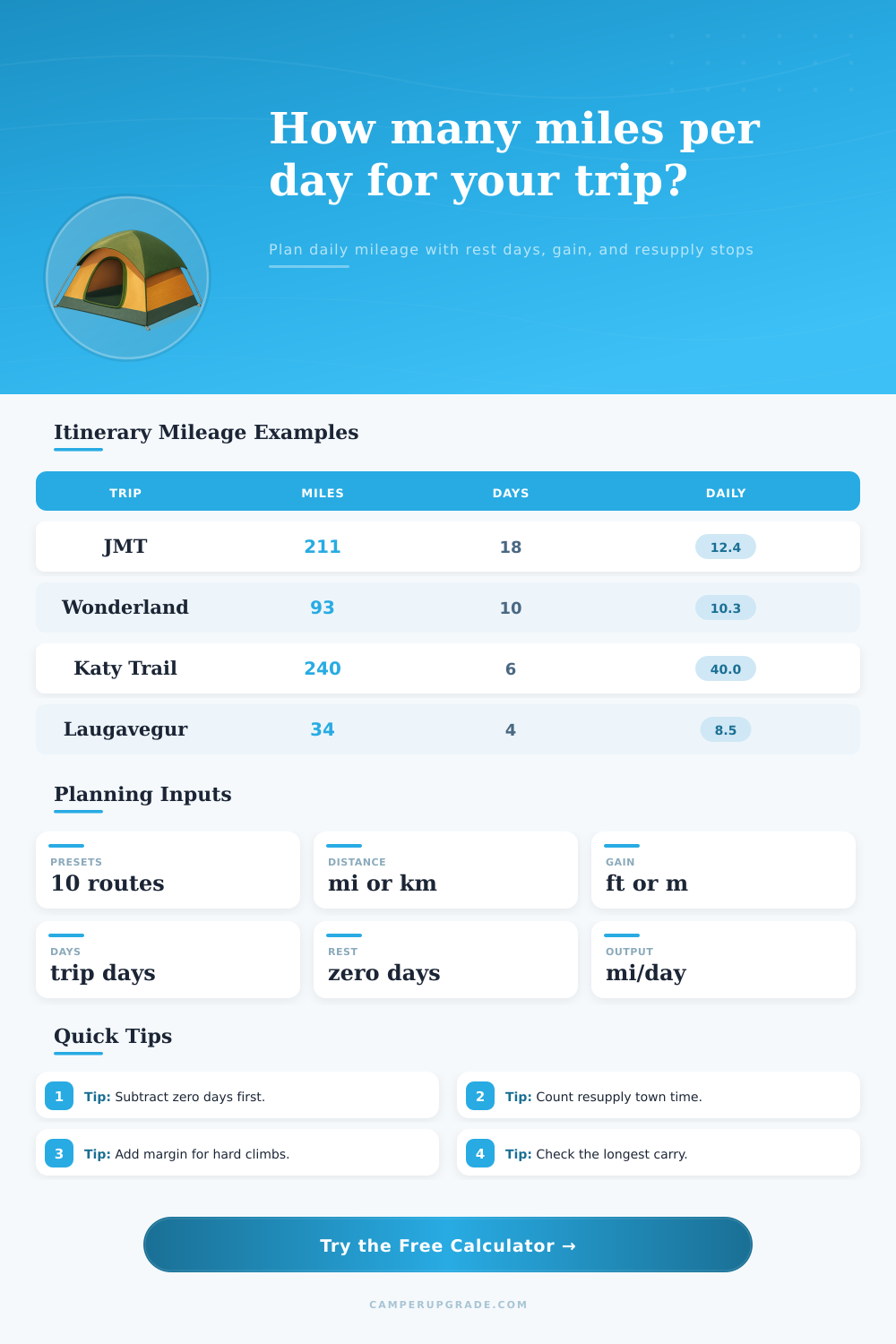
| Preset itinerary | Distance | Days | Typical plan note |
|---|---|---|---|
| John Muir Trail | 211 mi | 17-22 | Big gain, permit camps, high passes |
| Wonderland Trail | 93 mi | 8-12 | Steep rolling profile around Rainier |
| Laugavegur Trek | 34 mi | 3-5 | Short distance, weather-sensitive days |
| Katy Trail ride | 240 mi | 5-7 | Rail trail mileage with town stops |
| C&O Towpath ride | 184.5 mi | 4-6 | Flat but surface can be slow after rain |
| Trip style | Daily miles | Daily km | Planning signal |
|---|---|---|---|
| Beginner backpacking | 6-9 | 10-14 | Shorter days, more camp time |
| Steady backpacking | 10-14 | 16-23 | Common fit hiker range |
| Long trail push | 15-22 | 24-35 | Longer days and tighter recovery |
| Loaded bikepacking | 35-65 | 56-105 | Depends heavily on surface |
| Path touring | 45-80 | 72-129 | Town stops drive schedule risk |
| Elevation profile | Gain per day | Effort add | Use when |
|---|---|---|---|
| Lowland path | 0-800 ft | Small | Rail trails, towpaths, coastal routes |
| Rolling trail | 800-2000 ft | Moderate | Most forest and foothill itineraries |
| Mountain route | 2000-3500 ft | High | Passes, ridges, steep camps |
| Rugged alpine | 3500+ ft | Very high | Talus, snow, route finding, thin air |
| Resupply pattern | Leg length | Load effect | Schedule note |
|---|---|---|---|
| Daily towns | 10-20 mi | Light | Time stops can exceed load savings |
| Two to three days | 25-45 mi | Moderate | Common weekend backpacking pattern |
| Four to six days | 45-90 mi | Heavy | Food weight affects early mileage |
| Remote carry | 90+ mi | Very heavy | Plan easier days after pickup |
Planning a trip requires you to determine how much distance you will travels each day on your trip. Determining how much distance you will travel each day requires you to consider a variety of factor that may make your trip more difficult or more comfort. You cant simply divide the total distance that you will travel by the total number of days that you will be on your trip; instead, a variety of factors will make that equation more difficult to calculate.
Factors that may impact the difficulty of your trip include elevation gain, terrain, pack weights, and the need for resupply stops. Each of these factors will help to determine if your trip schedule is comfort or if your trip schedule may be too exhausting to complete as a backpacker. One of the factor that many individuals dont consider when planning a trip is the impact that the elevation gain along a route will have upon the time that it takes to travel a certain distance.
How to Plan Your Daily Distance
A flat distance of ten miles may be easy for an individual to walk, but a route of ten miles with three thousand feet of elevation gain will take an individual more time to travel and will leave an individual feeling more tired after the trip. The calculator will perform the math for you regarding the impact of elevation gain, and will provide you with a distance calculation that allows you to see how many miles you can travel each day (after calculating for elevation gain). In addition to elevation gain, you must also consider the inclusion of rest day and resupply stops into your planning trip.
These days will reduce the number of days that you are able to travel to the total number of days for your trip. For instance, if you plan on being on a trip for ten days, but you include two days for rest and resupply, you will only have eight days to travel the total distance of your trip. Therefore, your daily distance that you calculate must be higher for these travel days then your distance for a ten-day trip without any rest day.
This calculation can also be made within the calculator. Other factors that may influence the distance and difficulty of your trip are the terrain for which you will be traveling, the surface of that terrain, and the distance that you will travel with your pack. Each of these factors will impact your speed while on the trip.
For example, if there are rocky or muddy area along your trip, your speed will decrease compared to an area that is well-graded and features little in the way of difficulties in traveling long distance. If your pack is heavy, your speed will also decrease with the additional distance that you have to travel each mile. The calculator will automatically account for these factors.
An additional factor to consider is the longest distance that you will carry your pack. While the average distance that you may travel each day may seem good for your trip plan, there may be one specific section of the trip that will be much longer than the miles that you travel on average each day. This section may require you to travel at a faster pace, or it may create issue for your resupply plan for the trip.
By calculating the longest carry for your trip, you can ensure that the distance for each day will allow for you to complete the longest carry, and that you will not have any issue or difficulties during the planning of your trip. Many individuals that are just beginning to backpack will plan for their best days for their trip, instead of planning for their average days. For instance, when beginning backpackers plan for a trip, they may want to plan for days with perfect weather and their best physical strength.
However, inclement weather and fatigue will make the trip last longer than the trip that they had planned. Therefore, it is recommended for beginning backpackers to include a buffer for these variable. The reference tables located on this page show the distance for different types of trips, such as backpacking, long trail pushes, and bikepacking.
These tables provide a range for individuals to understand how the distance may change with the type of trip that they are planning. These tables are not rules for each individual trip that you plan, but they may help to show you if your figures for the trip are within a workable range. If your distance that you plan to travel each day falls outside of the workable range for that type of trip, you may be asking too much of your body each day for that trip.
Once you have established how many miles you will travel each day, you can begin to plan the remainder of your trip. For instance, you may be able to calculate your start times for the day, you may be able to move resupply stops to ensure that you have the proper amount of supply for your longest carries, and you may be able to plan your rest days better with the knowledge of your schedule. The goal for planning your trip is not to plan for you to travel to a certain number of miles each day.
Instead, the goal is for the route that you plan for yourself to be more difficult than you may expect for the trip. You should plan your trip for yourself to travel at a pace that is slower than the distance that you may hope for. By planning for this slower distance, time, and effort for each day, your trip will be more likely to work according to the daylight hours that is available for each day.