Knot Rope Length Calculator
Estimate how much rope to cut when knots, bends, hitches, loops, rope diameter, tail length, knot count, and safety margin all take up usable length.
| Knot preset | Take-up factor | Tail bias | Common camping use |
|---|---|---|---|
| Bowline | 12x diameter | Moderate | Fixed loop for tarp corners, dock lines, and gear loops |
| Figure-eight loop | 15x diameter | Moderate | Bulkier fixed loop that is easier to inspect |
| Trucker's hitch | 18x diameter | Long | Tensioning tarp ridgelines, loads, and camp lines |
| Taut-line hitch | 13x diameter | Long | Adjustable guyline tensioner on tents and tarps |
| Clove hitch | 8x diameter | Moderate | Fast tie-off around posts, poles, and rails |
| Knot preset | Take-up factor | Tail bias | Common camping use |
|---|---|---|---|
| Sheet bend | 11x diameter | Long | Joining two ropes when diameters are close enough |
| Double fisherman's | 26x diameter | Long | Joining cord ends into a loop or backup knot pair |
| Prusik hitch | 22x diameter | Long | Friction loop around a larger line, non-life-safety only here |
| Alpine butterfly | 16x diameter | Moderate | Mid-line loop for hanging or isolating a section |
| Square knot | 10x diameter | Long | Light lashing and bundle ties, not critical loads |
| Rope behavior | Multiplier | Tail guidance | Planning note |
|---|---|---|---|
| Static accessory cord | 1.00x | Baseline | Predictable hand-tight knots |
| Paracord or soft cord | 1.06x | Add a little | Compresses and buries into tight knots |
| Slick polypropylene | 1.03x | Add more | Low grip means longer tails are useful |
| Nylon rope | 1.08x | Baseline plus margin | Stretch and wet loading can change final length |
| HMPE or Dyneema | 1.02x | Very long | Slippery fibers need conservative tails |
| Rope diameter | 12x knot | 18x knot | 26x knot |
|---|---|---|---|
| 3 mm cord | 36 mm | 54 mm | 78 mm |
| 5 mm cord | 60 mm | 90 mm | 130 mm |
| 8 mm rope | 96 mm | 144 mm | 208 mm |
| 10 mm rope | 120 mm | 180 mm | 260 mm |
| 12 mm rope | 144 mm | 216 mm | 312 mm |
Calculating the correct length for the rope that will be used in a project is an necessary step in the process. If the length of the rope is incorrect, the rope will be too short once the knots are tie. Many people who calculates the length of rope that is required for a project only measure the spans that is required for the project.
However, this dont account for the length of rope that the knots that will be tied into the rope will consume. Every knot that is tied into the rope will consume some of the length of the rope. For example, a bowline knot will consume some of the length of the rope that the knot is tied into, as will a trucker’s hitch knot, which involve multiple wraps of the rope around itself.
How to Calculate Rope Length for a Project
The length of rope that a knot consumes depend on the diameter of the rope and the material of that rope. For instance, soft rope material will compress within the knot more than slick rope materials, which will require the tail of the rope to be longer when tied to itself. The rope length calculator included on this page can help to calculate the length that the rope should be cut to.
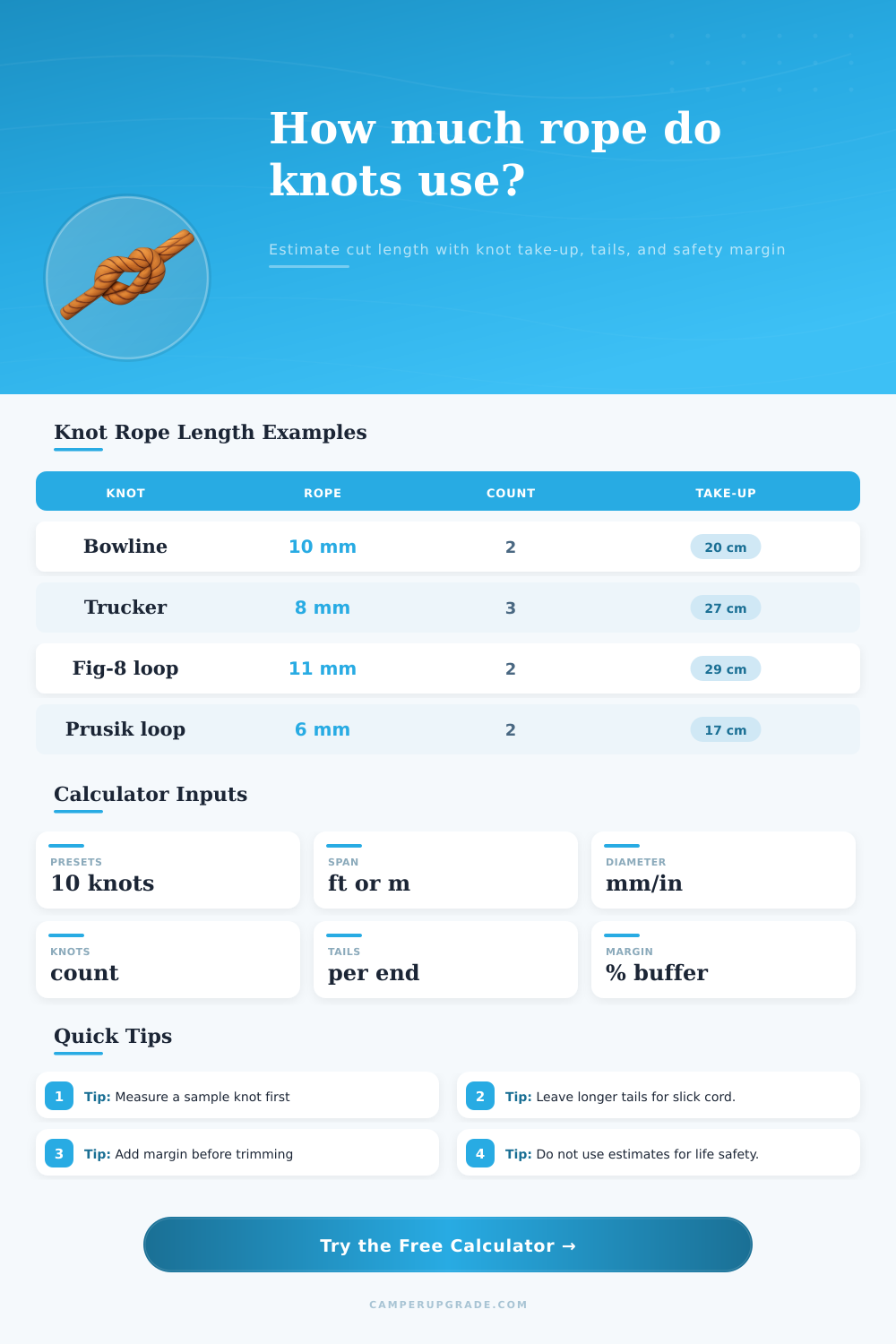
To use the calculator, enter the length of the span that is required for the project, the size of the rope, the number of knots that will be tied into the rope, and the length of the tail of the rope preferences. The calculator will output an estimated length of the rope that should be cut from the rope. There will also be a field for the margin for trimming the rope.
This field allow the length of rope to be cut to allow for errors in tie the knots or adjustments in how the rope is tied. Each of these fields can be adjusted, as the length of the rope will change with each adjustment. For example, if you change the material of the rope from slick to soft, the calculator will adjust the estimated length of the rope for the project.
Similarly, if you change the preference for the length of the tails of the rope from short to long, the calculator will adjust the length of the rope that should be cut from the rope. The length of the tails of the rope is another critical factor in determining the length of the rope that will be required for the project. The length of the tails of the rope that is desired can be entered into the calculator to estimate the length of the rope that will be required for the project.
The tails of the rope are the lengths of rope that extend beyond the knots that are tied into the rope. Using the rope length calculator, it is also possible to test out various lengths of the tails of the rope to determine the length of the tails of the rope that will be long enough for the project. The length of the rope may change when it is used in the project.
For instance, the knots that are tied into the rope will settle into the rope if the rope gets wet or if it is under a heavy load. In these instances, the margin for trimming the rope can be used to allow for the length of the rope to be trimmed once it is under tension so that it will not be too short for the task. Twelve-percent margins are often used for rope projects, as this percentage of the total length of the rope allow for it to be trimmed after it has been tensioned.
Without a margin for trimming the rope, it is possible that the rope may become too short for the tasks that it is to be used for. The reference tables that are included on this page can help to show the differences between knots. For instance, clove hitches are compact knots that are efficient for tie-off, while double fisherman’s bends are bulky knots that is designed to hold under tension.
By examining the tables that are included on the page, it is possible to determine which knots will be best suited for the tasks that the rope is to be used for. Finally, tying a single test knot into the rope before cutting the rope to the length of the project will ensure that the length of the rope is correct for the rope that will be used in the project. By tying a test knot into the rope, it is possible to determine if the length of the tails of the rope are long enough for the project.
While the rope length calculator will allow for an estimate of the length of the rope, the test knot will allow for the length of the rope to be test on the rope that will be used in the project. The goal of the rope length estimate is to ensure that the rope is long enough to complete the task without running out of rope.