Bike Frame Size for Bikepacking Calculator
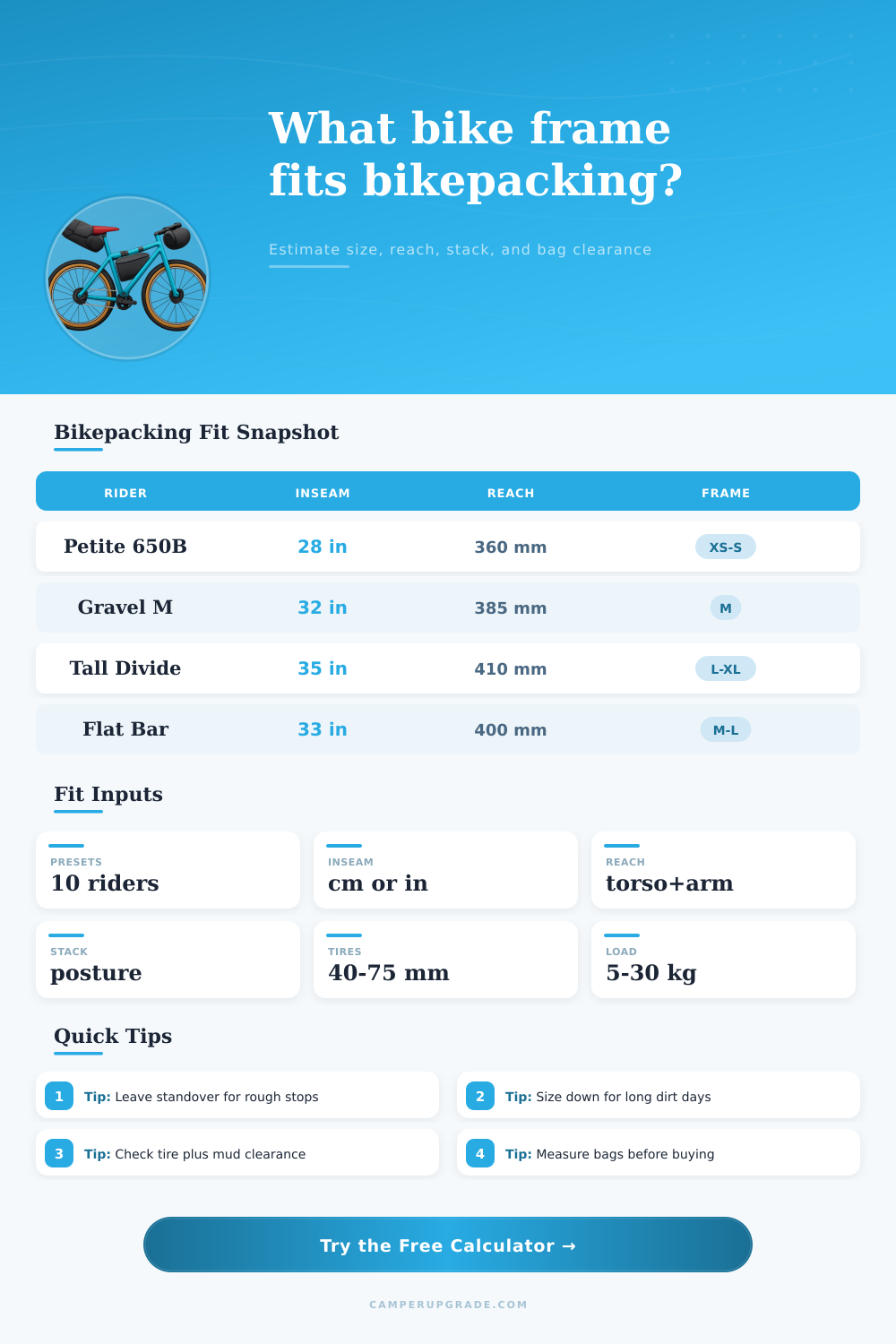
Estimate a bikepacking frame range from inseam, torso, arm length, riding posture, handlebar type, wheel size, tire width, cargo load, standover margin, and frame-bag clearance.
🚲Bikepacking Rider Presets
⚙Rider, Geometry, Tire, and Load Inputs
📐Bikepacking Fit Spec Grid
📊Frame Geometry Reference Tables
| Frame range | Seat tube | Reach | Best rider note |
|---|---|---|---|
| XS | 44-48 cm | 350-370 mm | Shorter riders, 650B common |
| S | 48-52 cm | 365-382 mm | Compact bikepacking fit |
| M | 52-55 cm | 378-395 mm | Common all-day gravel range |
| L | 55-58 cm | 392-412 mm | Taller rider, stable loaded bike |
| XL | 58-62 cm | 408-430 mm | Long rider or flat-bar setup |
| Bike type | Size formula | Reach bias | Stack bias |
|---|---|---|---|
| Gravel drop bar | inseam cm x 0.66 | baseline | all-day moderate |
| All-road touring | inseam cm x 0.67 | shorter | taller front end |
| Hardtail MTB | inseam cm x 0.57 | longer frame | high control stack |
| Flat-bar adventure | inseam cm x 0.60 | longer cockpit | neutral high stack |
| Fat bikepacking | inseam cm x 0.56 | shorter loaded | upright rough-route |
| Tire platform | Typical tire | Needed gap | Frame note |
|---|---|---|---|
| 700C gravel | 38-50 mm | 8-10 mm | Fast mixed surfaces |
| 650B gravel | 47-60 mm | 9-12 mm | Small frames, comfort load |
| 29er MTB | 55-75 mm | 10-14 mm | Rough routes and bags |
| Fat bike | 95-125 mm | 12-18 mm | Snow, sand, remote travel |
| Mud route | any width | add 4 mm | Reduce stated max tire size |
| Load style | Cargo load | Fit bias | Why it matters |
|---|---|---|---|
| Credit-card kit | 5-10 kg | normal fit | Little handling change |
| Weekend bags | 10-16 kg | shorter reach | More stable fatigue posture |
| Water haul | 16-24 kg | size down if between | Weight changes steering feel |
| Remote route | 24-30 kg | higher stack | Better control when tired |
| Winter gear | 18-30 kg | more standover | Bulky bags and awkward stops |
💡Bikepacking Fit Tips
Choosing a bicycle that will work well when you are transporting the weight of your house requires that you consider how that bicycle will function when it are loaded with that weight. Any bicycle that might be considered for loaded travel must still fit the body of the cyclist when the bags are also attach to the bicycle. Bikepacking change the requirements for a bicycle; you are no longer riding a bicycle that is empty, and you are no longer commuting on smooth roads.
Instead, you are on a bicycle that is transporting a home from one place to another, and the bicycle has to accommodate not just the body of the cyclist, but also the bicycle bag and the extra weight of that transported home. Furthermore, the bicycle has to also be able to accommodate the need to stop sudden on the loose gravel surfaces. Thus, these factors impact the choice of bicycle frame size that may be purchase for bikepacking.
How to Choose the Right Bike Size for Carrying Gear
The calculator included on this page will assist with the mathematical calculation of the proper size for your bicycle once you have input measurements into the calculator. Your measurements should include your inseam, your torso length, your arm length, the type of riding posture that you use when you ride your bicycle, your wheel size, your tire width, the weight of the cargo that you will be transporting, and the standover margin that you desire to use when riding your bicycle. Each of these measurement will have an impact on different aspects of your bicycles fit.
For instance, inseam and torso length will help to determine your frame size, while arm length will help to determine your reach. The reach will help to ensure that your handlebars will land in a position that allows your shoulders and back to remain comfortaly during long rides. Furthermore, cargo weight will impact the way that your bicycle steers, while tire width will impact the amount of mud that you have to worry about.
Finally, standover margin is a small number that will become important when you are wearing your heavy bicycle pack. For the majority of individuals, the frame size that will fit an empty gravel bicycle will not be the same frame size that works for a loaded bicycle. When the calculator is used to determine bicycle frame size for loaded bicycles, the reach for the bicycle will be decrease and the stack will be increased along with the addition of the cargo weight.
This change is made not to create a bicycle that is smaller for the individual that is to own and ride the bicycle, but rather to ensure that the handlebars and the front wheel of the bicycle remain stable when loaded with the required weight. An individual that has a long reach may experience instability when commuting for a full day with twenty pounds of weight being transport on the bicycle; the same individual would feel similarly uncomfortable with a short reach while commuting on long descents. The terrain that is to be ridden with the bicycle that is selected also has an impact upon the recommendation that is provided by the bicycle frame size calculator.
Smooth terrains will allow for the bicycle’s components to have a smaller amount of clearance around the bicycle, as well as for the rider to have a smaller standover margin. However, rough terrains or those that might be remote may require additional clearance for both the bicycle and its rider. Additional clearance is required for both rough and remote routes if the bicycle is to be dismounted, as well as if the bicycle is to allow for additional room for mud or snow on the tires.
Thus, the calculator increases the standover target and the side gap for those types of routes. These calculators are only helpful in the number of different types of trips that you may take with your bicycle if the bicycle can still maintain these clearances with the changing conditions for which your bicycle may be ridden. If you choose to measure your body prior to shopping for a bicycle model, you will find this to be beneficial.
By measuring your body, you can ensure that you are not guessing as to the size of the bicycle that you may require based off the size charts of the bicycle brand from which you wish to purchase. For instance, your inseam can be difficult to measure correctly, as you may use your shoes to take the measurement, or you may take the incorrect body contact point. Furthermore, your torso length is actualy a more important measurement than most individuals is aware of.
Your torso length will help to determine how much of the reach of your bicycle is from your torso versus your arms. Another of the body measurements that will help to determine the features of your bicycle is your shoulder width, which will impact the type of handlebars that you use, which will impact the width of your frame bag. These different features impact comfort during long rides.
The tables that are present on this page provide information regarding the typical size for the seat tube, reach, and tire capacity. These tables are not the replacement for the geometry chart that is published by the manufacturer of the bicycle. However, the tables can help to reveal if the bicycle that you are considering falls within the range of the calculator.
For instance, if a medium frame bicycle from manufacturer A has similar specifications to a large frame from manufacturer B, then these tables will allow you to compare the actual measurements of each bicycle. This comparison is important. Many individuals purchase a bicycle frame that matches their road bike measurements but finds that the geometry of the bicycle differ for bikepacking bicycles.
Finally, the actual routes that you plan to ride can include variables that may not be easily accounted for within the bicycle frame size calculator. Factors like the weather along the routes that you will take may alter the width of the tires that you use, as well as the need for hike-a-bikes may require an additional standover margin. Your luggage may also be soft, allowing for bulges that may not be accounted for in the frame calculations.
Thus, while the calculator will help to determine a range for which you can shop for a bicycle, you may need to also test the bicycles to see how well they allow for the bags that you plan to use. You can easily adjust for the additional standover or reach required by continuing to look for a different bicycle. Ultimately, you want to find a bicycle that feels like an extension of your body while you are both on the bicycle and on rough or uneven terrain.
Finding this balance in the performance of the bicycle is what separates those individuals who only use a bicycle from those who trust their bicycle to accompany them on their bicycled trips for many days.