Portage Count Time Calculator
Estimate how many loaded carries a portage needs, how far the crew actually walks, and how much time goes into walking, rests, loading, unloading, and canoe or kayak handling.
🛶Real Portage Presets
⚙Distance, Load, Speed, Rest, and Loading Inputs
Formula basis: load count = ceiling(total load / crew carry capacity), carries = ceiling(load count / paddlers), walking traversals = 2 x carries - 1, trail distance = one-way distance x traversals, then total time adds loaded walking, empty returns, rests, loading time, and buffer.
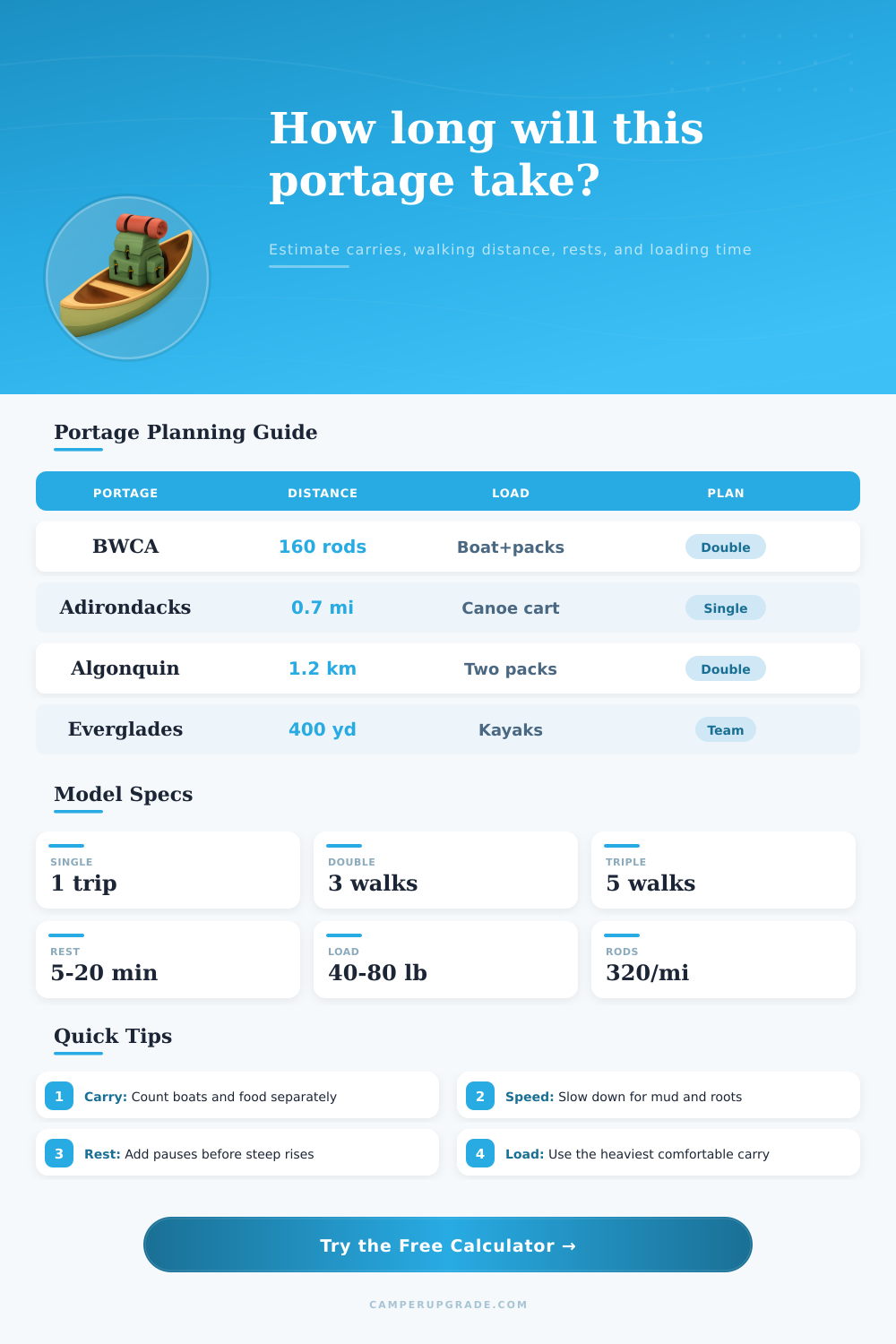
📐Portage Spec Grid
📊Portage Reference Tables
| Carry Style | Loaded Crossings | Total Walks | Meaning |
|---|---|---|---|
| Single carry | 1 | 1 | Everything moves across once |
| Double carry | 2 | 3 | Carry, return empty, carry again |
| Triple carry | 3 | 5 | Two empty returns and three loaded walks |
| Four carry | 4 | 7 | Heavy group load or multiple boats |
| Distance | Rods | Miles | Use Note |
|---|---|---|---|
| Short hop | 20-80 | 0.06-0.25 | Landing time can dominate |
| Classic carry | 100-180 | 0.31-0.56 | Load sorting matters |
| Long carry | 240-360 | 0.75-1.13 | Rest plan matters |
| Big route carry | 400+ | 1.25+ | Consider lighter loads |
| Trail Condition | Factor | Loaded Pace | Planning Cue |
|---|---|---|---|
| Smooth dry trail | 1.00x | 2.0 mph | Good yoke rhythm |
| Roots and rolling | 1.12x | 1.7 mph | Foot placement slows pace |
| Rocky or steep | 1.25x | 1.4 mph | Rest before climbs |
| Mud or wet landing | 1.38x | 1.1 mph | Extra handling time |
| Load Type | Typical Weight | Carry Count Impact | Note |
|---|---|---|---|
| Solo canoe | 35-55 lb | One person load | Yoke comfort matters |
| Tandem canoe | 45-80 lb | One heavy load | May pair with light pack |
| Food barrel | 35-70 lb | Often one load | Gets lighter each day |
| Camp pack | 40-75 lb | One load | Balance loose gear inside |
💡Two Portage Planning Tips
A portage is an process of moving equipment from one body of water to another by walking on a trail. A portage is not a single walk along the trail, but is actualy a series of walks that is required to move the gear from one body of water to the next. When planning a portage, you should consider the distance of the trail, the weight of the boats and packs, and the amount of weight that an individual can carry along a trail.
The weight that is to be moved and the distance that must be traveled are the two variable that determine the number of times that an individual must walk along the trail. The calculator help to determine the total number of trips that will be required to complete a portage. You must enter the distance of the portage, the weight of the boats, the weight of the packs, and the load size for each individual into the calculator.
How to Plan a Portage
Based off these variables, the calculator will provide the number of loaded crossing that will be required to complete the portage, the total distance that the individuals will walk during the portage, the time that will be spent on rests during the portage, and the time that will be spent loading and unloading the gear during the portage. There are a number of inefficiencies that can occur during the portaging of gear that may impact the total time required for that portage. For instance, if the portage to be made is relatively short in distance, it is possible that a large amount of time will be required if many of the groups that will perform the portage will use the same point of landing.
In the same way, if the long-distance portage to be performed is likely to occur on smooth ground, the portage may feel to occur at a relatively fastly rate. However, if the ground to be used for the portage is difficult to traverse, the long distance portage may still require a relatively large amount of time to complete. Ground that is muddy, that includes many roots, or that includes steep hills will require the individuals to spend more time walking, which will impact the total time to complete the portage.
Thus, the distance that is shown on the map is not the same than the total time that will be required for the individuals to travel the trail. The size of the groups and the total weight of the gear that they will carry will impact the total distance that the groups will travel. If the groups decide to carry lighter loads of gear along the trail, they will have to traverse the trail a greater number of times.
Thus, each individual will have to travel a greater distance for the group to successfuly portage the gear. Conversely, if each group will be carrying the gear and gear components of a relatively heavy load, there will be fewer trips along the trail than if the load were light. Thus, the total distance that each individual will walk will be less.
The calculator helps to indicate which of these two situations is preferable to a group, based upon the distance and the weight of the gear to be transported. A number of different variables may impact a groups time during the portage. For instance, if it rains during the portage, the trail may become difficultly walk.
Additionally, a tired group will likely walk at a slower rate than one that is fresh and rested. Finally, it is possible that an individual may forget an item along the shore that is to be transported to the next body of water, which may require those individuals to walk back to the shore to recieve the item. These variables may impact a groups time for the portage.
Thus, time should of been allotted for these possible variables in addition to the time that the calculator calculates. The reference tables help to indicate the way in which a portage may develop. Each of the tables help to indicate the number of walks that is required for each type of carry.
Other tables help to indicate the impact that trail conditions will have upon the rate at which the groups travels along the trail. Finally, other tables help to indicate the way that different types of loads move along the trail. While it is not necessary to memorize the information in these tables, they can help individuals to understand that additional weight or worse footing along the trail will result in an additional trip or time for the groups to travel along the trail.
By utilizing these tables and the calculator, individuals will have a clearer understanding of the portage process.