Rest Step Interval Calculator
Estimate a practical uphill rest rhythm from trail grade, pack weight, altitude, fatigue, step cadence, rest length, and stride so a steep climb turns into repeatable walking blocks.
🏔Real Climb and Pack Presets
🥾Grade, Pack, Altitude, Fatigue, and Cadence Inputs
Formula basis: grade = gain / distance x 100, pack ratio = pack / body weight, effort load = grade x pack x altitude x fatigue x cadence factors, and rest interval = base walking block divided by effort load.
📐Rest Step Spec Grid
📊Rest Step Reference Tables
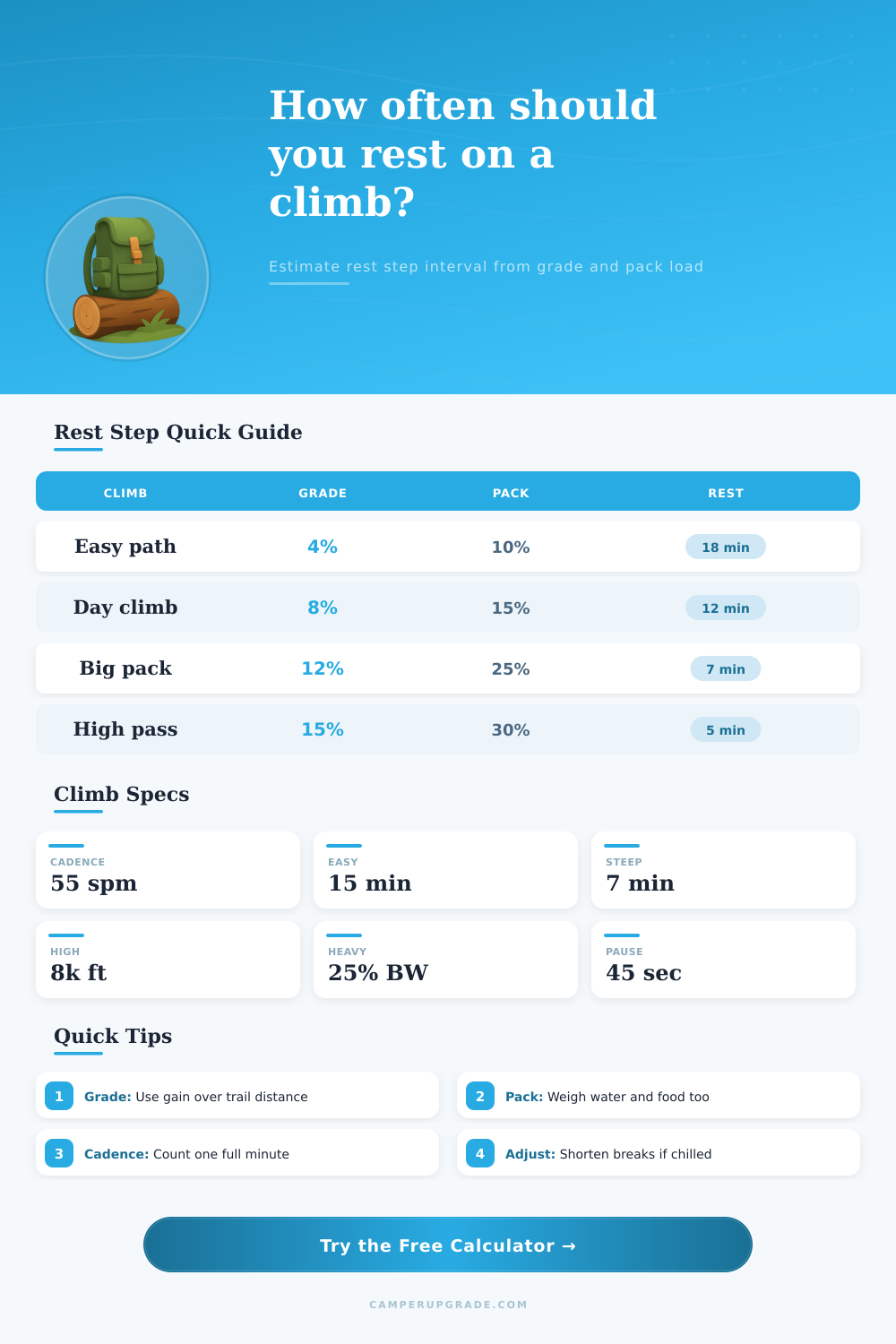
| Grade | Angle | Climb Feel | Base Interval |
|---|---|---|---|
| 0-4% | 0-2.3 deg | Rolling trail | 18-25 min |
| 5-8% | 2.9-4.6 deg | Steady uphill | 12-18 min |
| 9-13% | 5.1-7.4 deg | Steep climb | 7-12 min |
| 14%+ | 8.0 deg+ | Sustained push | 3-8 min |
| Pack Ratio | Example | Load Factor | Interval Effect |
|---|---|---|---|
| 0-10% | Light day kit | 1.00-1.09 | Small |
| 11-20% | Day hike plus | 1.10-1.18 | Noticeable |
| 21-30% | Overnight pack | 1.19-1.27 | Shorter blocks |
| 31%+ | Expedition load | 1.28+ | Frequent rests |
| Altitude | Added Factor | Fatigue 5 | Use Note |
|---|---|---|---|
| 0-5k ft | 0% | +22% | Normal pacing |
| 7k ft | +7% | +22% | Slow cadence |
| 10k ft | +18% | +22% | Short rests |
| 13k ft | +38% | +22% | Watch symptoms |
| Cadence | Steps in 5 min | Style | Rest Cue |
|---|---|---|---|
| 35 spm | 175 | Slow grind | Breath check |
| 50 spm | 250 | Rest step | Timed pause |
| 65 spm | 325 | Strong climb | Use timer |
| 80 spm | 400 | Fast push | Ease pace |
💡Two Practical Rest Step Tips
A rest step rhythm are a pattern of walking and standing break that will allow a person to move efficient up a climb. A rest step rhythm prevents a person from making stops during a climb due to fatigue. When a person is transporting a pack up a hill, a person may experience fatigue before the person realize they are tired.
A rest step rhythm will allow a person to maintain their effort as they travel upward on a climb with steep descent and with a heavy pack. A rest step rhythm will allow a person to maintain their momentum by preventing them from taking rest stops that may become too longly. Several variable will determine the requirement of a rest step rhythm for an individual.
How Rest Steps Help You Climb
The requirements will include the steepness of the trail, the weight of the pack, and the altitude of the climb. The steepness of the trail will impact the demands placed upon the leg and the lungs of an individual. The weight of the individual pack will impact the demands placed upon the body of an individual.
The altitude impact the amount of oxygen present in the air which will make movement more difficult for an individual. Fatigue will also play a crucial role in determining the requirement of an individuals rest step rhythm. Factor such as the steepness of the trail, the weight of the pack, the altitude, and the fatigue of an individual can all be accounted for in the calculator.
The calculator will produce a load score that can be used to determine the walking interval for an individual. These variables do not have a linear relationship to one another, so an individual will have to understand how each of these variable affects the other. For instance, an increase in the steepness of the trail will decrease the walking interval that an individual can take.
An increase in the weight of the individual pack will also decrease the walking interval that an individual can take. An increase in the altitude that an individual reaches will compound the effect of the steepness of the trail and the weight of the individuals pack. The fatigue that an individual experience will also have an effect upon the walking interval for that specific individual.
An individual who is experiencing fatigue will have a different walking interval than an individual who is not experiencing fatigue. An individual who is tired and climbing on flat terrain may have the same walking interval as an individual who is not tired but is descending steep terrain. A rest step rhythm will include a walking block and a standing break.
The walking block will be measured in both minutes and step. During a walking block, an individual should ensure that their legs remains warm by walking until they reach the walking block time. Following a walking block, an individual will take a standing break to allow their breathing to settle.
However, the standing break should be brief to ensure that the individual doesnt lose the warmth of their leg. Following this pattern of walking and resting, an individual will be able to continue upward on the climb. Using both walking and standing break will allow an individual to conserve their energy for the descent or for the remaining portion of their journey on the trail.
Although an individual can utilize the rest step rhythm described, the rest step rhythm is a guideline rather than a rule. External condition may require an individual to change their rest step rhythm. External conditions can include changes in the wind, changes in the terrain that an individual is on, and changes in the temperature.
For instance, if an individual comes across terrain that contain loose rocks, that individual may have to skip a standing break to avoid falling. In this case, an individual should return to their rest step rhythm once the terrain have become safe for the individual. The calculator may produce the correct time for an individual to take a rest step rhythm, however, an individual on the trail must use their judgement to determine if they should of adhere to the calculated time for a rest step rhythm.