Hiking Energy Expenditure Calculator
Estimate hiking calories from body weight, pack load, distance, gain, grade, moving pace, trail surface, and terrain intensity.
| Terrain | Base MET | Use when |
|---|---|---|
| Easy path | 4.8 | Maintained path, low grade, light footing demands |
| Rolling trail | 5.8 | Normal hiking with small climbs and dirt tread |
| Rocky mountain trail | 6.8 | Rocks, roots, steps, and frequent pace changes |
| Steep sustained climb | 7.8 | Long uphill work with few flat sections |
| Scramble or cables | 8.6 | Hands-on sections, ladders, cables, or big steps |
| Sand, snow, loose | 8.0 | Soft or sliding surface that wastes stride energy |
| Grade | Multiplier | Trail feel |
|---|---|---|
| 0-5% | 1.00 to 1.08 | Easy or rolling |
| 5-10% | 1.08 to 1.18 | Noticeable climb |
| 10-15% | 1.18 to 1.28 | Hard sustained hiking |
| 15-25% | 1.28 to 1.45 | Steep climb or rough descent |
| 25%+ | 1.45 cap | Use caution; route may include steps or scrambling |
| Pack load | Add | Planning note |
|---|---|---|
| 0-5% body weight | 0-3% | Day hike or very light kit |
| 5-12% | 3-8% | Normal day pack with water |
| 12-20% | 8-14% | Big day, camera kit, or overnight load |
| 20-30% | 14-20% | Backpacking load; slow the pace target |
| 30%+ | 20% cap | Recheck route choice and recovery margin |
| Preset hike | Distance | Gain |
|---|---|---|
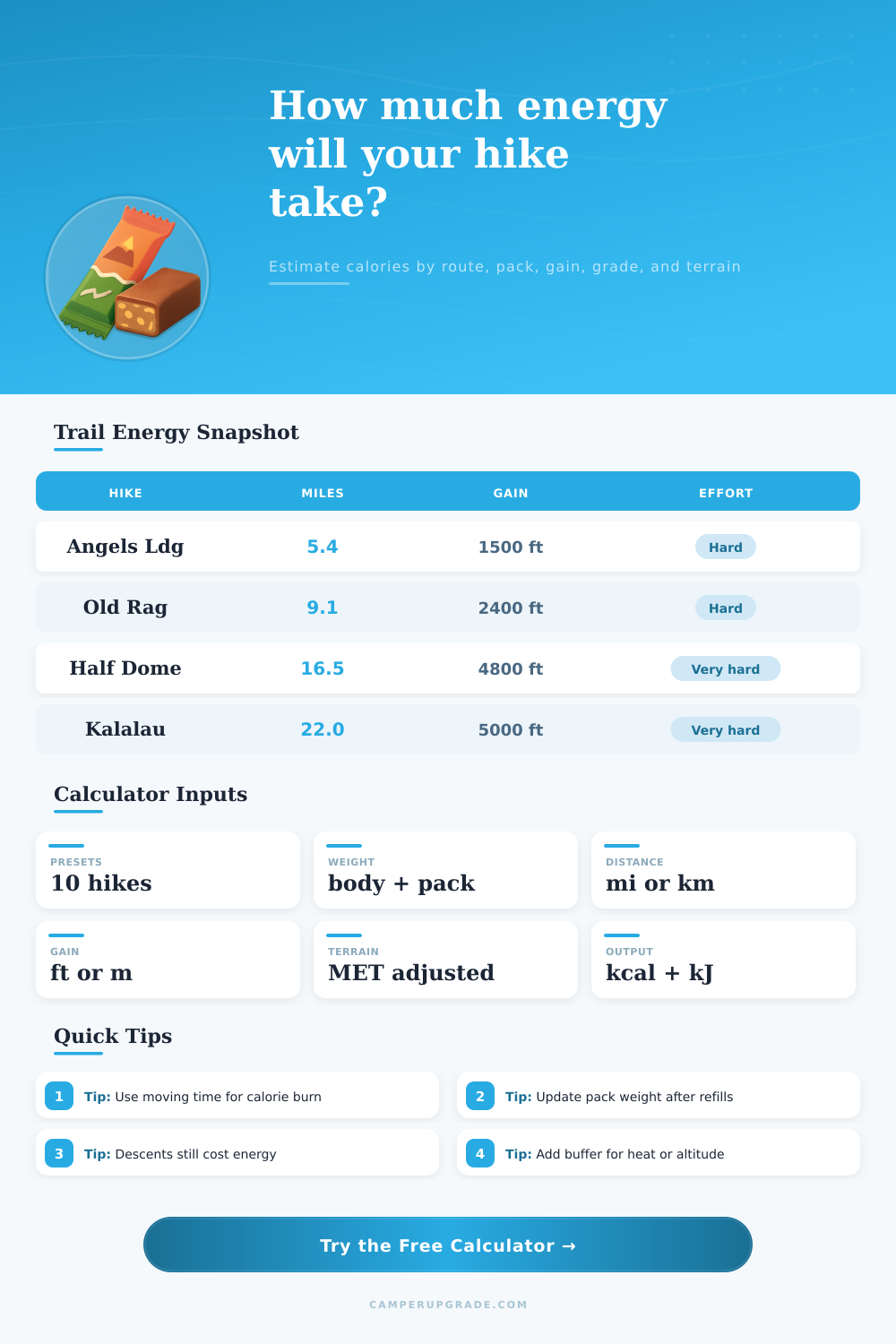
| Angels Landing | 5.4 mi | 1500 ft |
| Old Rag | 9.1 mi | 2400 ft |
| Half Dome | 16.5 mi | 4800 ft |
| Bright Angel to Indian Garden | 9.2 mi | 3060 ft |
| Franconia Ridge Loop | 8.9 mi | 3900 ft |
| Kalalau Trail out and back | 22.0 mi | 5000 ft |
Planning a hike require an estimate of the energy that is required to complete that hike. Hikes requires a specific amount of energy to complete. People often dont account for the energy requirements of a hike due to the distance of the hike.
A hike include three main factors: distance, elevation, and the weight of the individuals pack. Each of these factors play a crucial role in determining the energy that an individual will use during their hike. An estimate of the energy that will be used during the hike is required prior to beginning the hike to ensure that the individual has enough food and water for the hike.
How Much Energy You Need for a Hike
The energy that is used during a hike is dependent upon a number of factors. Body weight is one factor in energy use due to the energy that is required to move the bodys own weight. The weight of the individual pack is another factor in energy use as the additional weight increase the amount of energy that is required to move that weight.
Distance and the length of time that an individual take to hike the distance also play a role in the energy use as hiking at a fast rate will increase the metabolic rate of the individual. Finally, the elevation of the hike is a factor in the energy use of an individual as climbing hills requires more energy than walking on flat terrain. However, the descent of those hills also requires some energy to counterbalance the weight of the individual and there pack.
Terrain also play a role in the energy that is used during a hike. Terrain can range from smooth dirt path to rocky areas that require the individual to expend more energy to walk on those areas. Additionally, terrain that requires more energy to move on, such as sand or snow, will increase the energy use of an individual on that hike.
Finally, the weather is another factor in the energy use of an individual on a hike. Hot weather requires the body to use energy to move blood to the skin to release heat, while cold weather require the body to use energy to maintain core body temperature. Each of these factors will increase the rate at which an individual burns energy on a hike.
A single factor cannot determine energy use; rather, the interaction of the various factors determines energy use. Each of the factors interact with each other to create the total amount of energy that is used during the hike. For instance, an individual may complete a short hike, but if they have a heavy pack and challenging hills, they may use more energy then an individual who takes a long hike with a light pack and even terrain.
Similarly, an individual who hikes at a fast rate on smooth terrain may use more energy per hour than an individual who hikes at a slow rate on rocky terrain. Many individuals may only consider distance or elevation as the main factor for hikes. However, if an individual considers only these factors, they may not consider how each of these factor interact with each other to determine total energy use for the hike.
For instance, an individual with a modest pack who hikes in the heat may use more energy than an individual who is heavily loaded with their pack but hikes in the cool. An individual can use an energy calculator to determine the energy use for an individual on a hike. These calculators can make it easier for individuals to determine the energy that they will use on a hike and to avoid guesswork.
However, an energy calculator does not account for how an individual might feel during the hike. Factors like fitness, sleep, hydration, and the fit of an individual boots will change the amount of energy that they use during a hike. Therefore, the energy calculations are only a starting point for individuals planning a hike.
An individual should add some extra energy use to the energy calculation for factors like heat, altitude, and slow sections of the trail. Additionally, the individual should always bring more food than the energy calculation suggests; this extra food can be used in the instance that the hike uses more energy than the energy calculation estimated. Thus, planning with a buffer for energy use will ensure that an individual has enough energy to complete the hike.