Campfire Ring Clearance Calculator
Estimate campfire ring outside diameter, ember clearance, wind buffer, overhead clearance, and mineral-ground prep radius from site, fuel, slope, and nearby exposure inputs.
🔥Campfire Site Presets
🧮Ring, Fuel, Wind, and Clearance Inputs
This calculator is a planning aid. Local fire restrictions, campground rules, fire bans, wind advisories, and land-manager requirements always override a calculated result.
📏Clearance Spec Grid
📋Campfire Clearance Reference Tables
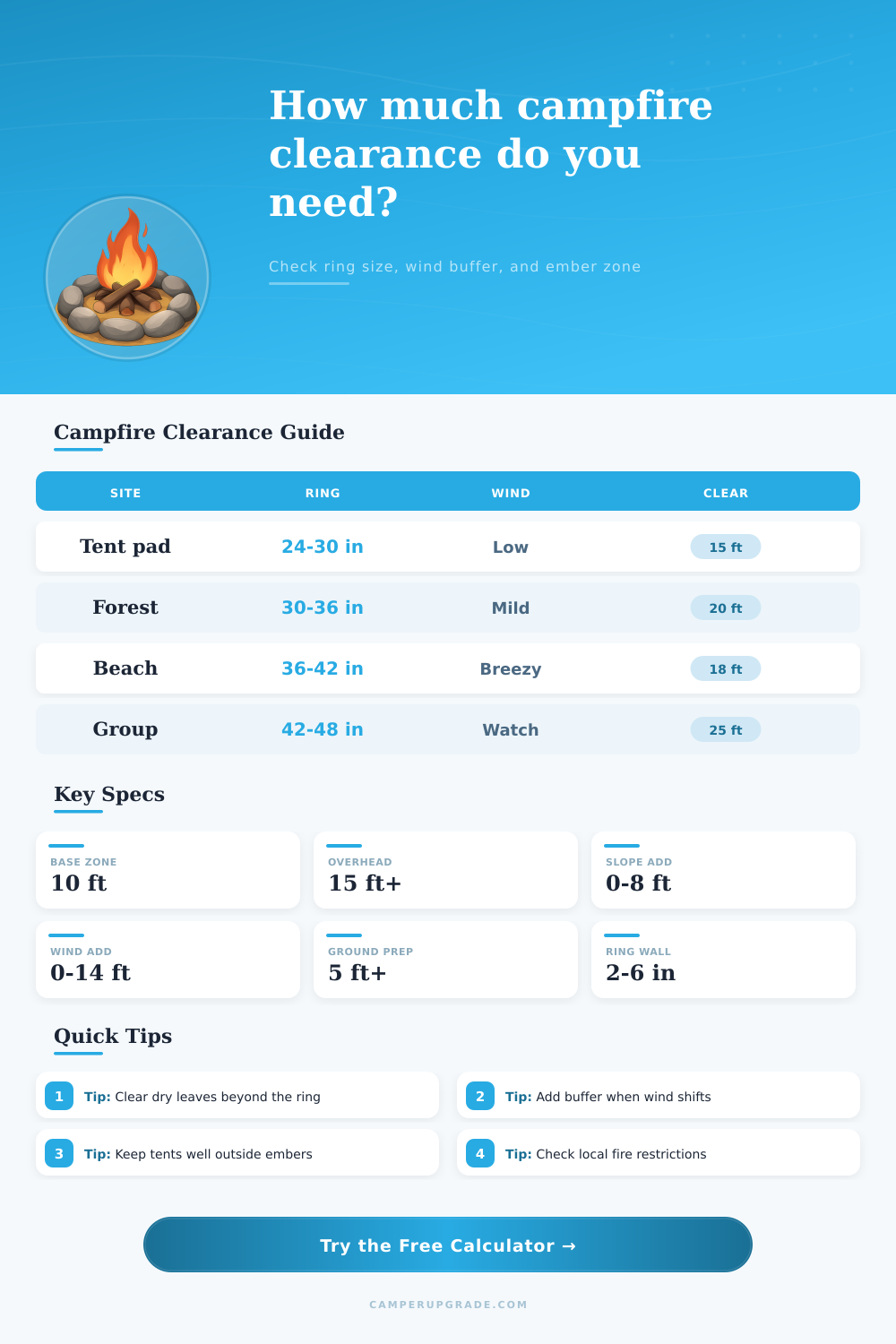
| Site preset | Typical ring | Base radius | Watch item |
|---|---|---|---|
| Forest tent pad | 24 to 30 in steel | 15 to 20 ft | Needles and low branches |
| Desert wash camp | 30 to 36 in stone | 14 to 18 ft | Wind changes and brush |
| Beach breeze ring | 36 to 42 in dug sand | 18 to 24 ft | Steady onshore wind |
| Group campsite | 42 to 48 in steel | 22 to 28 ft | Larger fuel and foot traffic |
| RV gravel pad | 28 to 36 in steel | 15 to 22 ft | Awnings and vehicles |
| Formula | Calculation | Use | Planning note |
|---|---|---|---|
| Outer diameter | inside + 2 x wall | Ring footprint | Includes stone or steel wall |
| Working fire diameter | max(outer, wood x 1.25) | Fuel fit | Allows angled firewood |
| Wind buffer | mph above 5 x exposure | Ember drift | Gusty sites add more |
| Slope buffer | grade x 0.25 ft | Rolling embers | Capped for planning clarity |
| Overhead | max(15, flame x 4) | Branch clearance | Wind adds extra height |
| Ring type | Containment factor | Ground prep | Best use |
|---|---|---|---|
| Steel campsite ring | Standard | 5 ft minimum | Established campground pads |
| Stacked stone ring | Small add | 6 ft minimum | Dispersed mineral soil |
| Concrete block ring | Standard | 5 ft minimum | Cabin and base camp sites |
| Raised fire pan | Small reduction | 4 ft minimum | Leave-no-trace style sites |
| Dug mineral pit | Small add | 6 ft minimum | Sand, gravel, or bare soil |
| Surface | Ember add | Ground add | Clear before lighting |
|---|---|---|---|
| Gravel, sand, mineral soil | 0 ft | 0 ft | Loose paper and small sticks |
| Cleared dirt with duff | 2 ft | 1 ft | Leaf litter and roots near edge |
| Short grass edge | 4 ft | 2 ft | Dry grass and seed heads |
| Dry leaves or needles | 7 ft | 3 ft | Needles, cones, bark, chips |
| Snow over mineral soil | 1 ft | 0 ft | Melted edge and hidden duff |
💡Practical Clearance Tips
Campfire clearance is the amount of empty space that you must provide around the campfire to prevent the fire from spreading into surrounding objects or areas. The correct amount of campfire clearance are difficult to determine due to various factors that can affect campfire safety. However, a campfire clearance calculator can help you to determine the proper amount of clearance to allow for your campfire.
To use this calculator, you must enter several different measurement of your potential campsite, such as the ring size, the type of surface, the wind speed, the slope of the ground, and the distances to nearby objects. By entering these measurements, the calculator can calculate the amount of space that the campfire will require to be safe. Using the calculator is helpful because you wont have to guess at these measurements.
How Much Space Do You Need for a Campfire
Instead, the calculator will utilize the formulas and requirement of campfire safety to provide you with the correct measurement. The first of the measurements required is the size of the ring. This measurement is important because it will help to determine how many piece of firewood you can use and the diameter of the fire circle.
The larger the diameter of the fire ring, the more firewood you can use without having to angle the firewood. The type of surface where the campfire will be held is another important measurement. This will determine the fires embers distance from the campsite.
For example, if the ground is gravel or mineral soil, the campfire will need to be farther from the campsite than if it were on dry leaves or needles that will easily ignite. The third measurement is the fuel load that you will use for the campfire. The amount of firewood will impact the size of the campfire and the embers that will be created.
A small fire will need less clearance than a large fire. The fourth and fifth measurements is the wind and the slope of the land. These are two factors that can impact the spread of the fire.
For example, if the wind is blowing at a higher speed than five miles per hour, the fire’s embers will be able to travel farther from the campsite. The slope of the land can also impact the fire’s embers because they will be able to roll downhill from the campfire. The final category is the overhead clearance of the campsite.
This measurement is the distance from the campfire to any overhead branches or tarps. This is an important measurement because, in addition to considering the height of the flames from the fire, you must allow space for the flames to travel farther in the presence of the wind. To calculate this measurement, the calculator will determine an overhead distance as a multiplier of the flame height and the wind speed.
The calculator will then compare this to the actual height of the lowest branch or tarp. If the result is a negative number, then the campsite isnt safe for a campfire. There are also reference tables on this page that show the difference between the various types of camping areas.
For example, the reference tables will show the difference between the requirements of a forest tent pad versus a beach ring or a group campsite. These reference tables allow you to compare your inputs to an example of a campsite of each type. The calculator also utilizes a series of formulas to calculate each of the variables.
For example, the calculator calculates the outer diameter of the fire ring as the inside diameter of the ring plus the thickness of the ring. The working diameter is calculated as the outer diameter or one and a quarter times the length of the firewood. The ember radius has a starting point that is the radius of the fire ring and the working diameter, but then also accounts for the wind, the slope of the land, the type of fuel, the type of surface, and the planning margin.
The final number is the radius that the fire will have, and that radius will determine the size of the open area that is required for the campfire. Another step that is involved in camping with a campfire is preparing the ground. To prepare the ground, you will have to clear the area of any fuel for the fire.
The calculator will determine the radius of the area of mineral soil that you will need to clear of any roots or other vegetation that may start a fire. This is a small step in the camping process, but one that is important to ensure that the fire will not spread from the roots of the trees or other vegetation that you did not see from the campsite. Another measurement that the calculator will determine is the planning score for the campsite.
This score is determined by the calculator as a score that indicates whether or not the site will be safe for a campfire. A high planning score will indicate that the campsite is safe, and a low score will indicate that the campfire may be too close to the campsite. While this score will not guarantee the safety of the fire, it does force the campground visitor to consider all of the factor involved in the safety of the campfire.
Often, the conditions of the camping area will differ from the conditions described by the calculator. For example, while the wind speed may be five miles per hour on the campsite as determined by the calculator, there may be a sudden shift in the wind that could impact the spread of the fire. In these instances, the planning margin for the campfire will provide extra clearance for these potential issue with the campsite.
The cautious and strict settings for the planning margin will require you to provide an extra planning margin if there are shifts in the wind or dry grass on the campsite. However, even with these extra margins, you will still have to monitor the campfire and have water nearby in case you must extinguish the fire. It is recommended that you use the campfire calculator prior to constructing the fire ring for the campsite.
By calculating the fire ring prior to constructing it, you will be able to make any changes to the location or the amount of fuel that will be used for the campfire. Additionally, by calculating the fire ring prior to constructing the fire ring, you can provide a record of the campfire plan in case a ranger or the campground owner asks you for information about the fire. Campfire clearance is the process of ensuring that the fire has the space that it needs while ensuring that other objects are outside of that clearance.
The calculator will help you to establish that space. Therefore, you should use the calculator to plan your campfire, but you should also use your judgment to manage the fire while camping. You should of checked the wind speed too.
It is actualy more important then most people think. It can be a dificult process, but it is worth it to avoid a luxurios disaster. Use the calculator based off the information you have.
The furnitures near the fire should be moved. You’re going to want to be carefull.