Firewood Stack Cord Fraction Calculator
Measure a stacked pile, convert it to cubic feet, full-cord fraction, face cords, ricks, and estimated thrown-load volume.
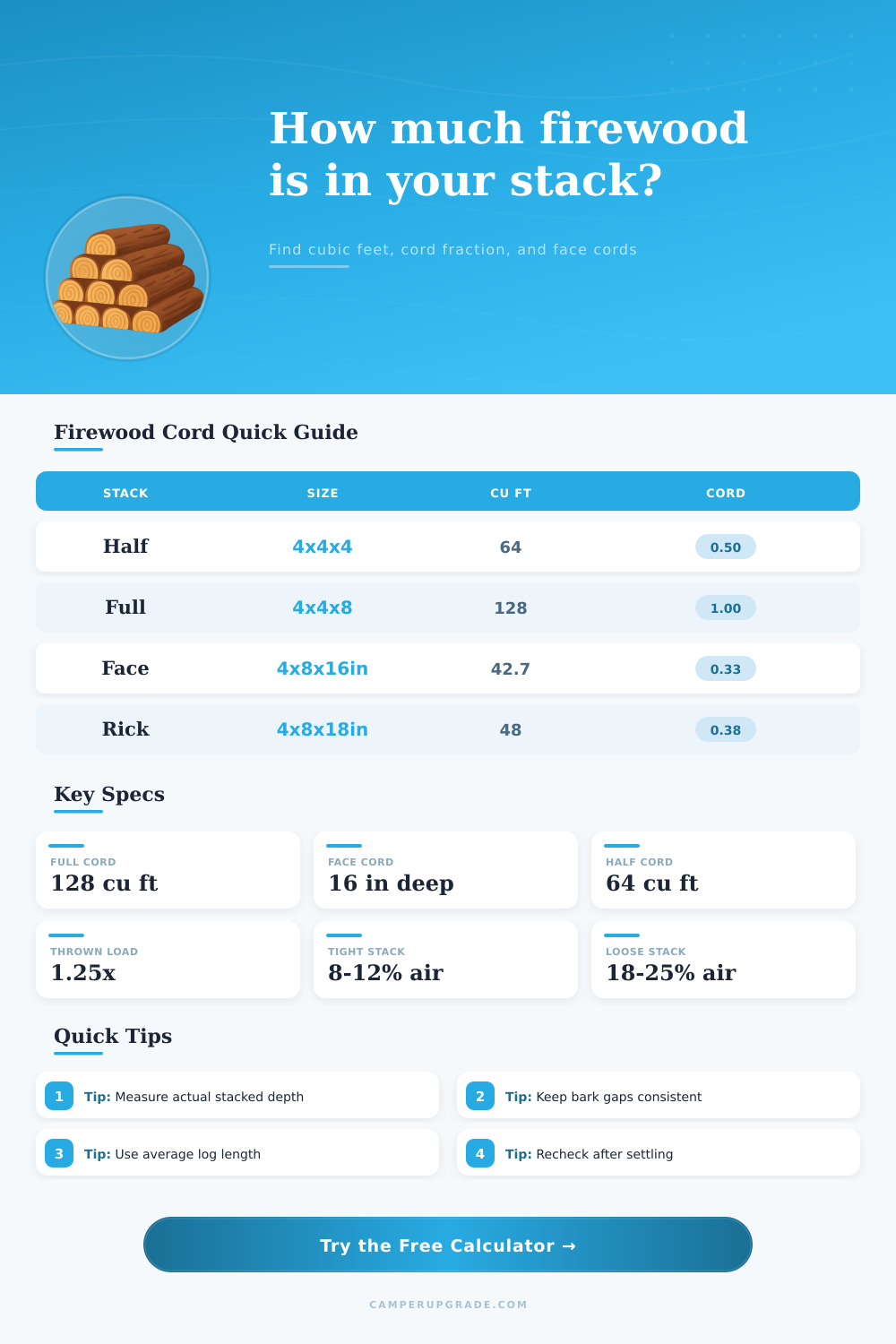
A legal full cord is a stacked volume of 128 cubic feet.
Four feet high by four feet deep by eight feet long.
A face cord has a 4 ft by 8 ft front surface.
Loose thrown wood usually occupies more space than stacked wood.
| Stack Type | Dimensions | Cubic Feet | Full Cords |
|---|---|---|---|
| Full cord | 4 ft x 4 ft x 8 ft | 128.0 | 1.000 |
| Half cord | 4 ft x 4 ft x 4 ft | 64.0 | 0.500 |
| Quarter cord | 4 ft x 4 ft x 2 ft | 32.0 | 0.250 |
| Eighth cord | 4 ft x 4 ft x 1 ft | 16.0 | 0.125 |
| Log Length | Face Cord Cu Ft | Full Cord Fraction | Face Cords Per Cord |
|---|---|---|---|
| 12 in | 32.0 | 0.250 | 4.00 |
| 14 in | 37.3 | 0.292 | 3.43 |
| 16 in | 42.7 | 0.333 | 3.00 |
| 18 in | 48.0 | 0.375 | 2.67 |
| 24 in | 64.0 | 0.500 | 2.00 |
| Common Stack | Length | Height | Volume at 16 in |
|---|---|---|---|
| Porch rack | 4 ft | 4 ft | 21.3 cu ft |
| Short wall | 6 ft | 4 ft | 32.0 cu ft |
| Face cord | 8 ft | 4 ft | 42.7 cu ft |
| Two face rows | 8 ft | 4 ft | 85.3 cu ft |
| Long shed row | 12 ft | 4 ft | 64.0 cu ft |
| Thrown Load | Stacked Cord | Typical Loose Cu Ft | Notes |
|---|---|---|---|
| Quarter cord | 0.25 | 40 cu ft | Small truck bed |
| Half cord | 0.50 | 80 cu ft | Loose delivery |
| Face cord 16 in | 0.33 | 53 cu ft | One front row |
| Full cord | 1.00 | 160 cu ft | Stack to confirm |
The measurement of firewood are important due to the fact that firewood is typicaly sold by a cord. However, the amount of firewood that are stacked in many firewood pile does not necessarily equal the amount of firewood that would make up one cord. A cord is measured as a rectangle that is 4 feet in width, 4 feet in length, and 8 feet in height.
The majority of firewood piles, however, will be of a different shape then this rectangle. As a result, the volume of firewood in the firewood pile will be differently from the volume of firewood that would be contained in a cord of firewood. Since the length of time that a pile of firewood will last during the winter is dependent upon the volume of firewood that is contained in the pile, it is essential that you measure the volume of firewood in a pile to ensure that the quantity of firewood contains enough firewood to last the winter.
How to Measure Firewood
To calculate the volume of a firewood pile, you must obtain a series of measurement of the firewood pile. The length of the firewood pile, the height of the firewood pile, and the depth of the firewood pile must be measured. The depth of the firewood pile is the average length of the firewood logs that is contained within the firewood pile.
The depth of the firewood pile isnt the distance from the front of the firewood pile to the back of the firewood pile. Instead, it is the depth of the logs in the firewood pile, and you must account for the depth of those logs in the calculation of the volume of firewood in the firewood pile. Additionally, you must account for the amount of air that is contained within the firewood pile.
Air gaps between the firewood logs will take up some of the volume of the firewood in the firewood pile, and thus the volume of air in the firewood pile must be accounted for. Finally, the settling of the firewood must be accounted for. Firewood shrink over time as it dries.
This drying of the firewood will result in the firewood logs decrease in size. Thus, the settling of the firewood logs will decrease the total volume of firewood that is accounted for in the firewood pile. The calculator provide three different results based off the measurements of the firewood stack.
The first result is the cord fraction. The cord fraction indicates the fraction of a cord that the firewood in the firewood pile contains. The second result is the face cord count.
The face cord count indicates how many row of firewood are present in the firewood pile. This measurement is especially helpfull for those who purchase firewood by the row. Finally, the third measurement is the thrown volume.
The thrown volume indicates the amount of space that the firewood will take up if it is not neatly stack in the firewood pile. For example, if a driver will load the firewood into a truck, the thrown volume will help to ensure that the truck will be able to contain all of the firewood. By measuring the firewood in a firewood pile, it is possible to verify how much firewood the supplier of the firewood has sold to the individual.
For example, the supplier may indicate that the firewood that is being delivered to the individual is the equivalent of one cord of firewood. However, if the length of the firewood logs is shorter than usual, it is possible for the firewood to be less than a cord in volume. Thus, by measuring the firewood in the firewood pile, it is possible to ensure that there is an equivalent amount of firewood to that which the supplier sold.
Finally, the measurements of the firewood can help to determine how the firewood will burn. For instance, if the firewood logs are tightly stacked with one another, there will be fewer air gap within the firewood logs than if the firewood logs is of varying length and stacked in any fashion. Because firewood is able to dry in these gaps in the firewood, the drying of the firewood will be different if there are more air gaps then if there are fewer air gaps.
Thus, by measuring the firewood logs, it is possible to determine whether or not the firewood will dry appropriate. Finally, these measurements can be used to determine how much firewood should of be purchase in the future. Through measuring the firewood that is currently in the firewood pile, it is possible to determine how long the firewood will last throughout the winter.
Thus, the amount of firewood that is needed to purchase in the near future can be determine.