RV Fan Ventilation CFM Calculator
Estimate required fan CFM, real airflow after vent restrictions, air changes per hour, purge time, and 12V amp-hour draw for an RV cabin or zone.
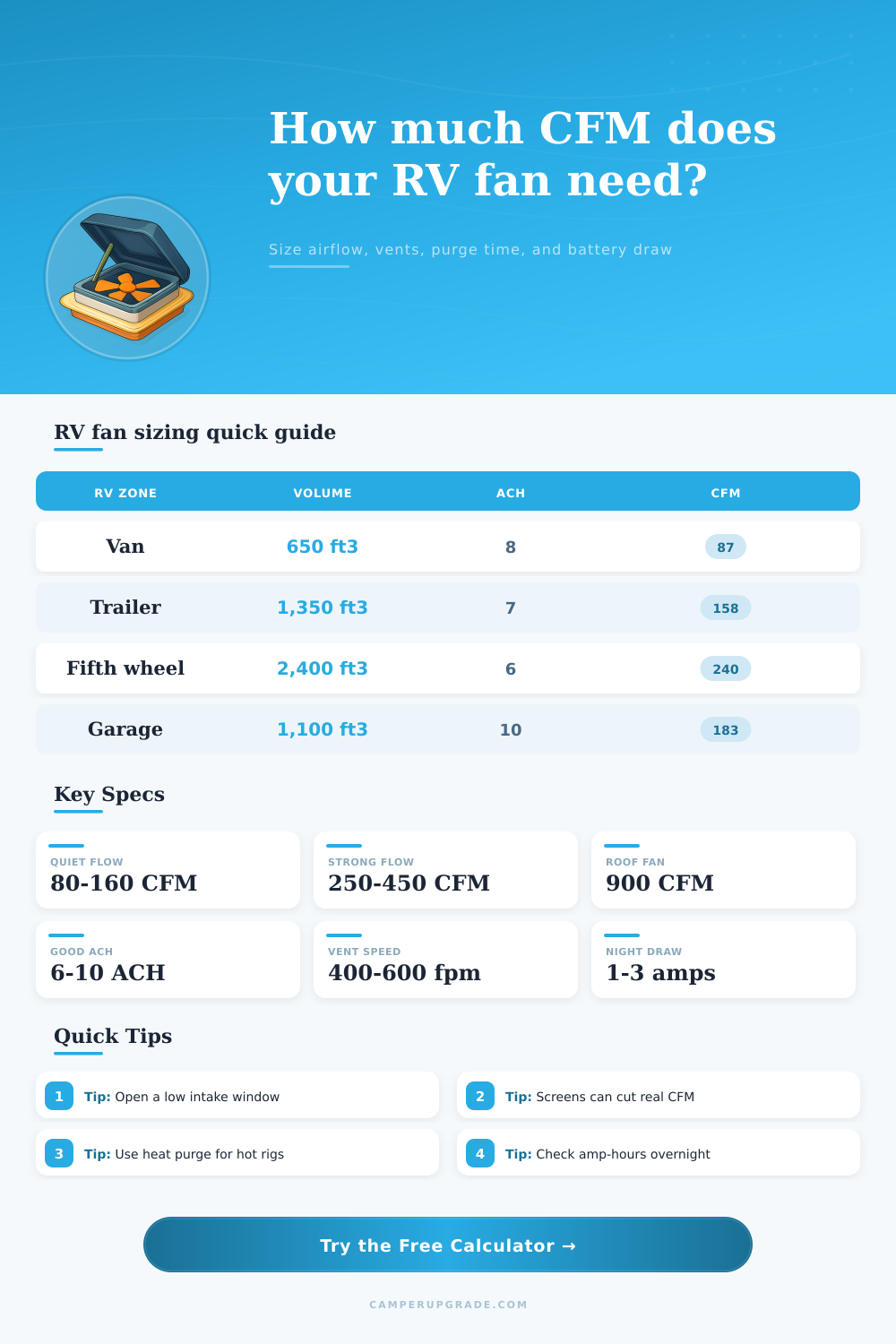
Use 4-6 for quiet sleeping, 8-12 for fast purge.
Lower numbers require more CFM for heat purge.
Add cracked windows, floor vents, and door vents.
RV fan ventilation result
| RV use case | Target ACH | What it means | Best fan style |
|---|---|---|---|
| Quiet sleeping ventilation | 3 to 5 ACH | Fresh air with low noise and low amp draw | Variable-speed roof fan |
| Normal cabin exchange | 6 to 8 ACH | Steady air turnover for daily occupancy | Roof fan with open window intake |
| Hot-rig purge after parking | 8 to 12 ACH | Moves trapped roof and cabin heat quickly | High-flow reversible roof fan |
| Shower or cooking exhaust | 10 to 15 ACH | Short burst to remove moisture or odor | Fan near source plus intake path |
| Toy hauler garage purge | 10 to 20 ACH | Fast clearing before occupying the space | Exhaust fan with low intake opening |
| Fan or opening condition | Typical value | Calculator effect | Planning note |
|---|---|---|---|
| Small bath fan | 50 to 120 CFM | Good for source exhaust | Needs a door gap or intake grille |
| Powered roof vent, low speed | 100 to 250 CFM | Quiet long runtime | Often enough for sleeping airflow |
| Powered roof vent, mid speed | 250 to 500 CFM | Daily cabin exchange | Works best with shaded intake air |
| Powered roof vent, high speed | 600 to 900 CFM | Fast purge mode | Restriction often limits real output |
| Normal screen | 0.90 factor | Small CFM loss | Clean screens keep airflow up |
| Rain cover plus screen | 0.78 factor | Moderate CFM loss | Use more intake area when possible |
| RV space | Example dimensions | Approx volume | CFM at 8 ACH |
|---|---|---|---|
| Teardrop sleeping cabin | 8 ft x 5 ft x 4 ft | 160 ft³ | 21 CFM |
| Class B camper van | 16 ft x 6 ft x 6.2 ft | 595 ft³ | 79 CFM |
| 19 ft travel trailer | 16 ft x 7.5 ft x 6.5 ft | 780 ft³ | 104 CFM |
| 25 ft travel trailer | 22 ft x 8 ft x 6.7 ft | 1,179 ft³ | 157 CFM |
| Large fifth wheel zone | 30 ft x 8 ft x 7.5 ft | 1,800 ft³ | 240 CFM |
| Fan speed plan | Typical amps | 8 hour draw | Use case |
|---|---|---|---|
| Low continuous | 0.3 to 0.8 A | 2.4 to 6.4 Ah | Sleeping with cracked intake |
| Medium cabin exchange | 1.0 to 1.8 A | 8 to 14.4 Ah | Daily airflow in mild weather |
| High purge bursts | 2.0 to 3.5 A | 16 to 28 Ah | Short hot-rig purge or cooking exhaust |
| Restricted vent path | Same amps | Less useful CFM | Open another intake before raising speed |
Ventilating an RV require more than just the use of a roof fan. The effectiveness of the roof fan depend on several factor. The first factor a person must consider is the volume of the space to be ventilated.
Another factor to consider is the resistance in air path. Lastly, the amount of heat inside the RV is another factor that will impact the effectiveness of the roof fan. A roof fan will not move the amount of air indicated on the fan if these factor are not considered when determining how many time per hour to change the air in the RV.
Things That Affect a Roof Fan in an RV
The first factor to consider is the volume of the space to be ventilated. The air movement required by a compact van will be more different than the fifth wheel living area. The volume of air to be replaced in the RV will impact how many time per hour the air must be changed.
Fewer air changes may be required when sleeping, but more air changes may be required to remove the heat that build up from driving the RV in the sun. The second factor to consider is the intake area. The area through which the air will move will impact the amount of air that the roof fan can move.
If the intake area is small, such as a cracked window or small floor vent, the air will move quick through that narrow intake area. This will create resistance for the roof fan to push the air into the RV. As a result, the roof fan may have to work harder to push the air, but it will create less air movement than if the intake area were large.
Screens and covers on the intake area will also introduce resistance into the air path, reducing the movement of air from the roof fan. The third factor is the heat load in the RV. The sun on the RVs roof, cooking inside the RV, and the body heat of the individual in the RV will increase the heat load in the RV.
As the heat load increases, the temperature of the RV will increase. Consequently, the amount of airflow will have to increase to remove the heat from the RV. To account for the heat load, a person must select a heat profile on the roof fan calculator.
Selecting a heat profile will adjust the setting of the roof fan to provide more airflow. Another factor to consider is the battery power that run the motor for the roof fan. Individuals who travel off-grid will have to consider how much battery power a roof fan uses.
The faster the roof fan is set to run, the more current will move through the roof fan motor. Consequently, the more the roof fan is used, the more the battery will be drained. Using a roof fan calculator will allow an individual to calculate how much the roof fan will impact the battery.
This will allow an individual to decide if the amount of airflow from the roof fan is worth the cost to the battery. The path of the air from the roof fan does not necessarily move in a straight line through the RV. Any obstacle in the path of the air, such as doors, cabinets, or furnitures will impact the movement of the air from the roof fan.
These obstacle will cause the roof fan to work harder to push the air against these obstacle. An individual can use the path quality setting on the calculator to account for the impact of these obstacle on the movement of the air from the roof fan. The other consideration with using a roof fan is the balance between the amount of airflow, the noise created by the roof fan, and the power the roof fan consume.
An individual wont want to run the roof fan at the maximum speed for long period of time. However, there must be enough airflow moving through the RV to provide ventilation for the individual who travel in the RV. When the factor in the RV have returned to their ideal conditions, the speed of the roof fan can be lowered to save power and reduce the noise created by the roof fan.
A roof fan calculator will provide an individual with the effective CFM of the roof fan, the actual number of time the air in the RV changes in an hour, and the impact of the roof fan on the battery power of the RV. By considering each of these factor, an individual can determine the appropriate setting for the roof fan to ensure it moves an adequate amount of air within the RV.