Water Pump Duty Cycle Calculator
Estimate RV fresh-water pump runtime, starts per hour, accumulator drawdown, thermal duty margin, and battery use from real flow, pressure, fixture demand, and cycling behavior.
💧Real Camper Water-Use Presets
Presets are editable. The calculator estimates operating load; always keep the final duty cycle within the pump maker's manual and wiring limits.
⚙Pump, Pressure, and Cycling Inputs
Water Pump Duty Cycle Results
📊Live Pump Spec Grid
📋Duty Cycle Reference Tables
| Water use pattern | Fixture flow | Water-on time | Typical duty signal |
|---|---|---|---|
| Handwashing and teeth brushing | 0.35 to 0.70 GPM | 5 to 12 min/hr | Light load if drawdown is adequate. |
| Dish rinsing and sink cleanup | 0.70 to 1.30 GPM | 10 to 20 min/hr | Can push small pumps into warm cycling. |
| Low-flow navy showers | 1.00 to 1.50 GPM | 8 to 18 min/hr | Usually flow-limited more than cycle-limited. |
| Outdoor shower or washdown | 1.50 to 2.50 GPM | 10 to 30 min/hr | High duty; confirm continuous rating. |
| Jug or bladder transfer | 2.00 to 4.00 GPM | 10 to 40 min/hr | Often near continuous pump operation. |
| Accumulator drawdown | Best for | Cycle effect | Watch point |
|---|---|---|---|
| 0.05 to 0.15 gal | No tank or tiny chamber | Very frequent starts | May chatter at small faucet openings. |
| 0.25 to 0.50 gal | Compact RV accumulator | Moderate cycling | Good for sinks and toilet valves. |
| 0.75 to 1.50 gal | Quiet camper plumbing | Longer off periods | Needs space and correct precharge. |
| 2.00 gal plus | High-flow or remote pump | Few starts per hour | Pressure swing is more noticeable. |
| Pump class | Open flow | Pressure flow estimate | Typical RV role |
|---|---|---|---|
| Compact demand pump | 1.0 to 2.0 GPM | 0.7 to 1.5 GPM | Small vans, handwash sinks, toilet feed. |
| Common RV diaphragm | 2.8 to 3.5 GPM | 1.8 to 2.7 GPM | Most trailers and van conversions. |
| High-flow RV pump | 4.0 to 5.5 GPM | 2.6 to 4.1 GPM | Multiple fixtures or larger fifth wheels. |
| Transfer pump mode | 3.0 to 6.0 GPM | 2.4 to 5.0 GPM | Tank fill, jug transfer, or washdown tasks. |
| Calculated result | Comfort zone | Caution zone | Action cue |
|---|---|---|---|
| Thermal duty cycle | Under 60% of rating | Over 90% of rating | Reduce continuous use or use a rated pump. |
| Starts per hour | Under 30 | Over 60 | Add drawdown or correct precharge. |
| Flow recovery ratio | 1.5x fixture flow | Under 1.1x | Fixture may outrun the pump at pressure. |
| Daily pump energy | Under 10 Ah | Over 25 Ah | Check battery budget for long boondocking. |
💡Two Duty-Cycle Tips
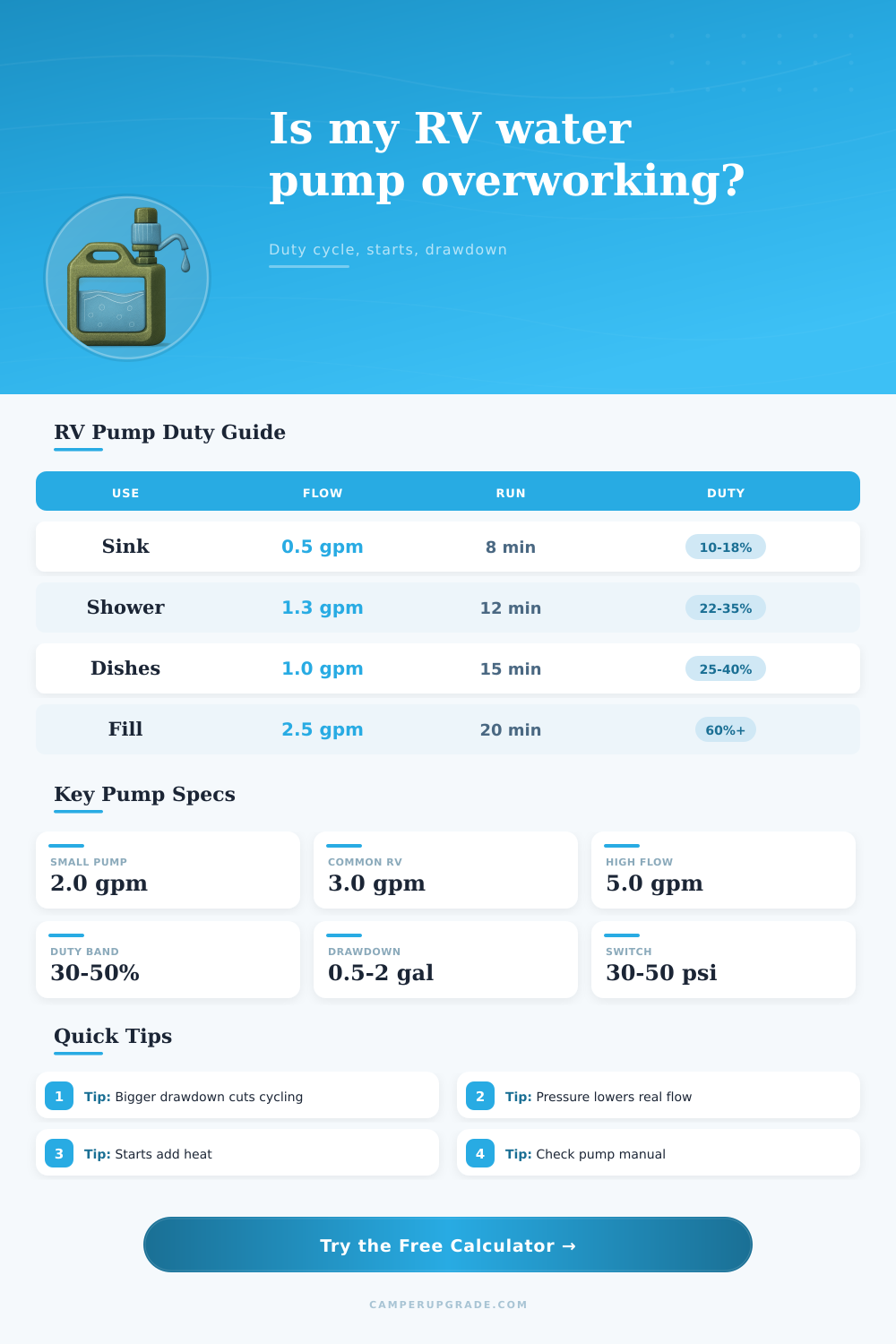
The water pump duty cycle are a measurement of how much time the water pump is working during a specific period. Water pump duty cycle is used to prevent the water pump from overheat. While the water pressure and flow rates are essential parameters for water systems, the water pump duty cycle is also important in determining how much heat build up in the water pump.
If the water pump operates for too long without a break, the water pump will generates too much heat. If the water pump starts and stop too often, the frequent starting can cause wear on the water pump motor and pressure switch. The duty cycle percentage for the water pump will show how many minutes out of 60 the water pump is working.
What Is a Water Pump Duty Cycle and How to Control It
You must ensure that the water pump duty cycle does not go beyond the limit that the manufacture of the water pump set for it. The fixture demand can affect the water pump duty cycle because there are different rate at which the fixtures in a water system can draw water. For example, the water flowing out of a shower head may be measured at 1.8 gallons per minute, while the rate for a bathroom sink may be only 0.5 gallon per minute.
As a result, the shower head will use the water more fast than the sink. As a result, the faster rate at which the water is drawn will reduce the water pressure in the system more quickly. As a result, the water pump will have to turn on more often to replenish the water.
The flow rate that should be used is the actual flow rate of the fixtures, not the flow rate that is listed for the water pump. An accumulator tank can change the water pump duty cycle. The accumulator tank will contain more water than the system use at any one time.
This increased amount of water in the tank will allow the water pump to remain off for longer periods of time. The water pump will generate less heat, and the pressure switch will experience less wear and tear. However, accumulator tanks takes up space in the tank system.
Additionally, using an accumulator tank will make changes in the systems pressure more noticeable when the faucet is open. Using a calculator, you can determine how big an accumulator tank is required for the system to meet a specific number of starts of the water pump per hour. The water pump will impact the battery bank.
The water pump will use electricity every time it is on. The longer the water pump runs, the more amp-hour will be used from the battery bank. The greater the number of starts of the water pump in a day, the more the battery bank will be drained of its stored energy.
Calculating how many amp-hours the water pump will use each day will allow you to determine if the battery bank has enough energy for the water system. If the water pump use alot of energy, a generator may have to be used to recharge the battery bank. The temperature at which the water pump operates will also impact the water pumps duty cycle.
The hotter the temperature at which the compartment housing the water pump is maintained, the less able the water pump will be to shed heat during operation. If the sun or some other heat source heated the compartment in which the water pump is house, the water pump will reach its operating temperature without having the same amount of time to shed the heat that it generates during operation. To improve the duty cycle of the water pump, ventilation or a small fan can be placed in the compartment that contains the water pump to reduce the temperature within which the water pump has to operate.
Many people makes mistakes when calculating the water pump duty cycle. One of the most common is using the flow rate that is listed on the water pumps label instead of the pressure adjusted flow rate for the fixtures in the system. The label flow rate will make the water pump look more efficiently than it is.
Some may also set the duty cycle to 100%, but most water pumps is made for intermittent duty only. The starting of the pump and the stopping of the pump create stress on the water pump that should also be accounted for in the calculations. If it is ignored, the water pump will end up running hotter than it should.
The purpose for calculating the water pump duty cycle is to allow the individuals creating and managing the water system to understand the interplay and tradeoff between the systems different components. Several management techniques can be used to manage the water pump duty cycle, such as increasing the size of the accumulator tank, purchasing a water pump with a higher duty cycle rating, or spreading out the periods of water use throughout the day. Through the management of these system component, it is possible to ensure that the water pump is functioning within its intended limits and does not fail premature.