Generator Run Hours Per Tank Calculator
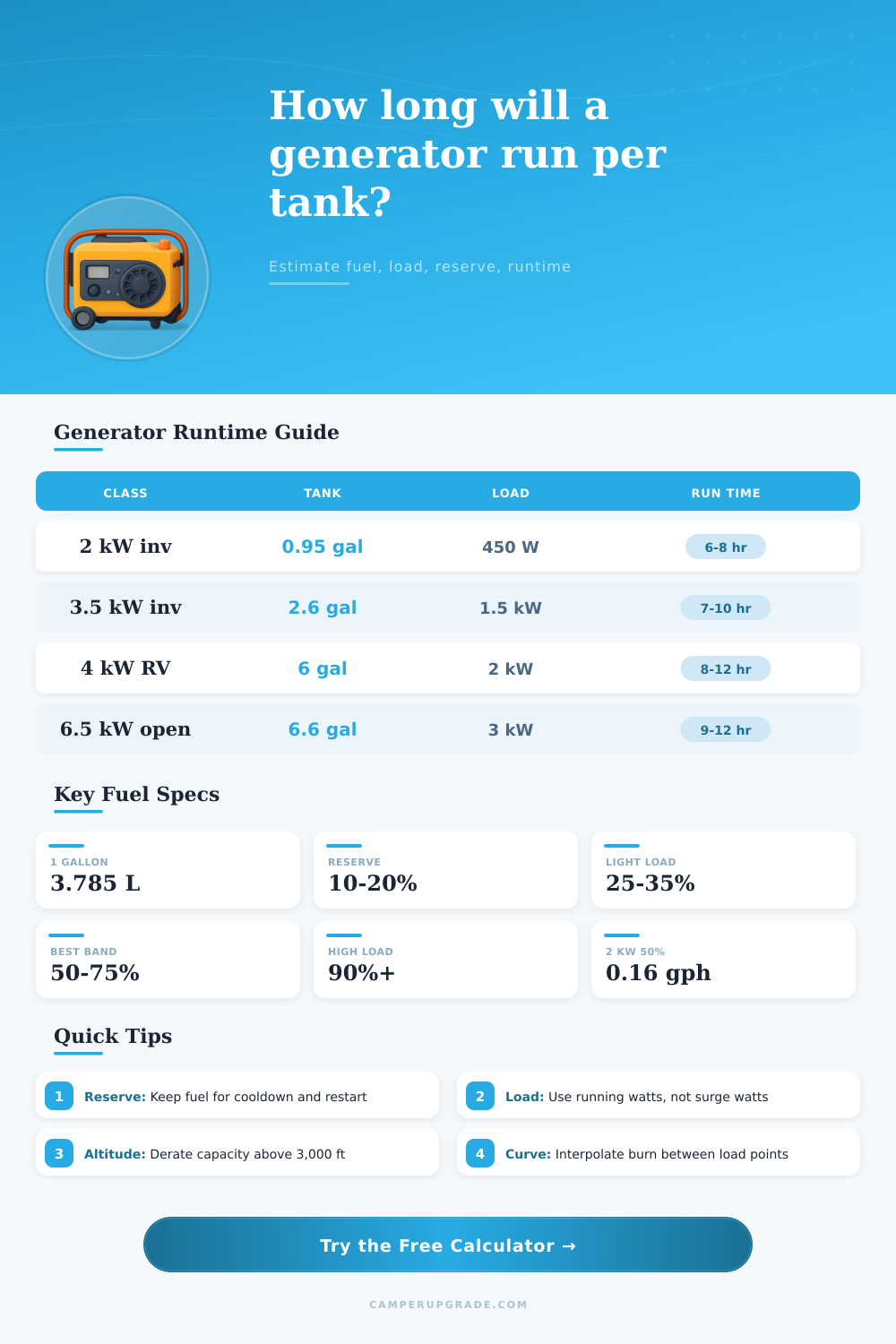
Estimate generator runtime from tank size, gallons or liters, reserve fuel, running load, surge demand, derated capacity, and interpolated fuel burn at 25%, 50%, and full load.
⛽Generator and Load Presets
⚙Tank, Load, Derate, and Fuel Curve Inputs
📊Generator Fuel and Load Spec Grid
📋Generator Runtime Reference Tables
| Generator class | Tank | Half-load burn | Typical runtime band |
|---|---|---|---|
| Compact 2 kW inverter | 0.95 to 1.1 gal | 0.14 to 0.18 gph | 5 to 8 hours with reserve |
| Quiet 3 kW inverter | 1.5 to 2.0 gal | 0.24 to 0.34 gph | 5 to 7 hours with reserve |
| 3.5 kW inverter | 2.3 to 2.7 gal | 0.26 to 0.36 gph | 7 to 10 hours with reserve |
| 4 kW onboard RV | Shared RV tank draw | 0.45 to 0.65 gph | Depends on allowed fuel pickup level |
| 6.5 kW open-frame | 6.0 to 7.5 gal | 0.55 to 0.85 gph | 8 to 12 hours with reserve |
| RV load | Running watts | Startup surge | Runtime effect |
|---|---|---|---|
| Converter charging batteries | 300 to 1,200 W | Low | Can hold a steady mid-load for hours. |
| Residential fridge | 120 to 300 W | 600 to 1,200 W | Low average load, but surge must fit. |
| 13.5k RV air conditioner | 1,300 to 1,800 W | 3,000 to 5,000 W | Heavy draw; soft start can reduce surge. |
| Microwave | 1,000 to 1,600 W | Low to medium | Short run time load; high instant demand. |
| Water pump and lights | 80 to 250 W | 150 to 600 W | Small average load with brief cycling. |
| Fuel volume | Gallons | Liters | Usable after 15% |
|---|---|---|---|
| Compact inverter tank | 1.0 gal | 3.79 L | 0.85 gal / 3.22 L |
| Medium inverter tank | 2.6 gal | 9.84 L | 2.21 gal / 8.37 L |
| Open-frame tank | 6.6 gal | 24.98 L | 5.61 gal / 21.24 L |
| Small fuel can | 5.0 gal | 18.93 L | 4.25 gal / 16.09 L |
| Large fuel can | 10.0 gal | 37.85 L | 8.50 gal / 32.18 L |
| Load band | Load percent | Fuel curve point | Planning note |
|---|---|---|---|
| Idle or trickle | 0 to 20% | Idle to 25% | Runtime is long, but inverter eco mode matters most. |
| Light camp load | 20 to 40% | 25% to 50% | Good band for fridge, lights, and charging. |
| Medium RV load | 40 to 70% | 50% blend | Often efficient and stable for converters and one AC unit. |
| Heavy demand | 70 to 90% | 50% to 100% | Runtime drops faster as throttle and heat rise. |
| Near limit | 90% plus | Full-load burn | Leave more headroom for surge and temperature. |
💡Generator Runtime Tips
In order to calculate the length of time that a generator will run, it is first important to understand the different variable that can affect the amount of time that a generator will run. The variables to consider include the amount of fuel that the generator tank contains, the electrical load of the device that the generator is to operate, the altitude at which the generator will be running, and the temperature of the environment in which the generator will be running. Each of these variable can potentially affect the amount of time that the generator will run before the fuel are depleted.
In each case, the amount of fuel contained within the generator’s tank alone cannot account for other variable, such as the amount of electricity that the generator will produce or the amount of fuel that the generator’s engine will consume. The first in determining the time that a generator will run is to determine the amount of fuel that is usable by the generator. The fuel tank of the generator may contain a significant amount of fuel, but it isnt necessary for the generator to assume the fuel is entirely usable.
How Long Will a Generator Run
Instead, it is necessary to consider the amount of fuel that should be reserved within the generator’s tank for safety. The fuel gauge on a generator is often not accurately, so it is essential to have some fuel within the tank for starting the engine. Additionally, the engine require fuel to cool, which also contributes to the need for a fuel reserve within the generator.
By subtracting the amount of fuel that should be reserved from the total fuel capacity of the tank, the user can determine the amount of usable fuel. The second variable to determine is the electrical load that will be placed upon the generator. The electrical load of the devices that the generator will use will determine how fast the generator will consume that fuel.
A small electrical load will result in the generator consuming fuel at a slower rate than if it were generating a larger electrical load. In addition to the electrical load, you must also determine the surge demand of the appliances. Surge demand is the additional power that is required to start an appliance that contains a motor.
The electrical load that is required to start an appliance is often higher than the electrical load that is required for the appliance to continue to run. Any electrical load that is determined to be higher than the capacity of the generator may result in the generator shutting off. The third group of variables includes those related to the environment at which the generator will be running.
The altitude at which the generator will be running can impact the amount of fuel that the engine will consume. A lack of oxygen at high altitudes can make the engine less efficiently at burning the fuel. Similarly, the temperature of the environment can impact the amount of fuel that the generator consumes.
High temperatures may impact the engine and the cooling system of the generator. The fourth variable to consider is the type of fuel that the generator will use. Generators can burn gasoline, propane, or diesel fuel.
Each of these fuel has a different amount of energy per unit volume. Consequently, the amount of time that the generator will run may be more different if it burns diesel fuel rather than gasoline. Some models of generators have an “eco mode” that reduces the rate at which the engine burns fuel.
Eco mode allow the engine to slow to match the electrical load that is being generated, which conserve fuel when the generator creates low electrical loads. Finally, in order to determine each of these variables, it is necessary to refer to certain table that describe the different variables of generators. For instance, tables can describe the electrical load requirements of different appliances.
Additionally, tables can describe the fuel volumes in gallons versus liters, which is especially useful for generators that use fuel other than gasoline. These tables will assist in creating an accurate estimation of the length of time that the generator will run, which will in turn assist in manage the fuel consumption of that generator.