Inverter Continuous Load Sizing Calculator
Estimate inverter running watts, startup surge, DC battery amps, headroom, fuse floor, and cable voltage-drop fit for RV and camper power systems.
Presets are editable starting points. Final sizing should stay within the inverter manual, battery BMS limit, fuse rating, and cable temperature rating.
Recommended Inverter Sizing
| Appliance | Typical running watts | Surge note | Sizing note |
|---|---|---|---|
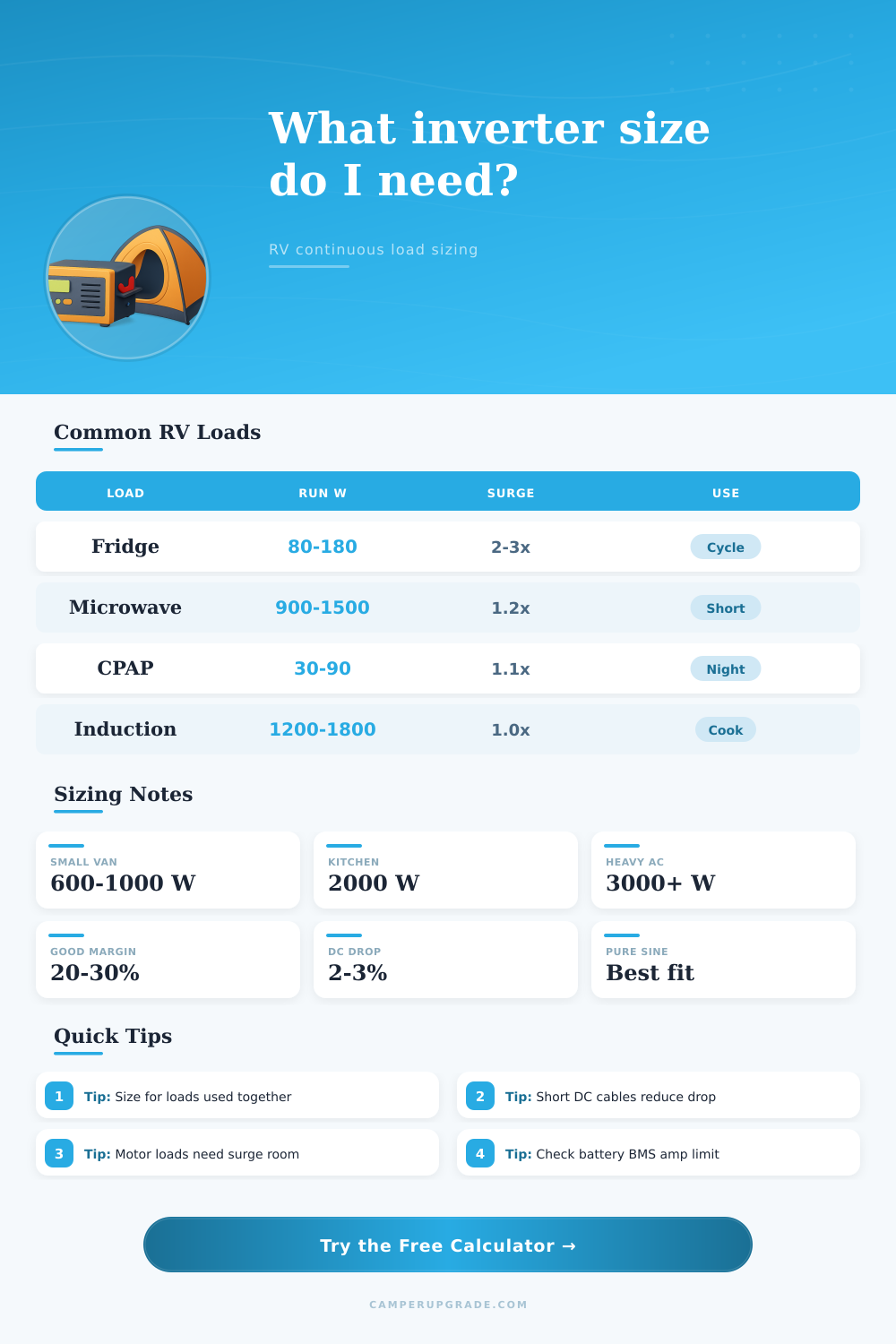
| Compressor fridge | 80 to 180 W | 2x to 3x | Average with duty factor, but surge still matters. |
| Microwave | 900 to 1500 W input | 1.2x to 1.5x | Use input watts, not cooking watts printed on the door. |
| Induction cooktop | 900 to 1800 W | Usually low | Often sets the continuous inverter size by itself. |
| Coffee maker | 700 to 1500 W | Usually low | Short run time, but high continuous draw while heating. |
| CPAP without humidifier | 30 to 60 W | Low | Use a higher number when humidifier heat is enabled. |
| Laptop plus monitor | 80 to 250 W | Low | Add router, Starlink, and USB chargers separately. |
| Tool battery charger | 150 to 900 W | Low to moderate | Large rapid chargers can surprise small inverters. |
| Small air fryer | 1200 to 1700 W | Low | Needs real continuous watt capacity while heating. |
| Inverter class | 12 V DC amps at 90% | 24 V DC amps at 90% | 48 V DC amps at 90% |
|---|---|---|---|
| 600 W | 56 A | 28 A | 14 A |
| 1000 W | 93 A | 46 A | 23 A |
| 1500 W | 139 A | 69 A | 35 A |
| 2000 W | 185 A | 93 A | 46 A |
| 3000 W | 278 A | 139 A | 69 A |
| 4000 W | 370 A | 185 A | 93 A |
| Copper cable | Reference ampacity | Resistance ohm/1000 ft | Common RV use |
|---|---|---|---|
| 10 AWG | 30 A | 0.999 | Small DC branch loads, not main inverter feed. |
| 8 AWG | 45 A | 0.628 | Small inverters with very short runs. |
| 6 AWG | 65 A | 0.395 | Light inverters or 24 V systems. |
| 4 AWG | 85 A | 0.249 | Low-power 12 V or mid-power 24 V systems. |
| 2 AWG | 115 A | 0.156 | Medium inverter feeds with short cable. |
| 1/0 AWG | 150 A | 0.098 | Common for 1500 W to 2000 W short 12 V runs. |
| 2/0 AWG | 190 A | 0.078 | Common for 2000 W short 12 V runs. |
| 4/0 AWG | 260 A | 0.049 | Large 12 V inverter feeds with very short runs. |
| Load mix | Headroom | Surge factor | Best practice |
|---|---|---|---|
| Electronics only | 15% to 20% | 1.2x | Keep inverter above the continuous electronics total. |
| Fridge plus electronics | 20% to 25% | 2.0x | Account for compressor startup and cycling overlap. |
| Kitchen heating loads | 25% to 30% | 1.3x | Continuous watts usually matter more than startup surge. |
| Pumps or compressor tools | 30% to 40% | 2.5x to 3.0x | Confirm the inverter surge duration is long enough. |
| Preset | Main loads | Typical bank | Expected inverter class |
|---|---|---|---|
| Weekend Van | Fridge, laptop, fans | 12 V | 600 W to 1000 W |
| Microwave Lunch | Microwave, fridge, outlets | 12 V or 24 V | 2000 W |
| Induction Cook | Cooktop, fridge, electronics | 24 V | 3000 W |
| Family Trailer | Coffee, microwave, chargers | 12 V or 24 V | 3000 W |
| Air Fryer Stop | Air fryer, fridge, outlets | 24 V | 3000 W |
To chooses the right inverter for your RV or camper, you first must determine the electrical loads that you will use. The inverter must be able to carry the continuous load of your appliance. Additionally, the inverter must also be able to handle the surge loads of your appliances.
Appliances such as refrigerators may cycles on and off to control the temperature within the appliance. However, appliances such as laptops may run for many hours while you are commuting or working on your RV or camper. Determine the total wattage of all of the appliance that you plan to use to make sure that the inverter will not overheat or shut off while you are using your RV or camper.
How to choose the right inverter for your RV or camper
The calculator included on this website will perform the calculations for you once you enter your appliances and their wattage. This inverter calculator will remove the guesswork of determining the size of an inverter that you need. The calculator will turn each of the individual wattages of your appliances into one continuous watt figure.
Additionally, the calculator will account for how often that you will use each appliance. Based off this continuous watt figure, you can determine the size of the standard inverter that you should purchase. For instance, if your calculated continuous watt figure is 1,800 watts, the calculator will allow you to determine if a 2,000-watt inverter will meet your need.
The battery voltage that you use will be another important factor in determining the size and components of the inverter. The battery voltage will change the amount of current that the inverter must carry. A 2,000-watt load at 12 volts will carry twice as much current as a 2,000-watt load at 24 volts.
Because the 12-volt system will require more current than a 24-volt system, the 12-volt system will require thicker cables and bigger fuses to carry that current. This inverter calculator allows you to change the voltage setting to see how this change your amperage and cable size requirements. Another important setting is the efficiency percentage of your inverter.
The efficiency percentage will impact the amount of current that is drawn from the battery. For instance, an inverter that is 90% efficient will require the battery to supply more current than an inverter that is 94% efficient. The efficiency of the inverter will impact how much current the battery must supply to running the appliances.
Surge capacity is another important consideration. Many of the appliances within your RV or camper will require more power during their start-up phase than they will during their continuous phase of operation. Appliances such as compressor refrigerators will require up to three times the wattage during their start up phase.
This inverter calculator includes a surge factor that will adjust the load according to the largest motor load in your RV or camper. If the surge load is higher then the continuous load of the inverter, the inverter calculator will show you that higher number. You need to make sure that the inverter has enough overhead to handle these momentary spikes in power.
Another important factor is the length of the cable that you use to power the inverter from the battery. If the cable is too long or too thin for your RV or camper, there will be a voltage drop. If the voltage drops too low, the inverter will shut off to protect itself.
Even if you have the perfect inverter, a voltage drop will prevent the inverter from functioning. The inverter calculator will allow you to enter the length of the cable that will be used, the battery voltage, and the acceptable percentage of voltage drop. Based on these settings, the calculator will suggest the size of the cable that will ensure that the voltage drop remains within the acceptable range.
Headroom is another factor that you should include in your calculations. You should never allow an inverter to run at its maximum setting for long period. If you allow an inverter to remain at maximum output for extended periods, the inverter will overheat.
Overheating will drastically shorten the life of your inverter. You should include 20-30% extra capacity for your appliances to provide headroom for the inverter. This headroom will allow the inverter to remain cooler while running and will provide extra capacity for additional appliances that you may have forgotten to include in your initial calculation.
The inverter calculator will automatically include this headroom in the calculations. The other last factor to consider is the limits of the battery management system (BMS) that is included in your RV or camper. An inverter can require a significant amount of current from the battery.
For instance, a 3,000-watt inverter on a 12-volt system will require over 250 amps to supply the power necessary to run the inverter. If the limit of the BMS is lower than this amount, the BMS will shut down the inverter to protect the battery. Therefore, you must know the limit of the BMS before you purchase your inverter.
The goal is to find the smallest inverter that can meet your needs. This inverter must meet the demands of your appliances while also staying within the limits of your battery and your wiring. If you find an inverter that meets all of these specifications, you will have an inverter that will run more cool and last longer.