RV Solar Daily Harvest Calculator
Estimate daily solar harvest for an RV, van, trailer, or truck camper from panel watts, peak sun hours, panel angle, shade, heat, controller type, wiring loss, soiling, and battery voltage.
☀Solar Harvest Presets
Presets fill realistic planning cases. Replace them with your panel label watts, measured shade, and local peak sun hours for the best estimate.
⚙Solar Array and Site Inputs
Daily Solar Harvest Results
📊RV Solar Spec Grid
📘Solar Harvest Reference Tables
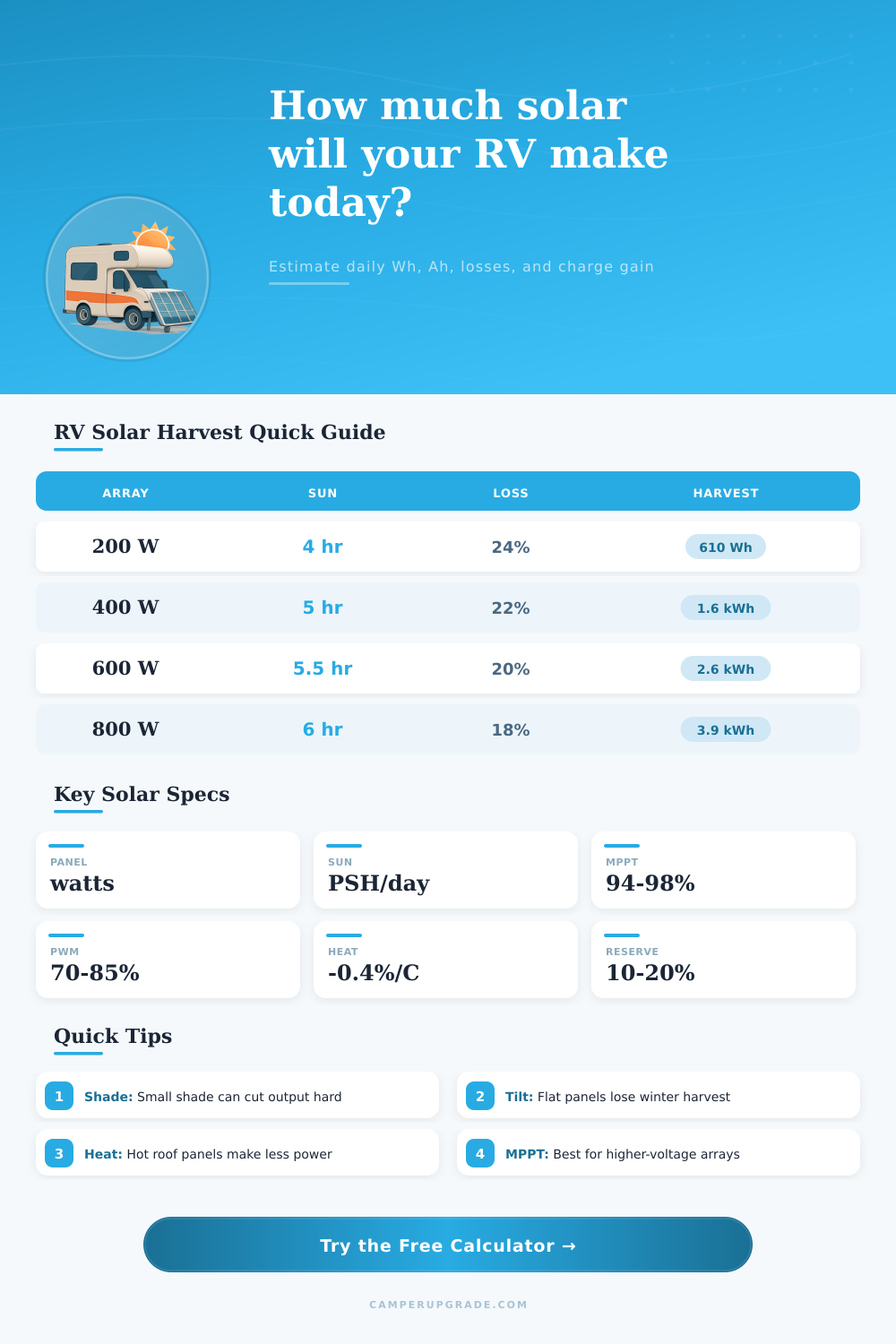
| Array size | 4 PSH at 75% | 5 PSH at 75% | 6 PSH at 75% |
|---|---|---|---|
| 100 W portable panel | 300 Wh per day | 375 Wh per day | 450 Wh per day |
| 200 W small trailer array | 600 Wh per day | 750 Wh per day | 900 Wh per day |
| 400 W common RV roof array | 1200 Wh per day | 1500 Wh per day | 1800 Wh per day |
| 800 W boondocking array | 2400 Wh per day | 3000 Wh per day | 3600 Wh per day |
| Loss source | Light case | Typical case | Heavy case |
|---|---|---|---|
| Controller conversion | 2-4% with MPPT | 4-8% with MPPT | 15-30% with poor PWM match |
| Panel heat | 0-4% cool weather | 6-12% warm roof | 14-22% hot roof |
| Wire and connectors | 1-2% short roof run | 3-5% common RV run | 6-12% long portable lead |
| Soiling and shade | 2-5% clean open site | 8-18% normal camp | 25% or more in trees |
| Controller setup | Best array match | Calculator factor | Planning note |
|---|---|---|---|
| MPPT controller | Series or higher-voltage arrays | Efficiency only | Good for cold panels, long wire runs, and larger arrays. |
| PWM, 12 V nominal panels | 36-cell panel to 12 V battery | Efficiency times 0.86 | Works, but voltage headroom is converted poorly. |
| PWM, high-voltage panel | Not ideal for RV charging | Efficiency times 0.70 | Large voltage mismatch can waste much of the panel output. |
| Solar through DC-DC charger | Combined alternator and solar units | Efficiency times 0.92 | Check input current limits so array watts are not clipped. |
| RV use case | Daily load range | Array starting point | Harvest target |
|---|---|---|---|
| Lights, fan, phone charging | 250-600 Wh | 100-200 W | Replace a simple day in good sun. |
| Compressor fridge and lights | 700-1400 Wh | 300-500 W | Cover a normal summer day with some margin. |
| Fridge, laptop, pump, inverter | 1500-2600 Wh | 600-900 W | Support regular boondocking with clear exposure. |
| Large RV with mixed inverter loads | 3000-5000 Wh | 1000 W or more | Reduce generator time, but track shade and roof limits. |
💡Calculation Tips
Planning your RV’s solar panel system requires you to determine how many watts the solar panels will deliver on an average day. The wattage of the solar panel arrays alone will not tell you how many watts is delivered to your battery bank; many factors will have an effect upon the power that is delivered. In order to determine the power that the solar panel system actualy delivers to your battery bank, it is necesary to calculate the effect of these various factors.
The calculator located on this page will allow you to run these calculations for your RV and your electrical load. The calculator contains two groups of inputs. The first group of inputs includes factors related to the solar array itself, such as the wattage of the panels, the number of panels that you will install, and the type of solar controller that you will use with the system.
How to Calculate Solar Power for Your RV
The second group of inputs includes factors related to the environment in which you will install the solar array. Factors that will impact the yield of the solar array include the number of peak sun hours that will be available at your site, the angle of the roof, the azimuth error of the roof, the percentage of shade that the panels will experience, the temperature of the panels cells, and the losses in yield that will result from dirt on the panels and the wiring from the panels to the battery bank. Each of these factors will impact the amount of power that will reach your battery bank.
For instance, crystalline solar panel systems experience a reduction in output of approximately ten percent if the roof temperature exceed 45 C. Similarly, any shade of a solar panel will reduce the output of the solar panel; the visible shade may suggest a certain percentage of reduction in yield, but the shade of a single string of solar panel cells can cause a much higherer percentage of yield to be lost. The calculator will weight the impact of these factors to provide an accurate estimation of the yield of your solar panel system. The voltage and the capacity (in amp-hours) of the battery bank are located near the bottom of the calculator.
These two factors are important to your RV solar system because you want to know how much of your battery bank the solar system will replace each day. The watt-hours that the solar system will produce can be converted into amp-hours at the battery bank voltage; this will allow you to calculate the percentage of your battery bank that will be replaced each day. For instance, a 400 watt solar panel array will produce 1,800 watt-hours of power during five peak sun hours of bright solar exposure each day; however, this amount of power will only replace 35% of a 400 amp-hour battery bank.
This percentage will allow you to determine if the solar system will be sufficient to power the items that you wish to operate on your RV site, or if you will need to supplement your power supply with a generator. The tables located on this page are general references only. The tables will help you understand the impact that different types of controllers can have upon the yield of your solar panel system, but the tables are not guarantees of the yield of your solar system.
The variables that can impact the yield of the solar system that are not accounted for in the tables may include other RVs that may cast shade upon your solar panels, or even factors like pollen that may coat your panels. People that intend to size the solar systems for RVs make some common mistakes without performing the calculations that is required to determine the yield of the solar system. For example, many people will count the watts of solar panels that are installed into a solar system rather than counting the watt-hours of energy that those panels will produce.
Many people will use the peak sun hours for summer to plan for year-round energy requirements. Similarly, many people will assume that if solar panels are mounted on a flat RV roof, then they will receive peak solar exposure for the year round; however, the angle of the flat roof prevents those panels from receiving any exposure to the sun during the winter months. Finally, many people will simply calculate the percentage of the area of a solar panel that an object may shade, but the shading of a single string of solar panel cells will impact the yield of the entire panel system.
The calculator can help you to understand these various factors. For instance, if you change the selected season from summer to winter, you can view how the panels will lose energy due to their flat roof and winter angle. If you increase the percentage of shade that you apply to the solar panels, you can see how the yield of the system will decrease.
Similarly, if you change the type of solar controller from an MPPT controller to a PWM controller, the efficiency of the solar system will change to reflect that decision. Each of these variables can be changed in the calculator to provide you with a view of how each factor will impact your solar system. It is recommended that you calculate the yield of your solar system for the sunniest month of the year, and then calculate the yield for the cloudiest month of the year.
The difference between the two yields will allow you to determine how much reserve and generator battery bank capacity you will need for the winter months. Many RV owners find that the summer calculations indicate that they will have ample solar power available to the RV and battery bank, but that the calculations for the shoulder seasons of spring or fall indicate that additional battery bank capacity or solar panels is required. You can perform the same calculations if you decide to change the electrical load that the solar system is to supply.
If you are adding an electrical device to your RV, such as a second refrigerator, you can re-run the calculations for your solar system to determine if the current solar system will be able to handle the additional load. Because you can change the parameters for the solar system, this calculator can assist you both in the initial installation of your solar system, as well as when you may need to upgrade that system in the future. The function of the solar panels on your RV will be to produce a certain amount of energy each day.
The electrical devices on your RV will be a certain load and will consume a certain amount of energy each day. The battery bank that you install on your RV will be in between the solar panels and the electrical devices that are to be powered. Thus, the battery bank will either gain energy each day from the solar panels, or it will lose energy each day to the electrical devices.
This calculator allows you to determine the energy gain or loss of the battery bank each day.