Ski Wax Temperature Band Calculator
Translate measured snow temperature, three-hour weather trend, humidity, surface moisture, crystal condition, sun exposure, ski use, base structure, and outing length into a practical wax temperature band.
🎿Temperature Band Presets
⚙Snow, Weather, Base, and Session Inputs
Use this calculator for glide-wax temperature range planning. Follow your wax maker's exact iron temperature, ventilation, scraping, brushing, and ski-base instructions.
🧪Wax Band Spec Grid
📋Wax Temperature Band Reference
| Band | Snow Range | Hardness | Typical Feel |
|---|---|---|---|
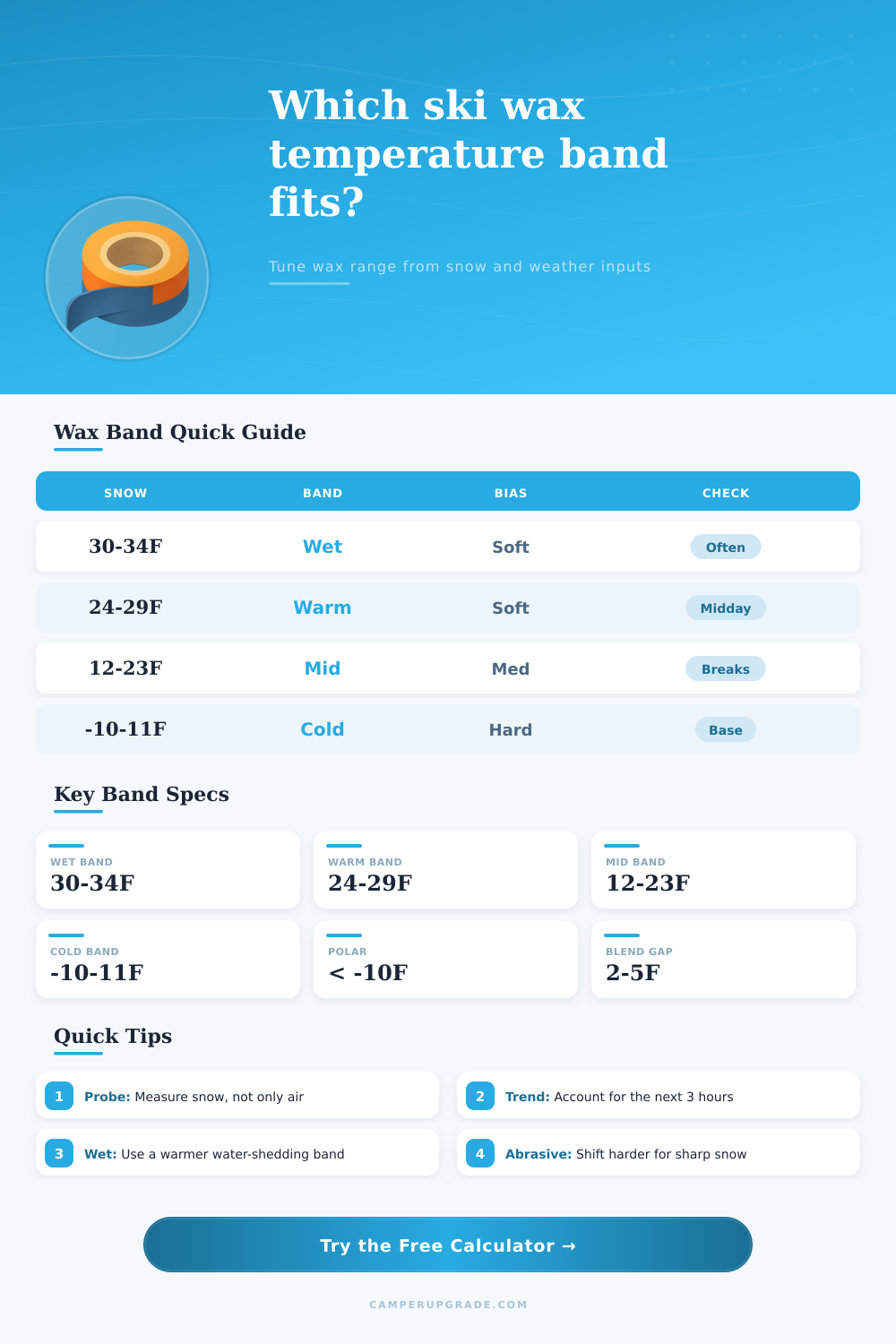
| Wet warm | 30 to 34°F / -1 to 1°C | Very soft | Free water, suction, slush, spring corn. |
| Warm | 24 to 29°F / -4 to -2°C | Soft | Damp groomers and mild winter snow. |
| Middle | 12 to 23°F / -11 to -5°C | Medium | Common packed powder and resort snow. |
| Cold | -10 to 11°F / -23 to -12°C | Hard | Dry squeaky snow and sharp crystals. |
| Polar | Below -10°F / below -23°C | Extra hard | Static-prone snow with very high abrasion. |
| Condition | Temp Bias | Spread Bias | Why It Matters |
|---|---|---|---|
| Wet or slush | Warmer | Wider | Water film shifts glide toward softer hydrophobic choices. |
| Refrozen crust | Colder | Narrower | Sharp crystals strip soft wax quickly. |
| High humidity | Warmer | Slightly wider | Damp air increases suction near the freezing point. |
| Dry cold air | Colder | Narrower | Static and hard crystals punish soft wax. |
| Strong sun | Warmer | Wider | Solar gain can change surface snow during the session. |
| Blend Result | Main Wax | Neighbor Wax | Use Case |
|---|---|---|---|
| 100 / 0 | Full band | None | Inputs sit near the center of a wax range. |
| 75 / 25 | Main band | Adjacent | Temperature is near one edge of the band. |
| 60 / 40 | Main band | Adjacent | Trend and moisture point toward the next band. |
| 50 / 50 | Two bands | Adjacent | Forecast uncertainty is high or conditions are changing fast. |
| Hard base | Cold layer | Top band | Abrasive snow needs durability under the glide layer. |
| Session Cue | Recheck | Band Action | Base Sign |
|---|---|---|---|
| Race or test | 30 to 60 min | Keep target narrow | Small changes are noticeable. |
| Resort laps | 1.5 to 3 hr | Use target band | Check after lunch or weather shift. |
| Touring | 1 to 2 hr | Favor durability | Mixed snow can wear the base fast. |
| Wet spring | 45 to 90 min | Watch suction | Water film and dirt change glide quickly. |
| Man-made snow | 45 to 90 min | Go harder | Edges of the base look gray or dry. |
💡Ski Wax Band Tips
Choosing the correct ski wax require a person to be able to identify the temperature range of the snow in which the ski wax will be used. Choosing the correct ski wax is necessary because the conditions of the snow can change frequent along a ski area. Most people will use the air temperature to choose the correct ski wax; however, the air temperature isnt the most important factor in choosing the correct ski wax.
The most important factor in choosing the ski wax is the temperature of the snow in which the ski wax will come in contact with the ski; the ski wax will touch the snow at a base contact layer of the ski. To determine this temperature, a person will use a probe to take the temperature of the snow; the probe will measure the snow while it is in the shade. Using the probe while it is in the shade will yield the most accurate measurement of the snow temperature.
How to choose the right ski wax
After determining the temperature of the snow, the person will also consider the trend in the snow temperature for the next three hour. If the snow is trending towards warming, the warming of the snow can change the temperature of the snow quick; if the temperature changes so rapidly, the wax that the person selected for the ski may become incorrect. A calculator tool allow a person to input the snow temperature and the trend of the snow temperature, and the calculator tool can then calculate the math for the individual to avoid having to guess at the changes that the snow temperature trend may cause to the ski wax selection.
In addition to the temperature of the snow, the moisture content of the snow can also change how a ski wax perform. Moisture content changes the way that a person should select a ski wax. Skis wax will perform better in dry snow if the snow has a harder wax apply to it.
In wet snow, the wax will need to be warmer. The water that is present in wet snow will create suction with the ski wax, which will make the wax less effective. High humidity levels near the freezing point will also introduce moisture to the snow, even if the snow does not appear to be wet.
High humidity levels will make the snow behave as if it contains more moisture. The condition of the snow crystals will also impact the ski wax. Snow that contains new and soft flakes will feel colder then the actual temperature of the snow.
Snow that contains old and abrasive crystals will wear down the ski wax very quick. These different conditions of the snow crystals will not change the target temperature for the ski wax, but they will change the durability of the ski wax. Sun exposure for the snow will change the snow temperature.
The sun will affect the way that a person select the ski wax. Strong sun will warm the snow, even if the air temperature remain the same. Shaded runs and days without direct sunlight will allow the snow temperature to stay steady.
If a person plans on skiing for a longer period of time, the length of the ski session will change the ski wax that the person selects. A short ski session will allow a person to use a wider band of ski wax, while a long session will require a more forgiving ski wax blend. A long ski session may contain many shaded area or cloudy portions of the ski area, and the longer a person skis, the more it is likely that there will be changes in the base of the snow.
The structure of the ski base will also impact the ski wax. A fine cold structure will work well on dry days, but it may feel grabby on wet snow. A coarse structure will release moisture well, but it may feel slow on cold snow.
Rental skis or older skis may have an older base that isnt as well maintained as newer skis; thus, a person should use a conservative blend of ski wax for those skis. Finally, the specific use case for the skis will dictate the type of wax that is used. If the skis are for racing, they should be within a tight temperature band.
Touring skis or snowboard skis has more leeway with the blend of ski wax. The ski wax calculator does not provide a number; instead, it provides recommendations for a band, an effective target temperature, a blend ratio, and a recheck window. Each of these factors provide a plan for the individual using the calculator.
The reference tables provide information on the shift of the target temperature according to the variables that are considered, and how the blend ratio change with the temperature inputs. Many people think too much about the air temperature of the snow and not enough about the snow temperature. Additionally, people dont think enough about the abrasion of the snow, which indicate the level of durability that the ski wax should have.
The calculator does include the air temperature, the snow temperature, and the abrasion in the equation; these factor are included in the equation to ensure that the ski wax band that the person selects for an individual reflects all of the variables of the snow conditions at the ski resort. You should of used the calculator to avoid mistakes with teh wax. It is actualy better to use it based off the snow temperature.
Its important to get the right wax for your’s skis.