Harness Webbing Length Calculator
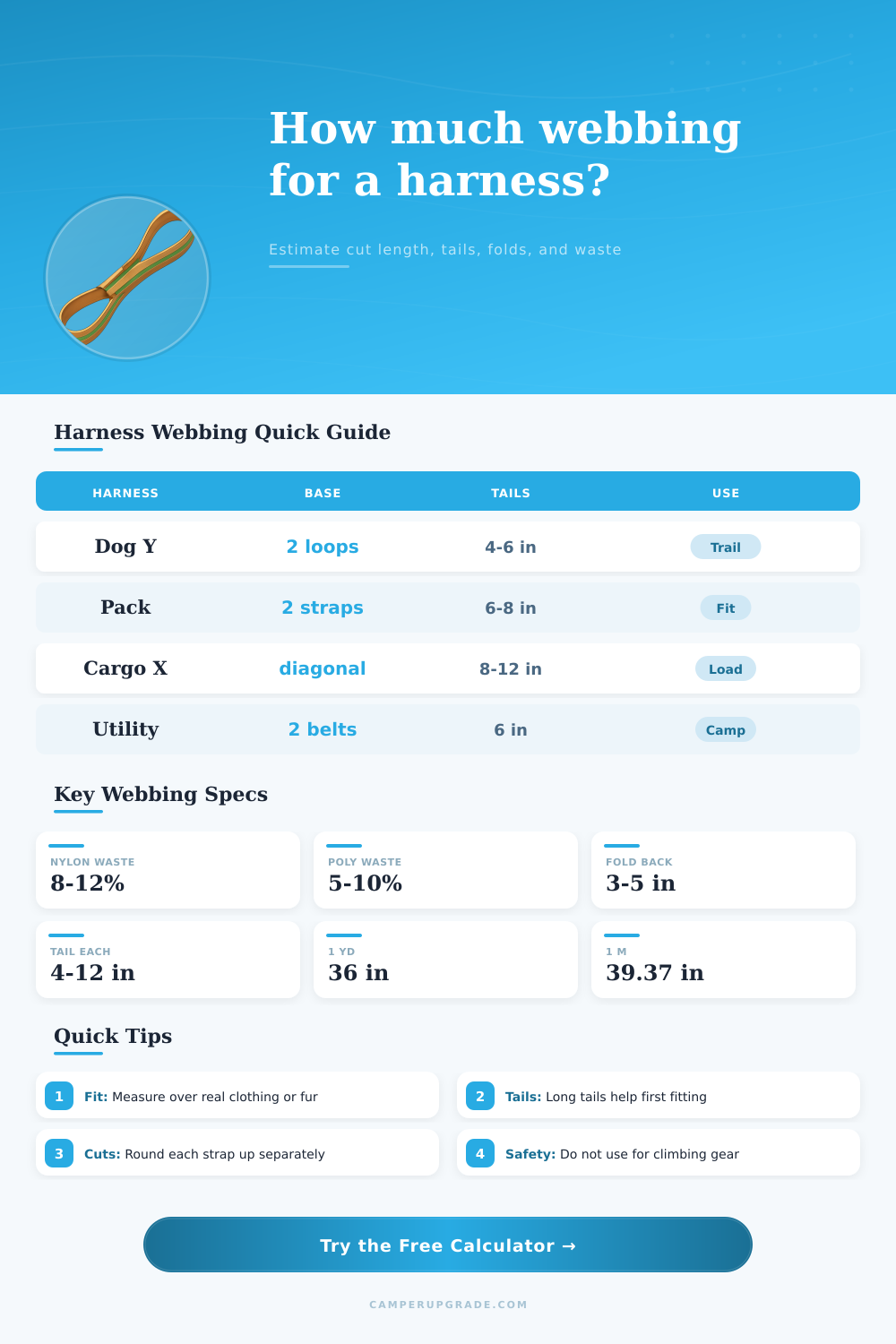
Estimate webbing for trail dog harnesses, backpack straps, camp utility belts, and cargo keeper harnesses from real measurements, hardware foldbacks, adjustment tails, stitching allowance, spares, and material waste.
🎒Real Harness Webbing Presets
⚙Harness, Measurement, Hardware, and Waste Inputs
📏Webbing Planning Spec Grid
📋Reference Tables
| Pattern | Primary loop | Secondary loop | Bridge and diagonal logic |
|---|---|---|---|
| Dog Y-front | Primary x 1.06 | Secondary x 1.03 | Bridge x 2.6 plus diagonal stabilizer x 0.35 |
| Dog H-back | Primary x 1.10 | Secondary x 1.00 | Bridge x 2.2 plus two side connector paths |
| Backpack straps | Primary x 1.90 | Secondary x 0.55 | Bridge x 2.0 for sternum and load lifter routing |
| Cargo X | Primary x 0.70 | Secondary x 0.35 | Two diagonals from panel length and width |
| Utility belt | Primary x 1.18 | Secondary x 0.10 | Bridge x 0.6 plus straight drops |
| Sled traces | Primary x 1.05 | Secondary x 0.75 | Bridge x 4.2 plus diagonal stabilizer x 0.25 |
| Hardware | Base allowance | Width factor | When to increase |
|---|---|---|---|
| Side-release buckle | 2.0 in each | 4 x width | Bulky acetal buckles or doubled webbing |
| Cam buckle | 2.5 in each | 5 x width | Thick webbing or long lever cams |
| Ladderlock | 1.5 in each | 3 x width | When the tail must reverse through hardware |
| D-ring or O-ring | 1.0 in each | 3 x width | Large leash tabs or handle anchors |
| Keeper loop | 1.5 in each | 1 x width | Wide elastic or folded webbing keepers |
| Sewn fixed loop | 0.5 in each | 2 x width | Heavy thread, pads, or foam sleeves |
| Width | Typical use | Fold note | Cutting note |
|---|---|---|---|
| 1/2 in | Small dog, keepers, light tabs | Short folds can slip | Seal carefully after cutting |
| 3/4 in | Small harnesses and pack straps | Often needs 3 in returns | Good for compact buckles |
| 1 in | General camp and dog projects | 4 in return is a common start | Most hardware is easy to source |
| 1-1/2 in | Large dogs, shoulder straps, belts | Longer folds reduce bulk | Round cuts up by the inch |
| 2 in | Cargo wraps and wide utility belts | Bulky at stitched stacks | Add prototype waste |
| Project | Primary measure | Secondary measure | Typical buy length |
|---|---|---|---|
| Small dog H-back | 18 to 24 in girth | 12 to 16 in neck | 3 to 4 yd |
| Medium dog Y-front | 24 to 32 in girth | 16 to 22 in neck | 4 to 6 yd |
| Backpack shoulder pair | 32 to 44 in path | 10 to 16 in sternum | 4 to 5 yd |
| Cargo box X harness | 60 to 120 in perimeter | 0 to 40 in loop | 6 to 10 yd |
| Camp utility belt | 32 to 48 in waist | 0 to 12 in drops | 3 to 6 yd |
💡Webbing Cutting Tips
When you prepare to build a harness, you must first determine the correct amount of webbings that is required to complete the harness. If you dont have enough webbing to build the harness, you will not be able to complete the harness. It is possible that you may not have enough webbing because you did not account for each turn of the webbing, or for each spare piece of webbing that may be required to create the harness.
In order to determine the proper amount of webbing for your project, you must account for each of these factor. Many peoples attempt to calculate the amount of webbing that are required for their harness by measuring the length of the obvious loops that the harness is to create, and purchasing some additional webbing for that calculation. However, this calculation often fails to account for the difference between the types of hardware required to build a harness, and the differences in the width of the webbing required for those harnesses.
How to Measure Webbing for a Harness
For instance, a cam buckle will require a different amount of webbing than a side-release buckle. In addition, webbing that is widely will require additional length to create the turns at each termination point of the webbing. Each of these factors have the potential to alter the amount of webbing that is required to build the harness.
Thus, it is critical for an individual to account for these small differences. The webbing calculator allow for an individual to calculate the amount of webbing that is required for a harness according to these various factors. The webbing calculator can separate the length of each of the straps that the harness is to create from the hardware that the user will utilize.
Additionally, the calculator can separate the length of the adjustment tails that the harness will create from the allowance for waste of webbing that may occur during the building of the harness. This waste allowance protect the individual against possible mistakes in the initial creation of the harness. Additionally, every harness design will require a different amount of webbing and each type of calculation will require a different logic to determine the webbing amount.
Furthermore, the webbing calculator also calculates the number of segments of webbing that will need to be cut to create the harness. This is an essential calculation to determine if any short piece of webbing will be necessary to purchase in addition to the harness that is to be built. The webbing measurement should be taken over the actual layers of the item that the animal that is to wear the harness will wear.
For instance, if the animal is to wear a coat during the winter month, the webbing should measure over the layers of the coat. Similarly, if the animal is to wear a cargo box, the webbing should measure over the layers of the cargo box as well. If such a measurement is made over the actual layers, it will ensure that the webbing will not need to be emergency cut to account for an unexpected change in the depth of the cargo box or animal coat.
In addition, allowing for longer length of webbing than those calculated is another form of insurance to account for the possible movement of the animal while the animal is wearing the harness. The amount of webbing that will be waste in the creation of the harness is another factor to be accounted for when calculating the amount of webbing that will be required for the harness. An individual that is experienced in the type of harness and webbing can waste only eight percent of their webbing during the creation of the harness.
However, an individual that is performing a first creation of a harness with bulky webbing can waste more than eight percent of their webbing. Thus, the webbing calculator allow the individual to set a percentage for the waste of their webbing in accordance with their experience and skill with webbing. In addition to the waste amount that is calculated for the harness, an individual can also purchase an additional length of webbing as an allowance for future repairs to the harness.
The reference tables located on the web page allow for an individual to become more familiar with the allowances for each type of hardware and webbing width. These reference tables are useful in that they allow for each individual to understand the reasons for each type of allowance for each type of hardware. For instance, a two-inch belt will require the production of longer foldbacks along the hardware than those required for a three-quarter inch webbing belt.
Thus, the reference tables make it easier for an individual to understand and trust the webing calculater’s calculations for the harness. Overall, the goal of utilizing the webbing calculator is to allow the individual to successfully cut the webbing required for the harness. This will allow the individual to avoid potential second-guessing and the need to purchase additional webbing to complete the harness.
Thus, if the individual understands the different types of measurement for the harness that will require an allowance of webbing of a certain length, the webbing calculator can reassure the individual that they have purchased enough webbing to complete the harness.