Switchback Count Estimate Calculator
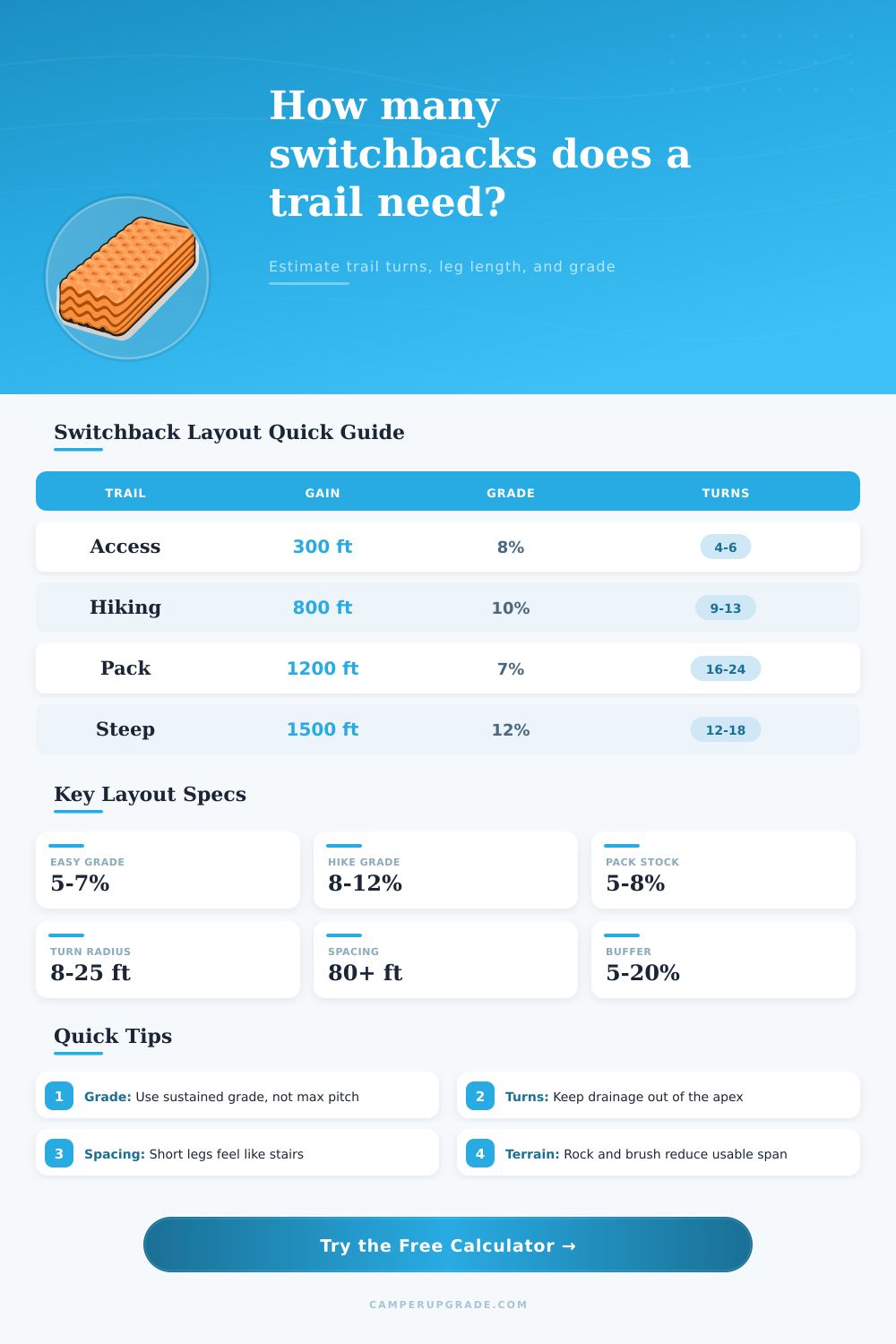
Estimate how many trail switchbacks fit a hillside from total climb, desired tread grade, usable traverse span, turn radius, connector loss, terrain efficiency, and minimum spacing.
🏕Real Trail Layout Presets
⚙Climb, Grade, Hillside, and Turn Inputs
📊Trail Layout Spec Grid
📐Grade and User Reference
| Use Type | Typical Target | Notes |
|---|---|---|
| Accessible walking path | 3% to 5% | Needs frequent rests and careful standards review. |
| Family hiking trail | 5% to 8% | Comfortable climb with fewer erosion issues. |
| General mountain trail | 8% to 12% | Common sustained hiking range on durable soils. |
| Short rugged connector | 12% to 15% | Use sparingly; drainage and footing matter more. |
| Pack stock or bike-friendly | 5% to 8% | Wider turns and longer legs usually needed. |
| Terrain | Efficiency Used | Planning Meaning |
|---|---|---|
| Open grass or desert | 98% | Few obstacles; most of the span can be traversed. |
| Mixed forest bench | 90% | Tree avoidance and drain dips trim usable length. |
| Rocky or talus pockets | 78% | Rock bands and poor tread spots shorten legs. |
| Dense brush or blowdown | 72% | Clearing limits and root zones shrink the corridor. |
| Wet drainage or sensitive soil | 68% | Wet areas force extra reroutes and protection. |
🧭Switchback Count Examples
| Scenario | Gain | Grade | Span | Approx. Turns |
|---|---|---|---|---|
| Short campground connector | 220 ft | 8% | 520 ft | 4 to 5 |
| Lake overlook trail | 640 ft | 9% | 700 ft | 9 to 11 |
| Pack stock climb | 900 ft | 6% | 820 ft | 17 to 22 |
| Steep canyon descent | 1500 ft | 12% | 900 ft | 13 to 17 |
| Alpine hut approach | 480 m | 8% | 240 m | 24 to 31 |
| Value | Imperial | Metric | Use In Calculator |
|---|---|---|---|
| Turn radius, foot trail | 8 to 15 ft | 2.4 to 4.6 m | Narrow hiker turns. |
| Turn radius, bike or stock | 18 to 35 ft | 5.5 to 10.7 m | Room for broad arcs. |
| Minimum leg spacing | 80 to 200 ft | 24 to 61 m | Shortcut and erosion check. |
| 1 mile of trail | 5280 ft | 1609 m | Built run conversion. |
| 100 ft of climb at 10% | 1000 ft run | 305 m run | Basic grade relationship. |
💡Trail Layout Tips
Switchbacks is often necessary on hillsides with steep ground to prevent the trail tread from eroding quick due to the straight climb on these hillsides. On hillsides with a relatively straight and steep climb, water channel down the middle of the trail, as well as individuals that take shortcut on the trail to reduce the distance that they must travel on the trail. Switchbacks introduce grading of the hill that reduces the grade of each section of the switchback, but also increases construction cost, maintenance cost, and the number of locations in which drainage can become an issue along the trail.
Thus, determining the number of switchbacks that will be constructed on a given trail is important to ensure that the trail is constructed in relation to the hillside that it will traverse, rather than working against the hillside. The amount of elevation that an individual gains along a hill determine the scale of the switchback that is constructed along that trail. Steep hills or short climbs may only require one single switchback and turn to allow the trail to gain that amount of elevation; however, mountains with significant elevation gain will require switchbacks and turns to allow for the trail to gain that amount of elevation without creating issue for the trail or those individuals that travel along that path.
How to Decide How Many Switchbacks a Trail Needs
The target grade that is selected for the trail will also impact the number of switchbacks that is constructed. For instance, a target grade that incorporates steeper pitches will reduce the number of switchbacks that are constructed along that trail; however, the steeper pitch will also increase the chance of water issues along that trail tread. Conversely, a gentler pitch will allow for the trail to be constructed with more switchback turn, and may be more comfort for those that travel along the trail; however, the gentler pitch will require a wider trail corridor to accommodate that grade.
Another of the factors that can impact the number of switchbacks that are constructed along a trail is the width of the hillside on which the trail is constructed. The usable width of the hillside is typically less than the total width of the hillside due to potential cliffs along the trail. Additionally, the turns along switchbacks require a certain radius, and the radius of the turn platforms will increase if the trail is to accommodate high traffic load.
For instance, turn platforms must be constructed wider for bikes and pack stock than for individuals that walk along the trail. Additionally, the turns of a trail will require a minimum amount of space along the trail; trails with too short of a travel distance along each switchback will lead to individuals taking shortcut along the trail. Terrain efficiency is another of the factors that may impact the number of switchbacks that are constructed along a trail.
Open terrain allow for the trail to utilize the full span of the hillside; however, terrain that includes forests, rocks, or other growth or obstacles require the trail to detour around those obstacle. Additionally, the trail must be constructed to allow for water drainage dips, grade reversals, and armored crossing along the trail, which can reduce the amount of terrain that is available for constructing the trail. The calculator included here will calculate the number of switchbacks that can be constructed on a specific trail given the available variable.
The calculator will calculate the number of turns that will fit along the hillside, the average length of each leg along the switchback trail, and whether or not the switchbacks will meet the minimum spacing requirements for that trail. The calculator will also indicate if the trail is too narrow or if the spacing is too tight for that hillside. However, these calculations is not the final plan for constructing the trail.
An on-site evaluation of the trail will be required to ensure stability of the trail, sight line into the trail, and the natural drainage of that trail. Some of the more common mistake among trail designer include constructing switchbacks that are based upon the slope of the hillside that is to be traversed. Because switchbacks will be constructed in a manner that accounts for setbacks due to cliffs, terrain feature, and traffic loading, the trail may be too cramped for the terrain with these changes applied.
Other mistakes include the selection of a target grade for the trail without considering the capability of the maintenance personnel that will care for that trail. For instance, if the selected grade for a trail is relatively steep, an increased number of water bars along the trail are required. Additionally, another of the most common mistake in constructing switchbacks is not accounting for the minimum spacing for the trail.
If the length of each leg of the switchback is too short, individuals may begin to take shortcuts along the trail, which can lead to the development of new erosion line along those shortcuts. The reference table included on this page provide information regarding the grades that are typically used for different type of trails, and the efficiency of different types of terrain. These tables provide designer with context for the type of switchbacks that may be required for different types of trails and terrains, but the tables are not rule to be followed; a trail for individuals in a hiking trail can incorporate steeper pitch than a trail for stock or bikes.
Thus, these tables are meant to help provide context for trail designer regarding the types of switchbacks that is required. Some of the most important habit and consideration for trail designer include performing the math calculation for two or three different target grade for the trail to determine if the trail will have a reduction in the number of switchbacks along the trail if the grade is increased, or if the changes in target grade will impact the switchbacks along some other portion of the trail. Additionally, another important habit is to ensure that the trail satisfy the minimum spacing for that trail; if the trail is too short along each leg of the switchbacks, individuals may begin to take shortcuts along the trail.
Field adjustment to the trail that are made after the trail is constructed may impact the number of switchbacks along that trail. For instance, a rock outcrop along the trail may require the trail to incorporate an additional turn along the trail; or, wet area along the trail may require the trail to incorporate an additional reversal of the trail. The value of estimating the number of switchbacks that will be constructed along a trail is not in the number that is calculated.
The value of constructing a switchback estimate is in the conversation that the estimate can initiate regarding the trail that is to be constructed. If the trail designer take the time to consider these variable prior to beginning trail construction effort, the trail will be able to survive the construction process and the first few season of use along that trail.