Tent Peg Count by Wind Calculator
Estimate how many pegs and guyline anchors to pack from tent size, profile, wind speed, gusts, exposure, soil holding strength, stake type, and the spare margin you want in your repair kit.
⛺Real Camp Setup Presets
⚙Tent, Wind, Soil, and Stake Inputs
This calculator estimates planning quantities, not a guarantee of shelter safety. Check tent manufacturer limits, local weather warnings, soil conditions, and move camp if gusts exceed the shelter design.
📌Stake Holding Spec Grid
📊Wind, Stake, and Tent Reference Tables
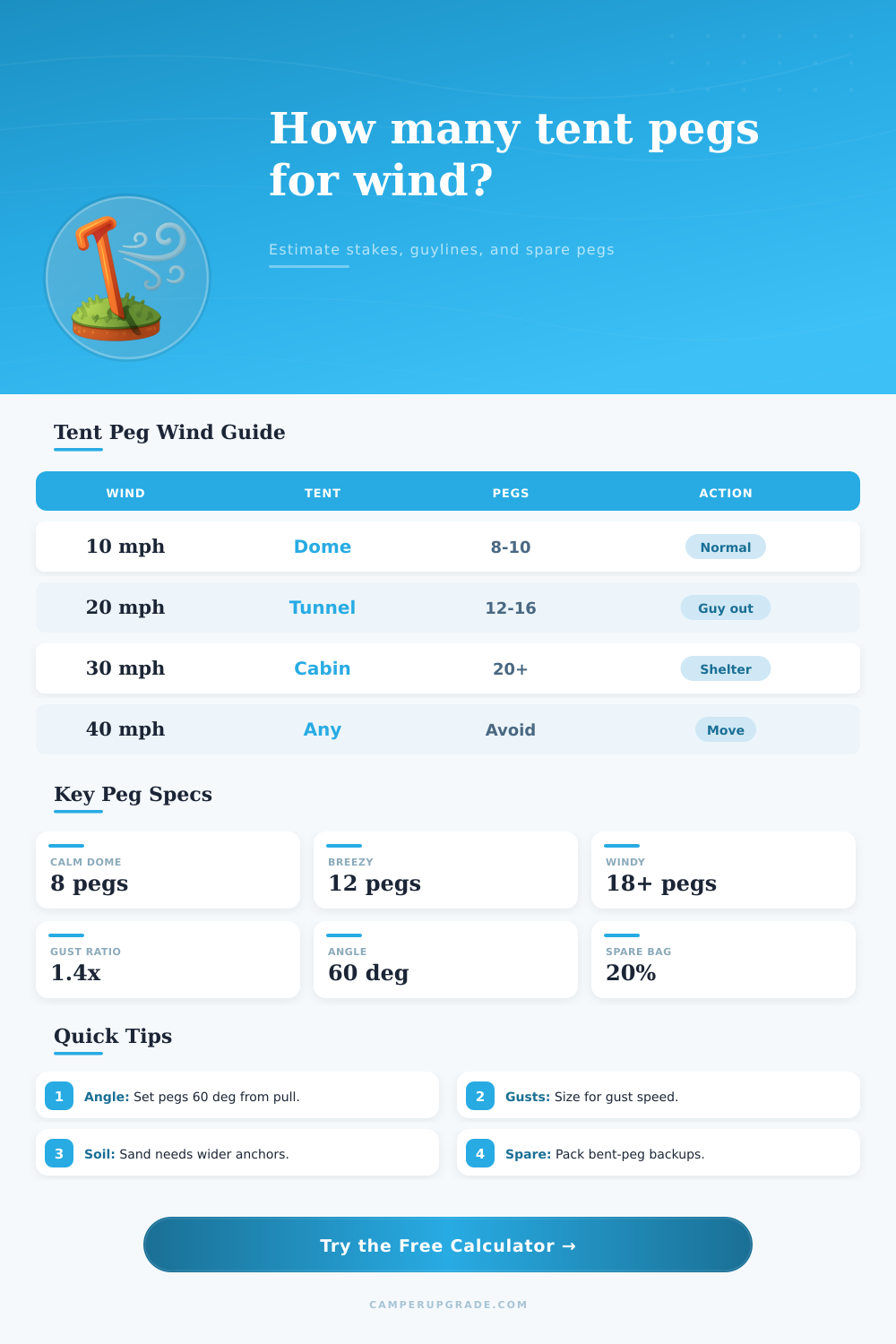
| Wind band | Design note | Typical peg strategy | Camp decision |
|---|---|---|---|
| 0-10 mph | Low aerodynamic load | Use required corners plus fly tabs | Normal pitch is usually enough |
| 11-20 mph | Noticeable fabric movement | Add main guylines and check angles | Stake the rainfly cleanly |
| 21-30 mph | Gust load rises quickly | Use all guylines and wider anchors | Look for a sheltered site |
| 31-40 mph | High load on tall tents | Double windward anchors where possible | Avoid exposed camping |
| 41+ mph | Severe load and fabric risk | Peg count may not solve the hazard | Relocate or wait out weather |
| Ground condition | Holding factor | Best anchor style | Field note |
|---|---|---|---|
| Hard clay or mineral soil | 1.15x | Steel nail, V-stake, Y-stake | Pre-angle before final seating |
| Firm loam or turf | 1.00x | Y-stake or V-stake | Reliable when fully buried |
| Mixed gravel or duff | 0.75x | Long Y-stake or steel stake | Probe for rocks and roots |
| Soft wet soil | 0.58x | Long stake, crossed stakes | Expect creep under gust load |
| Loose sand | 0.42x | Wide sand stake or buried bag | Use buried anchors for storms |
| Snow platform | 0.50x | Deadman, ski, snow stake | Allow anchors to sinter when possible |
| Shelter profile | Drag factor | Min pitch points | Wind note |
|---|---|---|---|
| Low backpacking tent | 0.72 | 6 | Low height helps, but guyline corners still matter |
| Dome tent | 0.82 | 6 | Good rounded shape with moderate side load |
| Tunnel tent | 0.95 | 8 | Strong when end-on, weaker broadside |
| Tall cabin tent | 1.20 | 10 | Large flat walls demand more anchors |
| Bell or wall tent | 1.05 | 12 | Many skirt pegs spread fabric load |
| Tarp or pole shelter | 1.10 | 6 | Panel tension and pole direction dominate |
| Awning or annex | 1.35 | 8 | Open edges can behave like a sail |
| Setup example | Dimensions | Wind | Starting peg count |
|---|---|---|---|
| 2P dome campground pitch | 9 x 7 x 4 ft | 15 mph | 8-10 pegs |
| Low backpacking tent on ridge | 8 x 5 x 3.5 ft | 25 mph | 12-16 pegs |
| 4P family cabin in open field | 12 x 9 x 6.5 ft | 25 mph | 18-24 pegs |
| Tunnel tent storm pitch | 15 x 7 x 4.5 ft | 30 mph | 20-26 pegs |
| Beach tarp or fly | 12 x 10 x 6 ft | 22 mph | 16-24 anchors |
| RV awning screen annex | 16 x 8 x 8 ft | 20 mph | 20+ pegs |
💡Field Tips
The tent peg calculator are a tool that allow you to determine how many tent peg you need on your camping trip. You use a tent peg calculator because the wind and the type of soil you encounter on your camping trip can change the number of tent pegs you need to secure your tent effectivly. If you dont use a tent peg calculator, you may end up with too few tent peg or tent pegs that is not strong enough for the ground.
Using a tent peg calculator allows you to calculate the load that each tent peg will have to carrying. To use the tent peg calculator, you must enter certain information into the calculator. You will have to enter the dimension of your tent, the wind speed, the gust speed of the wind, the type of soil in which you will be placing your tent pegs, and the type of tent anchor you will be using.
How to Use a Tent Peg Calculator
These variable affect the holding power of your tent pegs. For example, if you have a tall tent as opposed to a small tent, your tent will require more tent pegs because it will catch more wind. Additionally, if you are camping on hard clay as opposed to soft sand, you will need less tent pegs because steel stakes will have more of a grip on the hard ground.
The tent peg calculator uses the gust speed of the wind as opposed to the steady wind speed because gust of wind place more load on tents. The steady wind does not place a linear load on the tent, but the load increase with the square of the velocity of the wind. This means that a gust of wind will have more of a load on the tent than a steady wind of the same velocity.
For this reason, the tent peg calculator use the gust speed of the wind instead of the steady wind speed to calculate tent peg needs. Soil condition will change the number of tent pegs that you require for your tent. For example, an aluminum tent stake will hold 55 pound on firm turf, but it may only hold 25 pounds in sand.
The tent peg calculator will allow you to input the type of ground where you will be camping so that it can show you if the stake you have are sufficient for that ground. If you tent peg calculator determine that your stakes are not sufficient for your soil type, you can opt to use wider sand stakes or buried deadmen. Additionally, the location of your tent will play a significant role in the amount of wind load that your tent will encounter.
If you tent is in a sheltered valley, the wind load will be significantly less than if your tent is on a ridge or beach. Changing the location setting within the tent peg calculator will change the number of tent pegs that is recommended for your tent. One of the extra option included in the tent peg calculator is an option to include a spare buffer for your tent pegs.
During camping trip, it is possible to lose or bend your tent pegs. Therefore, adding a spare buffer of tent pegs to your total number of tent pegs will ensure that you have at least some extra tent pegs in case you do lose or bend one of your tent pegs. The tent peg calculator will show you the base number of tent pegs that your tent will require.
Additionally, it will also display the total number of tent pegs that you should buy for your tent, which include the spare buffer. The reference tables included in the tent peg calculator are for quick reference to the data included in the tent peg calculator. These reference tables shows the different band of wind speeds, the different condition of the ground, and the different profile of shelter that can be encountered when camping in the woods or outdoors.
These tables are not rules, but they do show pattern of the data that can help you understand whether or not your tents condition are within the normal limit for those variable. Using the tent peg calculator will not allow you to determine the weather condition or the soil that you will encounter at your tent site. However, the tent peg calculator will allow you to remove the uncertainty of the number of tent pegs that you should purchase for your tent.
Once you have determine the number of tent pegs that you will need with the tent peg calculator, you can decide whether to change the location of your tent or the type of tent anchor that you will use for your tent. Using the tent peg calculator will give you a head start on preparing your tent for the wind before the wind begin to hit your tent site.