Tent Stake Pullout Force Calculator
Estimate how much pullout force a tent stake can resist from soil type, embedment depth, stake profile, angle, compaction, moisture, guyline load, wind speed, and safety factor.
| Ground condition | Working shear | Calculator factor | Pullout behavior |
|---|---|---|---|
| Firm loam or grass turf | 7.5 psi | 1.00x | Balanced hold for most Y and V stakes. |
| Loose topsoil | 5.0 psi | 0.67x | Needs deeper embedment or more anchors. |
| Packed clay | 9.5 psi | 1.27x | Strong when fully penetrated, weaker when cracked. |
| Dry sand | 2.7 psi | 0.36x | Short pins pull quickly; wide stakes help. |
| Damp beach sand | 4.2 psi | 0.56x | Better cohesion but still width hungry. |
| Gravel or compacted pad | 6.2 psi | 0.83x | Variable because stones create voids. |
| Wet mud | 3.2 psi | 0.43x | Can pump loose under repeated gusts. |
| Snow or soft crust | 2.1 psi | 0.28x | Use long, wide, or buried anchors. |
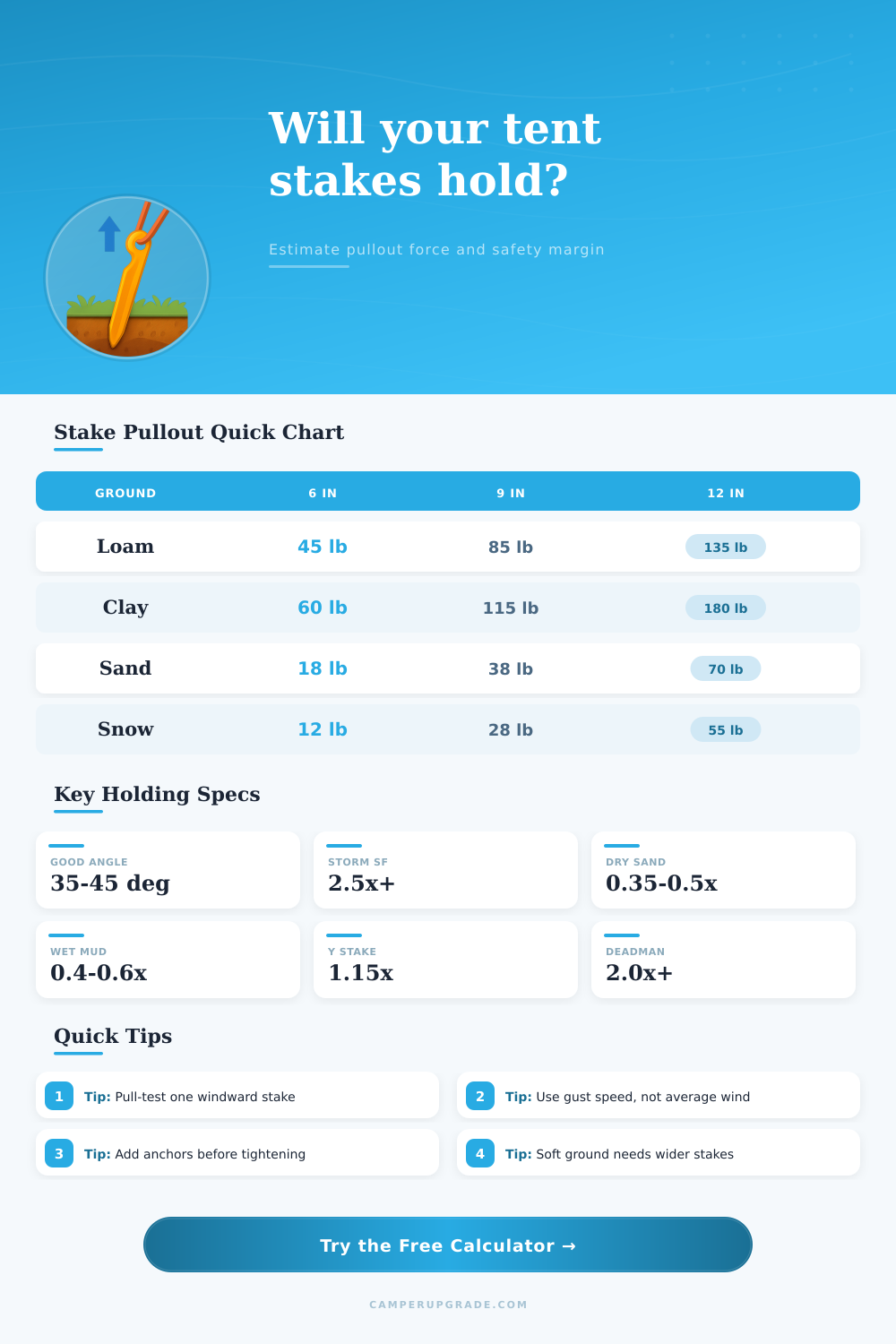
| Stake and ground example | 6 in buried | 9 in buried | 12 in buried |
|---|---|---|---|
| Wire hook in firm loam | 23 to 38 lb | 42 to 62 lb | 65 to 90 lb |
| Aluminum Y in firm loam | 45 to 70 lb | 85 to 125 lb | 135 to 190 lb |
| V stake in packed clay | 70 to 105 lb | 130 to 190 lb | 205 to 285 lb |
| Steel nail in gravel pad | 38 to 65 lb | 70 to 115 lb | 112 to 165 lb |
| Wide stake in dry sand | 28 to 48 lb | 60 to 95 lb | 105 to 155 lb |
| Buried snow deadman | 35 to 65 lb | 80 to 130 lb | 145 to 230 lb |
| Gust speed | Pressure | 36 ft2 panel | Per stake with 6 anchors |
|---|---|---|---|
| 20 mph | 1.02 psf | 37 lb | 6 lb |
| 30 mph | 2.30 psf | 83 lb | 14 lb |
| 40 mph | 4.10 psf | 148 lb | 25 lb |
| 50 mph | 6.40 psf | 230 lb | 38 lb |
| 60 mph | 9.22 psf | 332 lb | 55 lb |
| Reading | Range | Meaning | Better field choice |
|---|---|---|---|
| Angle efficiency | 35 to 45 deg | Highest normal pullout reserve | Set stake away from the tent. |
| Thin margin | Under 1.5x | Anchor may pull during gusts | Add depth, width, or another stake. |
| Usable margin | 1.5x to 2.5x | Reasonable planning range | Inspect after wind shifts. |
| Strong margin | Over 2.5x | Good reserve for entered load | Still recheck softening soil. |
| High upright pull | 60 deg or more | More vertical extraction force | Move stake farther from shelter. |
A tent stake pullout force calculator is a tool to helping determine if a tent stake will remain in the ground should the wind apply force to the tent. By entering specific inputs into the calculator, the calculator will provide a single number to the users that indicates whether or not the tent stake is strong enough to resist the tents wind forces. The inputs that must be entered into the tent stake pullout force calculator include soil type, stake shape, burial depth, stake angle, and the expected wind speed.
Each of these variables contribute to the amount of soil that will help to resist the tent stake’s pull out of the ground; as such, it is essential for the user of the tent stake pullout force calculator to enter accurate values for each of these parameters in order to receive an accurate calculation of the stakes strength. Several of the most important variables to consider are burial depth and stake width. Each of these parameters have the potential to alter the way that the soil provides resistance to the tent stake.
How to Use a Tent Stake Pullout Force Calculator
For instance, burial depth can alter the length of the tent stake that is buried into the ground, while the width of the tent stake can alter the amount of soil located in front of the tent stake’s buried portion. A stake with a narrow hook shape may have the same burial depth as a wide stake made of sand, but the sand stake will provide more resistance against being pulled out of the ground due to the increased area of the stake that is buried into the ground. Additionally, the angle at which the person drives the tent stake into the ground is also important; a tent stake driven directly into the ground has little resistance against being pulled out, but a tent stake driven into the ground at an angle of around 40 degrees will allow the force of the wind to be distributed in a way that is strongest against the soil.
Finally, soil moisture and compaction also play a role in the strength of the tent stake; the user can therefore manipulate the parameters for moisture and compaction within the calculator in the case that the soil is wet or soft. Wind load is also a factor that must be considered when using the tent stake pullout force calculator. Wind load is often stronger then the average wind speed.
Additionally, there may be a single strong gust of wind that exerts more force upon the tent than the average wind speed. The user can enter the wind force that is applied to the tents stakes into the calculator, and the user can provide a factor for safety by multiplying the wind force by a safety factor within the calculator. The safety factor will be the strength (capacity) of the tent stake divided by the demand of the wind.
If the safety factor is at 2.5 or more, the tent stake has comfortabley room to remain in the ground; however, if the safety factor is at 1.5 or less, the tent stake is near its limit in relation to the wind. Another important factor to consider is the shape of the tent stake. Different tent stake shape will produce different amounts of resistance in different types of soil.
For instance, a tent stake made of light aluminum and in the shape of a Y is easy to carry, but it may not be strong enough to remain in sandy or snowy conditions. If the tent stake pullout force calculator was used to compare the strength of a wide sand stake to a narrow tent hook, the narrow tent hook is likely to exhibit a lower safety factor indicating that it will not remain in the tent as strongly as the sand stake. In some instances, it is possible that the person camping may need to use a different type of tent stake or a buried deadman system instead of simply adding another tent stake of the same type.
Tent stakes has different placements and angles that impact the amount of resistance provided to the tent stake. For example, the tent may pull the tent stake upwards if stakes are placed too close to the tent. An upward tension on the tent stake reduces the horizontal resistance that the soil can provide for the tent stake.
Therefore, the user can improve tent stakes by moving them a greater distance away from the tent. The tent stake pullout force calculator includes the angle that the tent stake will make with the ground. However, the person who is setting up the tent must adjust the guyline to move the tent stake to the appropriate distance.
Finally, ground conditions may change while camping. For instance, soil may become soft due to rain falling or the foot traffic of those camping near the tent. These changes in the ground conditions can be accounted for in the tent stake pullout force calculator; tent stakes can be re-evaluated using the calculator to determine whether or not the tent stake is still appropriate for the tent.
If the tent stake isnt strong enough to remain in the tent in these changed conditions, there may need to be the addition of another tent stake or a change in the type of tent stake that is used to secure the tent. Finally, a person should also perform a physical test of the tent stake; a person could physically pull a tent stake to determine whether the ground is weaker than the pullout force calculator indicated.