White Gas Trip Fuel Calculator
Estimate how much white gas to pack for boiling water, simmering meals, melting snow, priming the stove, and keeping a real reserve for cold, windy, or remote trips.
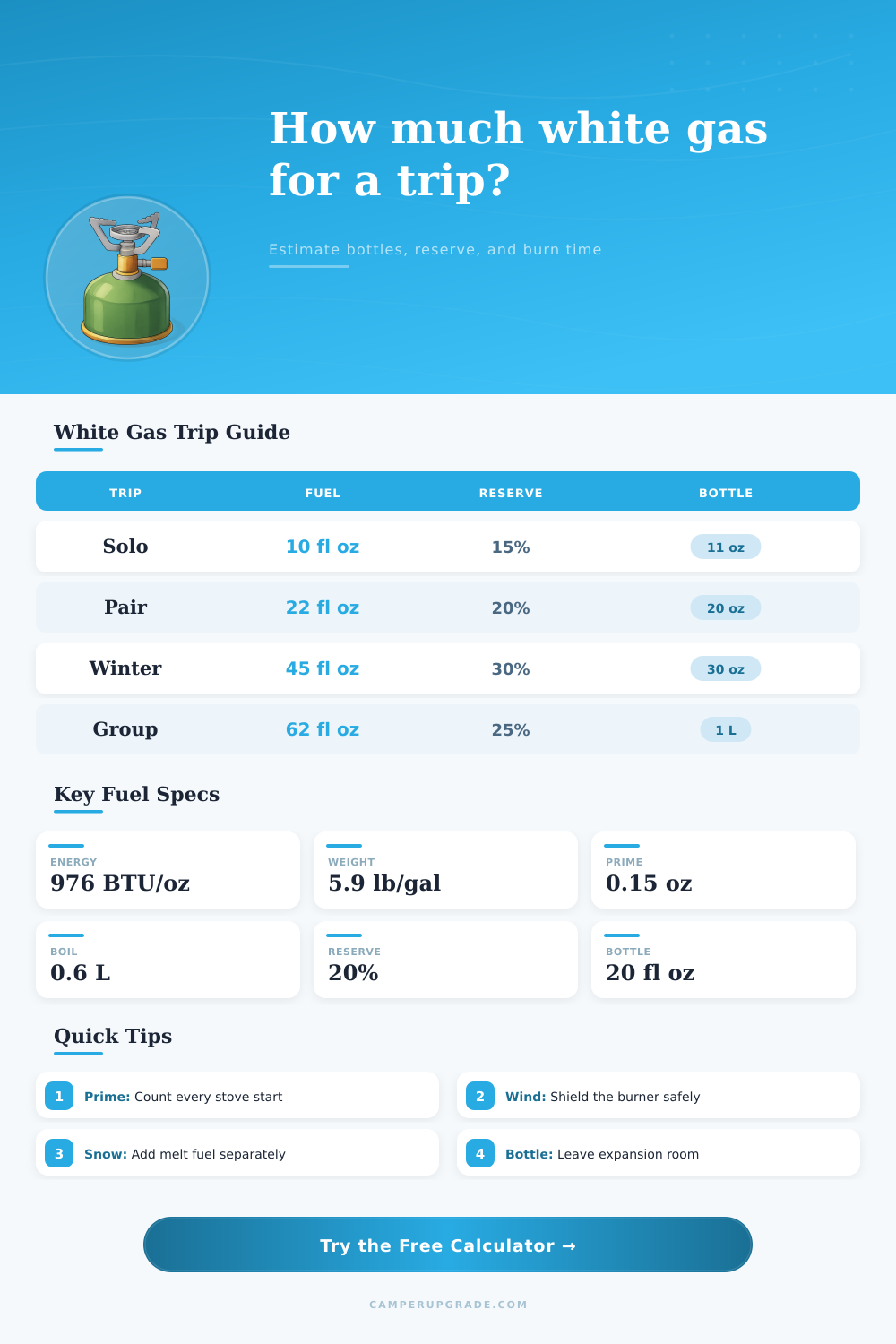
🏕White Gas Trip Presets
⚙Trip, Stove, Weather, and Bottle Inputs
The calculation combines water heat load, altitude-adjusted boiling temperature, white gas energy density, stove efficiency, simmer burn, snow melt, priming fuel, weather exposure, and a selected reserve.
📊White Gas Planning Specs
📑Reference Tables
| Bottle | Usable fill | Best trip role | Notes |
|---|---|---|---|
| Small fuel bottle | 11 fl oz | Solo backup | Good for short fair-weather cooking. |
| Medium fuel bottle | 20 fl oz | Most backpack trips | Common balance of capacity and packability. |
| Large fuel bottle | 30 fl oz | Winter or groups | Useful when boiling big pots or melting snow. |
| 1 liter fuel bottle | 33.8 fl oz | Expedition legs | Check the marked max fill line before packing. |
| Reserve | Use when | What it covers | Risk read |
|---|---|---|---|
| 10% | Short trailhead trips | Minor relights and drink boils | Light |
| 15% | Normal three-season route | Cool water and one extra meal | Balanced |
| 20% | Backcountry default | Wind, spills, and timing changes | Safer |
| 30%+ | Winter or remote travel | Snow melt, storms, and delays | Conservative |
| Pattern | Boil water | Simmer | Typical fuel |
|---|---|---|---|
| Solo coffee and pouch | 1.0 to 1.4 L/day | 0 to 4 min | 2 to 4 fl oz/day |
| Two hikers, hot meals | 2.0 to 3.0 L/day | 6 to 12 min | 5 to 8 fl oz/day |
| Group pasta pot | 4.0 to 7.0 L/day | 15 to 30 min | 10 to 18 fl oz/day |
| Winter snow melt | Variable | Often long | 15+ fl oz/day |
| Piece | Variable | Formula role | Why it matters |
|---|---|---|---|
| Boil heat | liters and temp | water kg x heat rise | Cold water drives fuel up. |
| Efficiency | stove setup | useful heat divided by efficiency | Pot match changes real fuel. |
| Simmer burn | minutes | fuel rate x simmer time | Long meals can exceed boil fuel. |
| Prime loss | starts | starts x prime fuel | Short burns waste more fuel. |
💡Trip Planning Tips
Always follow your stove and fuel bottle instructions. Do not overfill pressurized bottles, cook in a ventilated area, and keep fuel away from ignition sources while filling.
Planning a backcountry trip require you to think about every system that keep you fed and warm. The system that determines your comfort during your days on the trail is your fuel. White gas stove are one of the systems that many people use on their trips into the backcountry because white gas stoves perform well in wind, white gas stoves perform well at high altitudes, and white gas stoves perform well in cold conditions.
Canister stoves often fail in conditions that are cold, but white gas stoves does not fail in cold conditions. You need to carry enough fuel so that you dont run out of fuel on your trip, but you also dont want to carry too much fuel because it will add to your weight. The best way to avoid mistakes with fuel and it’s weight is to understand the factors that impact fuel consumption during your trip into the backcountry.
How to Plan Fuel for a Backcountry Trip
One of the largest factors that will impact the amount of fuel that you burn on your trip is the volume of water that you will boil on your trip. The more water you boil, the more fuel you will burn. If the water that you will boil starts at a cold temperature, you will burn more fuel than if you used hot water.
Additionally, if you plan on boiling water at a high altitude, you will burn more fuel because the boiling point of water drop at high altitudes. You can account for both the starting temperature of the water and the altitude of your destination in the fuel calculator because these two factors impact the total amount of fuel that you will burn while boiling water. Many individuals do not account for the fact that if the water that they intend to boil is very cold, they will require more fuel.
Additionally, if the air temperatures drop during the trip, the water will require more fuel to reach boiling point. Simmer time is another variable that will impact the amount of fuel that is burned on a trip. If the meal that you are cooking requires only rehydration of food, simmer time will be minimal.
However, if the meal contains rice and lentils, simmer time will be longer because rice and lentils takes longer to cook. If you are cooking rice or lentils, you will need to prime your stove for fifteen to twenty minutes. Simmer time that long will use up more fuel than boiling water.
The fuel calculator accounts for simmer time by having separate fields for the amount of fuel that is burned while boiling water and while simmering meals. Your cooking style will use more fuel than you account for in water volume alone. Another factor that will impact the amount of fuel that you burn is the number of times that you must prime the stove.
When you prime the stove, you must burn some of your fuel in order to heat the stove to the temperature that is required for the vaporization of white gas. This act of priming the stove consumes fuel. If you use your stove many times during your backcountry trip, you will prime the stove many times during the trip, and each priming of the stove consume some of your fuel.
For example, if you use your stove to make coffee many times during the day, you will use more fuel than an individual who only uses the stove only twice during the day. On some trips, because you are using the stove so many times during the trip, you may consume all of your fuel before you have even gotten to cook your meals. Another process that burns fuel at a different rate is the melting of snow.
Melting snow requires a different amount of fuel than boiling water. To melt snow requires the addition of heat to warm the snow to the rate at which it melts. However, melting snow also requires an additional amount of fuel to perform the process of melting the snow.
Because the efficiency in melting snow is less than the efficiency of boiling water, the amount of fuel that you burn to melt a given volume of snow may be more than you anticipate. People often underestimate the amount of fuel require for melting snow. An additional factor is the need for reserve margins for unexpected conditions.
For example, wind and cold temperatures will consume fuel. Additionally, boiling water at a high altitude will consume fuel. Drinking hot beverages will also consume fuel.
These unexpected conditions will consume fuel that you did not account for when you initially calculate your fuel needs. The fuel calculator allows you to select different percentages of reserve fuel. Twenty percent reserve fuel is enough for most three-season trips.
For winter and remote trips, a thirty percent reserve fuel margin or more is required. The reference tables on the page can provide information about fuel bottle sizes. Additionally, the reference tables can help you to understand how many unit of fuel you will consume based on the different reserve margins for fuel.
Once you determine the number of days that you will require fuel, you can account for the number of fuel bottles in your packing list. This calculation of the amount of fuel that is required to complete your trip allows you to treat fuel as a measurable system. If the amount of fuel that you calculate accounts for the real conditions on your trip, you will be able to ensure that you have enough fuel to cook your meals without carrying too much extra weight.