Isobutane Canister Days Remaining Calculator
Estimate how many cooking days, boils, simmer minutes, and safe reserve remain in an isobutane canister from canister weight, stove efficiency, weather, altitude, and your meal pattern.
⛽Camping Fuel Presets
⚙Canister And Stove Inputs
🍲Daily Cooking Pattern
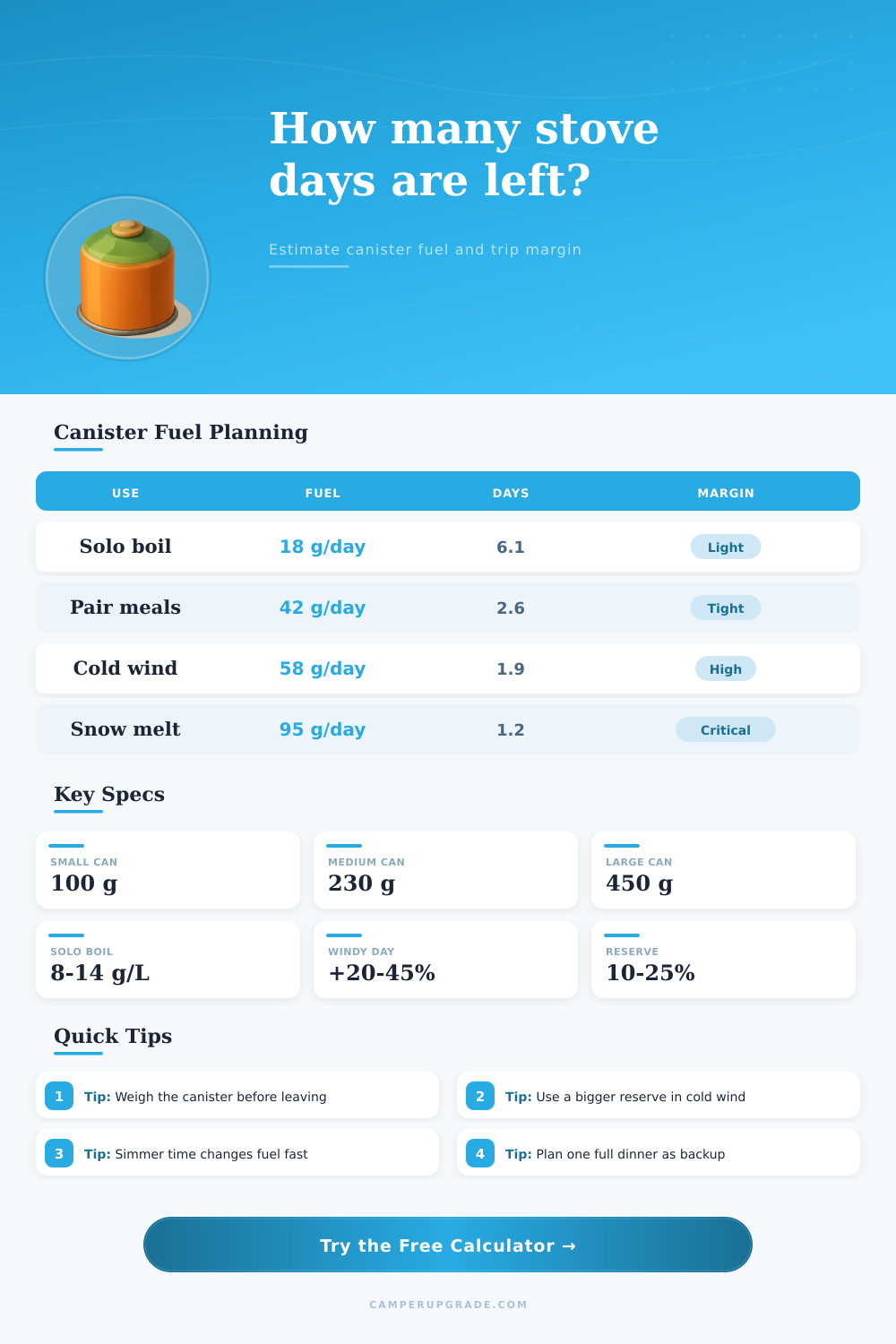
📊Isobutane Fuel Spec Grid
📋Canister Weight Reference
| Canister size | Net fuel | Typical empty can | Full gross estimate |
|---|---|---|---|
| Small backpacking can | 100 to 110 g | 85 to 100 g | 185 to 210 g |
| Medium backpacking can | 220 to 230 g | 140 to 160 g | 360 to 390 g |
| Large basecamp can | 440 to 450 g | 205 to 230 g | 645 to 680 g |
| Expedition canister | 500 g | 230 to 250 g | 730 to 750 g |
🔥Boil Fuel Reference
| Stove and pot setup | Protected mild fuel use | Wind penalty | Best calculator setting |
|---|---|---|---|
| Integrated heat-exchanger pot | 7 to 9 g per liter | Low to moderate | Use integrated heat-exchanger setting. |
| Efficient upright canister stove | 9 to 11 g per liter | Moderate | Use efficient upright setting with shelter. |
| Standard upright stove and pot | 11 to 13 g per liter | Moderate to high | Use standard setting and pick wind carefully. |
| Wide pot, no lid, or older stove | 13 to 16 g per liter | High | Use basic stove or older stove setting. |
| Condition | Multiplier | Meaning | Planning use |
|---|---|---|---|
| Sheltered | 0.92 to 1.00 | Protected flame and efficient pot | Good for calm forest camps. |
| Light breeze | 1.18 | Some heat loss around pot | Use for partial shelter. |
| Windy camp | 1.35 | Fuel rises quickly | Use for open campsites. |
| Exposed ridge | 1.55 | High loss and slower boils | Carry extra or cook lower. |
| Cooking pattern | Daily fuel | 100 g can | 230 g can |
|---|---|---|---|
| Solo drinks only | 12 to 18 g | 5 to 8 days | 12 to 17 days |
| Solo meals and coffee | 24 to 35 g | 2 to 4 days | 5 to 8 days |
| Two-person dinner boil | 38 to 55 g | 1 to 2 days | 3 to 5 days |
| Cold wind or snow backup | 70 to 110 g | under 1 day | 1 to 3 days |
💡Fuel Planning Tips
This calculator estimates fuel use for planning. Actual burn time varies with stove model, pot diameter, lid use, gas mix, valve setting, wind shelter, water temperature, and canister pressure.
A canister days remaining calculator is a helpfull tool for backpackers to determine how many days there fuel canister will last during their trip. Weather and the size of the groups on the trip tend to change. People may assume that the fuel consumption will be the same throughout the trip, but the temperature of the water being boil, the amount of wind exposure, and the altitude of the trip will impact the consumption of fuel.
Using a canister days remaining calculator allow backpackers to compare the amount of fuel they currently has to the amount of fuel that they think their trip will require. The first step is to find out the amount of fuel that they currently has in their fuel canister. You can do this by weighing the canister and then subtract the weight of an empty canister.
How to Check How Many Days Your Fuel Canister Will Last
Alternatively, people can estimate the amount of fuel in the canister by eye. However, weighing the canister is the most accurate way of determining the amount of fuel since weighing the canister will account for any fuel that might have been lost while packing the canister. Once they enters the amount of fuel that they have in the canister, the calculator will treat this as a maximum amount of fuel that they have.
The next step in using the canister days remaining calculator is to enter the cook requirement for each person in the group. This includes the number of people in the group and the number of boil each person will perform with a certain volume of water for each boil. These cook requirements must be adjusted according to the environmental factor that may impact how much the stove will use.
For instance, water that starts at a lower temperature will require more fuel to reach a boil. Boiling water in the wind will also require more fuel because the heat will be lost from the pot. Boiling water at a high altitude will require more fuel because of the boiling point of the water, as well as because of the wind present at high altitude.
Furthermore, different times can be entered for simmering rice or meal. The fuel consumption for simmering is at a different rate then boiling water. All of these environmental and cooking considerations must be accounted for in the calculator so that a proper estimate of fuel consumption for the trip is made.
Another factor in the calculator is the number of days of fuel that will be reserved. Fuel will be reserved in case of unexpected circumstance such as a storm that keeps the group in the campground for one or more extra night. Or, the fuel may be reserved in case the stove has difficulty in functioning properly in the cold.
If the calculated margin of fuel is small, it might be a good idea to move the date of the resupply of fuel for the trip prior to the group encounter conditions that may require the additional fuel that would normally be provided by the fuel canister. Alternatively, if the calculated margin of fuel is high, it might be okay to leave the group without fuel until they reach a resupply point for fuel. The type of stove and the type of pot that will be used will also impact the calculation of the length of time that the fuel will last in the fuel canister.
For instance, fuel consumption will be lower with an integrated heat-exchanger stove compared to a standard upright burner stove. Furthermore, the ignition loss of the stove can also be entered into the calculator. Each time the fuel canister is opened, some fuel is lost.
This loss of fuel is minimal for a single cook, but significant over a period of day. These factor can also be accounted for in the calculation of the length of days that the fuel will last. An extra event field can also be used in the canister days remaining calculator.
One extra event that might happen is melting snow to fill the canister with water. Furthermore, there may be an extra event of boiling water for coffee. These additional event will increase the amount of fuel that will be used up during the trip.
The purpose of the canister days remaining calculator is not to accurately calculate each of the variable for the trip, but rather to show the impact that certain change to those variables will have on the fuel supply of the group. For instance, if the trip is to change from a sheltered area to an area with more exposure to the wind, the fuel margin will decrease. Therefore, more fuel will have to be carried or the trip will be shortened.
Reference table are provided in the calculator. The reference tables indicate the typical weights of empty fuel canister as well as the impact that wind has on the fuel consumption of the stove. These reference tables will help the backpackers decide their inputs in the calculator.
Finally, the calculator will provide a planning snapshot. This planning snapshot will show if there is enough fuel for the trip that has been planned. If there is not enough fuel, it will be suggested that more fuel is added or that the amount of water that will be boiled each day is reduced.
Furthermore, if there is more fuel than is needed, the amount of fuel that will be carried on the trip can be reduced. Thus, the canister days remaining calculator allow a backpacker to turn the general notion of the fuel that will be needed for the trip into a specific comparison of the fuel that the backpackers have with the fuel that they will need on their trip.