Consumables Weight Per Day Calculator
Estimate camping consumable weight from water, dry food, stove fuel, hygiene supplies, pack-out waste, reserve margin, crew size, trip length, and refill spacing.
🏕Trip Presets
⚙Consumable Planning Inputs
📊Consumable Spec Comparison Grid
📋Water Planning Reference
| Condition | Multiplier | Best use | Weight impact |
|---|---|---|---|
| Cool shade / low effort | 0.85 | Static campground, mild weather, short walks | Reduces drinking water only |
| Mild camp / normal activity | 1.00 | Baseline car camping, van trips, and short hikes | Keeps entered water unchanged |
| Warm hiking or paddling | 1.18 | Warm trail days, sun exposure, or steady movement | Adds 18% to drinking water |
| Hot exposed route | 1.35 | Open desert roads, summer ridges, or dry lake beds | Adds 35% to drinking water |
| Desert or heavy exertion | 1.55 | Remote dry routes, sand, wind, or hard pack travel | Adds 55% to drinking water |
🔥Fuel And Food Weight Table
| Consumable | Typical planning value | When it rises | Calculator field |
|---|---|---|---|
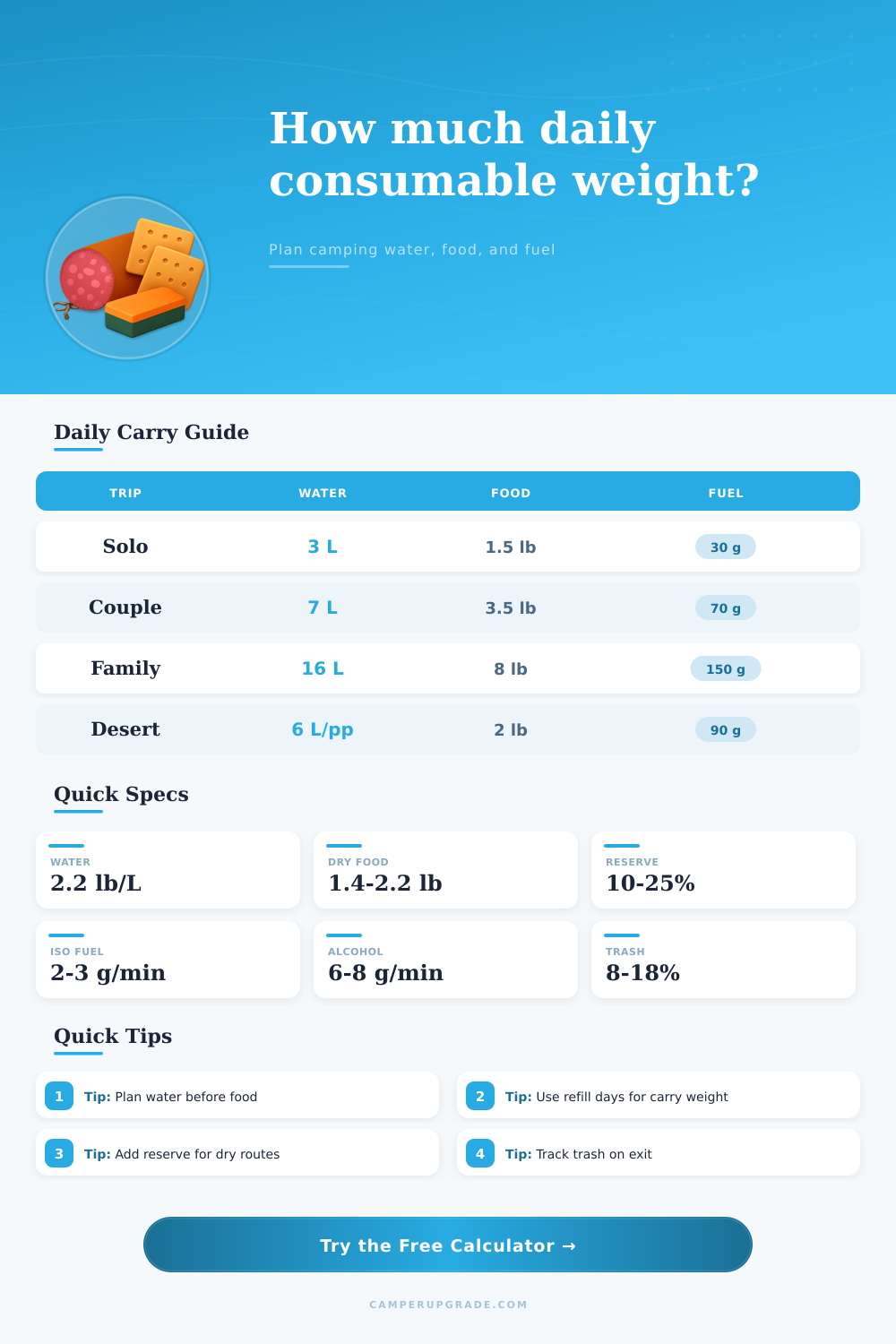
| Dry food | 1.4 to 2.2 lb per person day | Cold trips, high mileage, hungry crews, kids snacking | Dry food per person per day |
| Pet food | 0.4 to 1.4 lb per pet day | Large dogs, long trail days, cold conditions | Pet food per pet per day |
| Isobutane fuel | 2 to 3 g per burner minute | Wind, cold canisters, long simmers, snowmelt | Fuel burn rate |
| Propane fuel | 3 to 5 g per burner minute | Large burners, griddles, poor wind shielding | Fuel burn rate |
| Alcohol fuel | 6 to 8 g per burner minute | Low heat output, wide pots, cold weather | Fuel burn rate |
| Hygiene supplies | 40 to 120 g per person day | Group meals, kids, wet weather, longer gaps | Hygiene supply per person per day |
| Fuel package | Net fuel | Good for | Watch point |
|---|---|---|---|
| Small canister | 110 g | Solo hot drinks or short trips | Low margin in cold wind |
| Medium canister | 230 g | Pair or small group weekend | Check daily burner minutes |
| Propane cylinder | 465 g | Camp stove and car camping meals | Heavier steel container remains |
| Alcohol bottle | 500 g | Simple boiling and quiet camp use | Higher grams per minute |
| Refill gap | Carry logic | Best for | Reserve note |
|---|---|---|---|
| 0.5 to 1 day | Carry daily need plus reserve | Town loops and serviced campgrounds | Small margin is often enough |
| 2 to 3 days | Carry multi-day water and food | Weekend routes and dispersed camps | 10% to 15% works well |
| 4 to 6 days | Food and fuel dominate after water | Remote overland or river sections | 15% to 25% is common |
| 7+ days | Audit every category | Dry expeditions and long resupply legs | Use verified water sources |
🧭Common Trip Examples
| Preset | Crew | Consumable emphasis | Planning detail |
|---|---|---|---|
| Solo backpack | 1 person | Food density and fuel margin | Low water refill gap keeps starting carry manageable. |
| Couple car camp | 2 people | Comfort water and cooked meals | Starting carry rises quickly with two full water days. |
| Family campground | 4 people | Food volume and hygiene supplies | Group meals push waste and cleanup allowance higher. |
| Desert boondock | 2 people plus dog | Drinking water reserve | Water dominates total weight before food or fuel. |
| Remote overland | 3 people | Long refill gap and reserve | Useful for checking departure weight before leaving pavement. |
💡Consumable Weight Tips
This calculator estimates consumable planning weight only. It does not include fixed gear, vehicle payload limits, medical needs, local water rules, or personal dietary requirements.
Planning a camping trip require that you determine your daily carry weight. You must determine your daily carry weight to ensure that you do not carry too much weight or that you dont run out of supplies. Your daily carry weight depend on the weight of the water, food, fuel, and an hygiene supplies that you will need for your camping trip.
Each of these camping supplies have a specific weight that adds up to your total daily carry weight. Your supplies will change depending on the number of campers that you have and the number of camping days that you will have between resupply points of supplies. The distance between resupply points is another factor that will have an impact on the total weight of water and food that you will need to bring on your trip.
How to Calculate Your Daily Camping Weight
The camping trip calculator can help you to calculate your total camping trip weight. This camping calculator will determine your total weight based off your crew size and the distance between refill points for camping supplies. Use the distance between refill points to calculate your camping trip weight because this value will determine your starting weight for the camping trip.
If there are camping refills in the middle of your trip, such as on the second day, then you will need to carry less water to begin your camping trip. This camping calculator will separate the total length of your camping trip from the refill spacing to display your starting camping weight instead of your average camping weight. The weight of the water that you will use on your camping trip is often the most significant part of your total camping weight.
The weight of the water that you will need will depend on the climate that you will encounter on your camping trip. If you are camping in a hot climate, you will require more water then if you were camping in a mild climate. Additionally, camping in hot weather will require you to consume more water than if you were camping and spending time at all car camping location.
In addition to the water that you consume while camping, you will need to account for the water that you use for cooking and for cleaning camping gear. Do not forget to include the weight of the water that you will need to clean your gear because this weight will be part of the total weight of your camping trip. The weight of the food that you will require for your camping trip will be different than the weight of the water that you will need.
However, the weight of your food will change based upon your camping requirement. For example, if you are camping in cold weather, you will need to account for the additional weight of the food that you will need for your body to gain the energy that it requires to keep your body warm. Additionally, if you are camping on many miles, you will require additional food to sustain your energy for such a distance.
If you plan on having no-cook meals for your camping trip, you will save weight on your camping trip. Additionally, you can save weight by planning for no-cook meals because this will reduce the fuel that you need to carry on your camping trip. Finally, plan for a reserve amount of food in case of weather delays on the camping trip.
For short camping trips, ten percent of food is a reserve that is often enough. For camping trips that may be remote camping location, you may need to plan for a fifteen or twenty-five percent reserve. The fuel weight for your camping trip will depend upon the type of stoves that you will use on your camping trip and the number of minutes that you would like to use the burners on your camping stove.
Isobutane canister will burn at a different rate than fuels like white gas. Additionally, the weather conditions that you will encounter on your camping trip will impact the number of minutes that you plan for your burners. The camping trip calculator will calculate the number of fuel canisters that you will need based upon your daily burner minute.
Using the correct number of camping fuel canisters will allow you to avoid the extra weight that you may have with an extra load of fuel that you dont need to carry on your camping trip. The weight that your hygiene supplies and waste contribute to your camping trip will also add to the total weight of your camping trip. Any waste products that you will create during your camping trip, such as used cooking and food wrappers, will contribute to the weight of your camping trip.
The factor for waste will allow you to calculate the total weight that your camping trip will have while you are on the way out of the camping trip. Finally, using such a camping trip weight calculator will allow you to make assumption about the camping supplies and their weights. With these number for the camping supplies, you can make decisions about your camping trip.
For example, you can decide whether or not the distance between refill points for camping supplies is worth the extra weight that you will have to carry for the length of your camping trip. Additionally, you can decide whether choosing lighter camping gear, such as stoves that weigh less, will reduce the total weight that you have to carry on your camping trip. These types of decision about your camping supplies are the most important part of planning a camping trip.