Snowshoe Load Sizing Calculator
Estimate total carried load, pair flotation area, recommended snowshoe size, tail add-on effect, and sink risk from snow type, grade, shoe dimensions, and stride preference.
❄Snowshoe Presets
⚙Load and Snowshoe Inputs
📏Snowshoe Spec Grid
📊Snowshoe Reference Tables
| Snow Type | Target Pressure | Flotation Need | Planning Note |
|---|---|---|---|
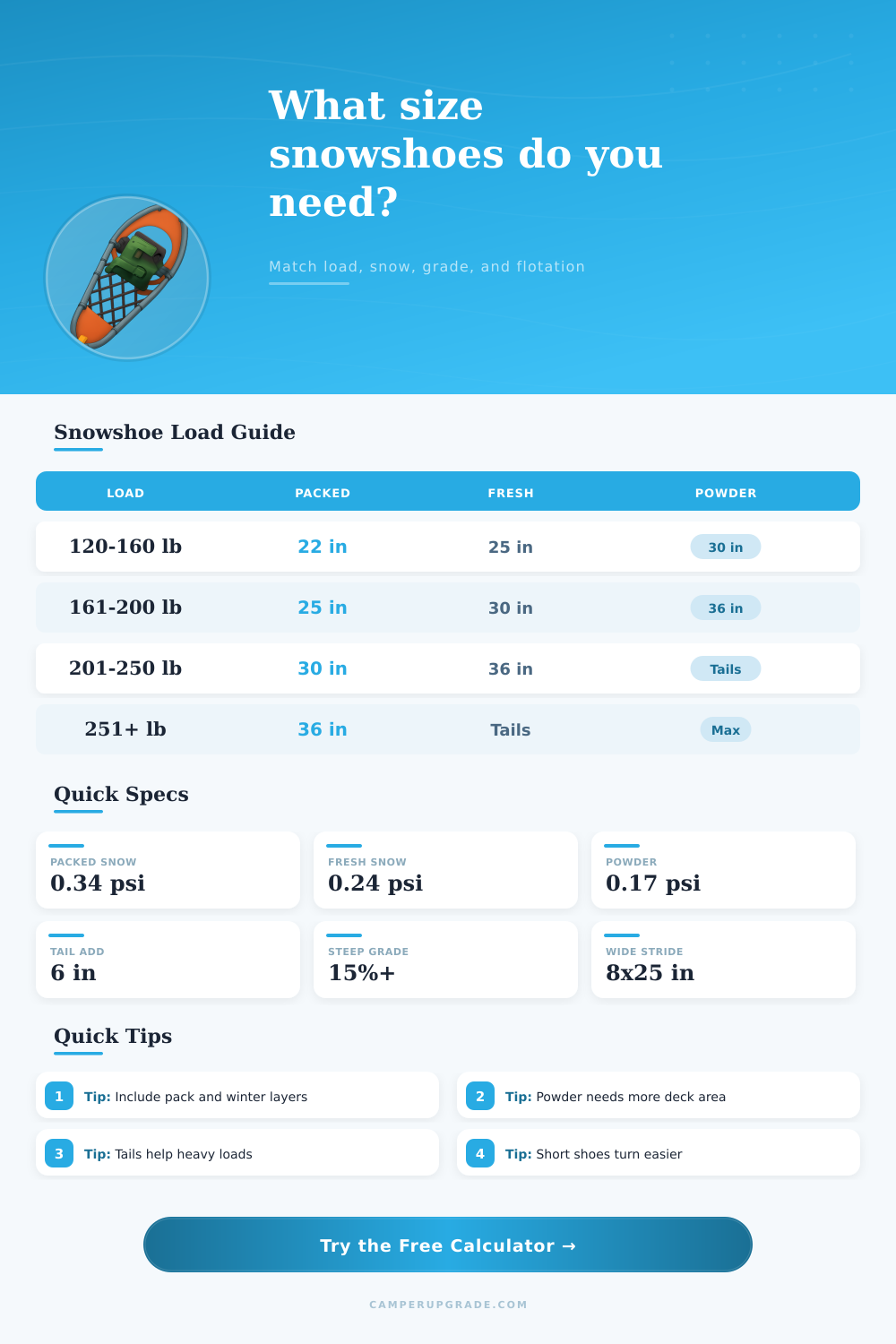
| Packed trail | 0.34 psi | Low | Shorter shoes handle turns and sidehills well. |
| Consolidated snow | 0.28 psi | Moderate | Good default for rolling off-trail travel. |
| Fresh snow | 0.24 psi | Moderate-high | Size up if carrying a winter daypack. |
| Deep powder | 0.17 psi | High | Long frames or tails reduce post-holing. |
| Wet spring snow | 0.22 psi | High | Heavy snow can collapse under small decks. |
| Pair Size | Approx Area | Best Load | Best Terrain |
|---|---|---|---|
| 7 x 22 in | 240 in² | 120-170 lb | Packed trails and tight woods |
| 8 x 25 in | 312 in² | 150-210 lb | Mixed trails and daypacks |
| 8.5 x 30 in | 398 in² | 180-250 lb | Fresh snow and heavier packs |
| 9 x 36 in | 505 in² | 220-300 lb | Deep snow and open terrain |
| 25 in + 6 in tails | 386 in² | 180-245 lb | Variable loads with removable tails |
| Total Load | Packed Trail | Fresh Snow | Deep Powder | Stride Note |
|---|---|---|---|---|
| Under 140 lb | 21-22 in | 22-25 in | 25-30 in | Shorter shoes suit narrow stride users. |
| 140-180 lb | 22-25 in | 25-30 in | 30 in or tails | Balanced sizing works for most day hikes. |
| 181-220 lb | 25 in | 30 in | 30-36 in or tails | Wider decks improve float but swing wider. |
| 221-260 lb | 30 in | 30-36 in | 36 in or tails | Use tails when loads vary by trip. |
| Over 260 lb | 30-36 in | 36 in or tails | Maximum flotation | Open terrain handles long frames best. |
| Preset | User + Pack | Shoe Setup | Snow Type | Expected Result |
|---|---|---|---|---|
| Packed Trail Day | 160 + 10 lb | 25 x 8 in | Packed trail | Low sink risk, easy stride. |
| Powder With Pack | 185 + 25 lb | 30 x 8.5 in | Deep powder | Likely size up or add tails. |
| Overnight Load | 180 + 38 lb | 30 x 9 in + tails | Fresh snow | Useful flotation with extra carried load. |
| Steep Approach | 170 + 20 lb | 25 x 8 in | Consolidated | Control may beat maximum flotation. |
| Deep Snow Tails | 205 + 30 lb | 30 x 9 in + tails | Powder | Tail add-on lowers pressure noticeably. |
💡Snowshoe Sizing Tips
When choosing the correct size for your snowshoes, there is several conditions that you should consider. The size of the snowshoes that you will use will depend on your weight and the type of snow that you will encounter. You cant solely rely on the body weight chart that is available for determining the size of the snowshoes that you should use.
Your body weight will change based off an environment. One of the primary variables to consider when choosing the size of snowshoes that you will use is the density of the snow. The density of the snow can change the amount of weights that the snow can support.
How to Choose the Right Snowshoe Size
With packed trail snow, the snow is dense and can support more of your weight. This means that you will need smaller snowshoes for this type of terrain. For fresh powder snow, the density of the snow are lower.
This means that you will need larger snowshoes to provide for the necesary amount of flotation for your movement on the snow. You needs to choose the type of snow correct on the calculator. The calculator use the snow density to determine the target pressure that you should have with your snowshoes.
Another variable to consider is the terrain grade. The terrain grade will impact the way in which your weight apply to the snow. On flat terrain, your weight will apply directly to the snow.
On steep slopes, the force of your weight will be applied at an angle. This extra weight will apply additional loading to your trailing foot. You must factor this terrain grade into the calculation that the calculator performs for you.
Steeper terrain may require shorter types of snowshoe. The third variable to consider is your pack weight. Your pack weight is one of the most critic factor in determining your snowshoe size that you should use.
Most people dont consider their pack weight when they are purchasing their snowshoes. Your pack will contain items such as an winter jacket, gloves, water bottles, and a safety kit. Use the calculator to separate your body weight and your load weight.
People with lower body weights but high load weights may require the same size snowshoes as people with a high body weight and a light load. The fourth variable is the use of tail attachment to your snowshoes. Tail attachments are used to increase the amount of surface areas of your snowshoe.
Increasing the surface area that your snowshoe makes contact with the snow will help to distribute your weight more effective. However, it will also reduce your agility with your snowshoes. Use the calculator to determine the effect that adding a tail will have on your snowshoe calculation.
Your stride and step cadence will affect the size of the snowshoes that you use. If you use more of an aggressive stride with high cadence snowshoe movement, you will need shorter types of snowshoes. If you use a slow movement on the snow with a long stride, you will need the longer and wider types of snowshoes that provides more flotation for your movement.
These movement characteristic will be reflected in your calculation that the calculator performs. The goal with your snowshoe size is to ensure that your sink depth remain within a manageable range. You will not want to become too exhausted from your snowshoe movement.
You want to ensure that your snowshoes will allow you to maintain your forward movement without sinking deep into the snow. If the risk that is shown on the calculator is moderate, your snowshoe size is within the requirement for your snow conditions but you may need to add a tail attachment to your snowshoe or you may need a longer frame if the weather worsen. For low risk, your snowshoes are noticeably oversized for your load and your snow conditions.
This is beneficial for those with high loads or for those with poor snow condition.