Climbing Grade Conversion Calculator
Convert between YDS, French sport, UIAA, V-scale, and British trad grades, then adjust the interpretation for style, seriousness, indoor or outdoor context, and route length.
🧗Climbing Grade Presets
⚙Grade Inputs
📊Grade Spec Grid
🗂Conversion Table
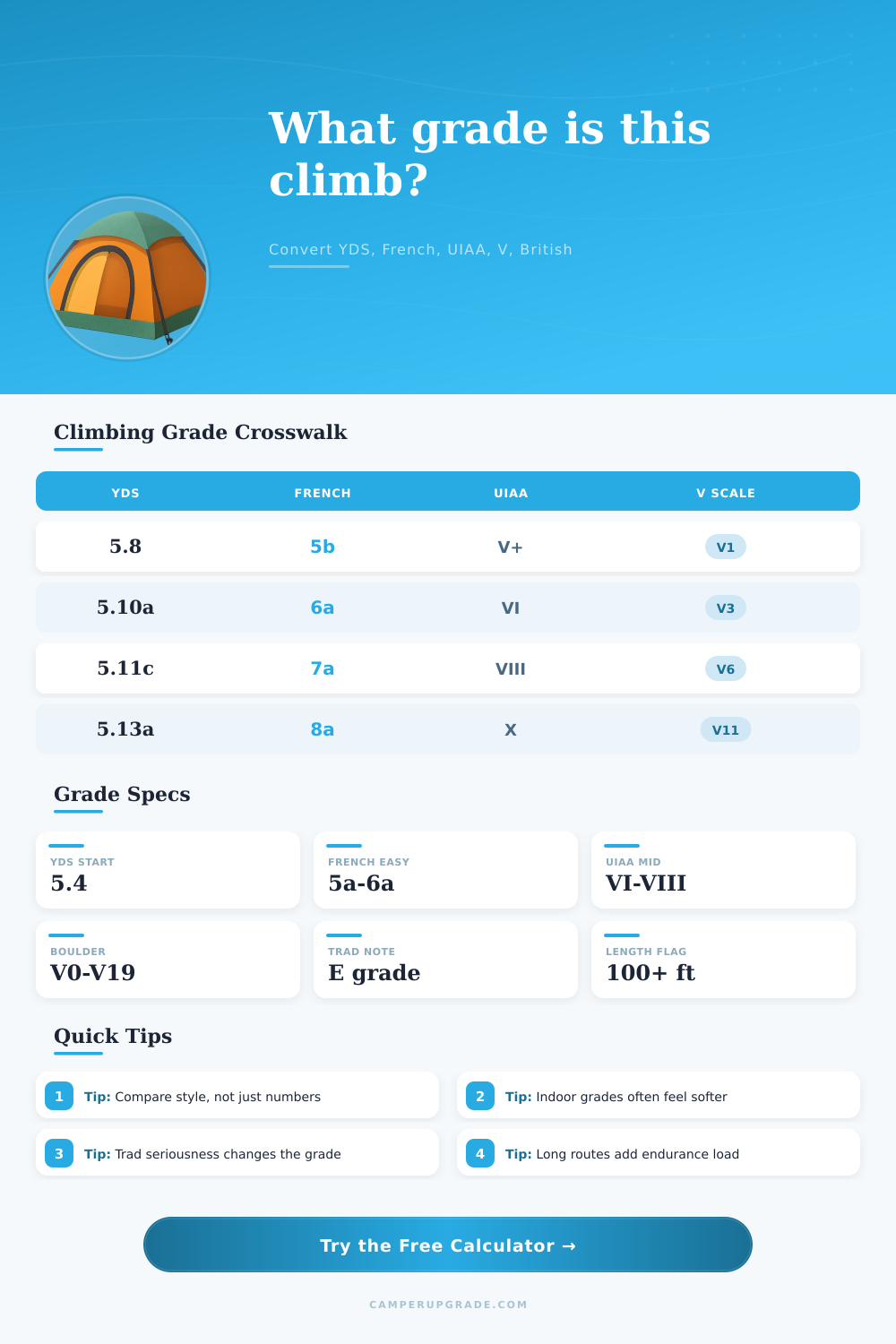
| YDS | French | UIAA | V-scale | British trad | General band |
|---|---|---|---|---|---|
| 5.6 | 4+ | IV+ | V0 | VDiff | Beginner route range |
| 5.7 | 5a | V | V0 | Sev 4a | Easy outdoor movement |
| 5.8 | 5b | V+ | V1 | HS 4b | Easy-intermediate |
| 5.9 | 5c | VI- | V2 | VS 4c | Intermediate |
| 5.10a | 6a | VI | V3 | HVS 5a | Intermediate |
| 5.10c | 6b | VII- | V4 | E1 5b | Solid intermediate |
| 5.11a | 6c | VII+ | V5 | E2 5c | Advanced |
| 5.11c | 7a | VIII | V6 | E3 6a | Advanced |
| 5.12a | 7b | IX- | V7 | E4 6b | Hard advanced |
| 5.12c | 7c | IX+ | V9 | E5 6c | Expert |
| 5.13a | 8a | X | V11 | E6 7a | Expert |
| 5.13c | 8b | XI- | V13 | E7 7b | High expert |
| 5.14a | 8c | XI+ | V15 | E8 7c | Elite |
| 5.14c | 9a | XII | V17 | E10 8a | World-class |
| 5.15a | 9b | XIII- | V18 | E11 8b | Elite limit |
🧱Style Adjustment Table
| Style | What the grade describes | Conversion caution | Best use |
|---|---|---|---|
| Sport / top rope | Technical and physical difficulty of the hardest sustained section. | Bolting, rests, and route length can change how hard the same number feels. | YDS, French, and UIAA cross-conversion. |
| Trad | Difficulty plus protection, route-finding, runouts, and fall consequence. | British adjective grades include seriousness, so they are not pure move grades. | Comparing British trad to YDS or French route grades. |
| Boulder | Short, dense movement difficulty without rope endurance. | V grades map poorly to long sport routes unless the route is very bouldery. | Estimating crux power or training targets. |
| Indoor | Set movement in controlled conditions with obvious holds and clean landings. | Gym grading varies heavily by setter, wall angle, hold style, and local culture. | Finding a starting outdoor grade range. |
| Outdoor | Real rock movement with texture, conditions, route-reading, and commitment. | Area traditions matter; a granite 5.10 and limestone 5.10 may feel different. | Guidebook planning and partner conversations. |
📏Progression Planning Table
| Current converted band | Comfort mileage | Project range | Progression note |
|---|---|---|---|
| 5.6 to 5.8 / 4+ to 5b | Repeat nearby grades on different angles. | One grade higher after clean movement. | Build footwork, belay systems, and downclimb judgment. |
| 5.9 to 5.10b / 5c to 6a+ | Climb several styles at the same grade. | Two letter grades above comfort level. | Learn rests, clipping positions, and route reading. |
| 5.10c to 5.11d / 6b to 7a+ | Track attempts by crux type and route length. | One or two grades above reliable sends. | Specific strength and movement tactics start to matter more. |
| 5.12a to 5.13a / 7b to 8a | Use a pyramid of onsight, flash, and redpoint grades. | Pick projects with clear cruxes and good conditions. | Finger load, recovery, and skin management become limiting factors. |
| 5.13b+ / 8a+ and above | Separate power, endurance, and tactical projects. | Small grade jumps can be very large. | Local benchmarks beat simple conversion tables. |
💡Grade Conversion Tips
Climbing grades are consensus labels, not measurements. Treat the result as a planning band and compare with local guidebook comments, route length, rock type, and protection.
A safe bolted 5.10a, a runout trad 5.10a, and a short V3 crux can share a conversion row while demanding very different judgment and preparation.
Short bouldery routes can feel close to V-scale conversions. Long pitches usually add pump, pacing, clipping, and rest-management difficulty beyond the single hardest move.
Some gyms, crags, and guidebooks are famous for soft or stiff grades. Once you know the local style, use the seriousness modifier to tune the practical band.
Grade conversions are approximate and style-dependent. Do not use a conversion table as a substitute for instruction, partner judgment, guidebook warnings, local ethics, or current route conditions.
Climbing grades exist because climbing grades provide a language for discussing difficulty, but there is difference in climbing grades due to the fact that different country have different systems of assigning climbing grades. A climber may encounter different climbing grades associated with the same climbing route, whether from teh topo map of the route vs. The climbing gym signage for that gym route. These difference in climbing grades can impact the decision of whether or not the climber will attempt to climbing that route.
The problem with climbing grades isnt the grade themselves, but the various factors that each climbing grade system measures. For instance, some climbing grade systems may measure only the difficulty of the hardest sequence of moves on a climbing route, but other system may also consider the quality of the protection on the route, the length of the climbing route, and the mental stress that a climber may experience while on the route with the potential for a fall. Understanding the distinction between climbing grade systems is important for those who intend to compare the climbing grades assigned to the same route by different climbing grade systems.
Why Climbing Grades Are Different
For instance, while a climbing route may be rated as both a French 7a and a YDS 5.11c, the former may indicate that the route is a sport climb with protection at each point of the climb, but the latter climbing grade may indicate that the route is on a granite cliff with few opportunity for protection along the climb. Thus, while a conversion table between climbing grades can help to translate a climbing grade from one system to another, the seriousness of the climbing route, the length of the climb, and other factors can also impact the difficulty of a route. A calculator that considers these various factors can provide a climber with a better idea of the difficulty of a route.
The length of a climbing route is one factor that can impact the difficulty of a route. The impact of route length on climbing difficulty is a factor that may surprise climbers when they learn of the influence of this variable. For instance, a short, powerful 5.12a climb may be of similar difficulty to a V7 boulder problem.
However, a 5.12a climbing grade on a 140-foot pitch may be more difficult than a V7 boulder problem due to the distance of the climb, the fatigue of the climber after such a length, the difficulty in making clipping move on such a long route, and the fatigue that may result from attempting to recover on small holds along the route. A climbing grade calculator can account for the length of the climb, which can provide a climber with a range of climbing grades that more accurately reflect the difficulty of a route of a given length. Seriousness is another factor in the assignment of climbing grades.
For instance, the assignment of a British E-grade to a climbing route considers the seriousness of a route, but not in a more basic YDS grading system. By selecting a high level of seriousness in a climbing grade calculator, a climber can adjust for the fact that the seriousness of the climb will increase the difficulty of the route, which can widen the range of climbing grades that are considered for that route. Thus, the seriousness factor does not change the climbing grade system that is used in guidebooks for the route, but ensures that a climber is aware of the difficulties of the protection on a route.
Another difficulty in the system of climbing grades is the difficulty of indoor climbing grades relative to outdoor climbing grades. Climbing gyms often set their climbing routes to incorporate large climbing holds, safe landings, and movement style that are easy for climbers to perform, which can result in gym climbing grades reflecting a lower level of difficulty than outdoor climbing grades. Outdoor climbing grades may be more difficult due to the smaller size of outdoor holds, the texture of the outdoor rock, and the need for climbers to read the rock without the benefit of the assistance of colored climbing tape.
However, a climbing grade calculator can account for the context of a climb, which will provide climbers with a better idea of the difficulty of outdoor climbing routes with consideration of these factors. Another factor that can help climbers to understand how to accomplish their goal of climbing routes of a specific difficulty is the consideration of progression tables. For instance, climbers who would like to work on route of a certain difficulty can use a progression table to select other routes that will serve as a good warm-up for the desired route; climbers can select routes of one or two climbing grades that are easier than the target climbing grades.
Additionally, climbers can use progression tables to determine other routes that can be targeted as “project” routes, again with the adjustment of the difficulty of those routes to be one or two climbing grades in difficulty than the target climbing grades. Beyond the decision of which routes to climb, progression tables can also help climbers to understand how to best train for those routes. For instance, instead of focusing on learning how to climb a specific number of routes of a certain length and difficulty, climbers may find more benefit in performing the same route with a variety of climbing styles; learning how to master such a route in a variety of different ways will enable climbers to develop their ability to read various types of rock formations.
While climbing grades can inform climbers of the difficulty of a route and lead climbers to make decisions regarding which routes to attempt, climbing grades are not a tool for the prediction of a climber’s success in climbing those routes. For instance, a climber may be able to use a climbing grade calculator to determine the difficulty of a set of routes that they wish to attempt; however, factors like the weather, the condition of a climber’s skin, and the strengths of that climber relative to the demands of the climbs may also impact the actual difficulty of those routes. Thus, while a climbing grade calculator can help to narrow the search for a climber for routes to attempt, the result that is obtained is simply the starting range of climbing grades for that individual climber to consider.