Belay Device Rope Range Calculator
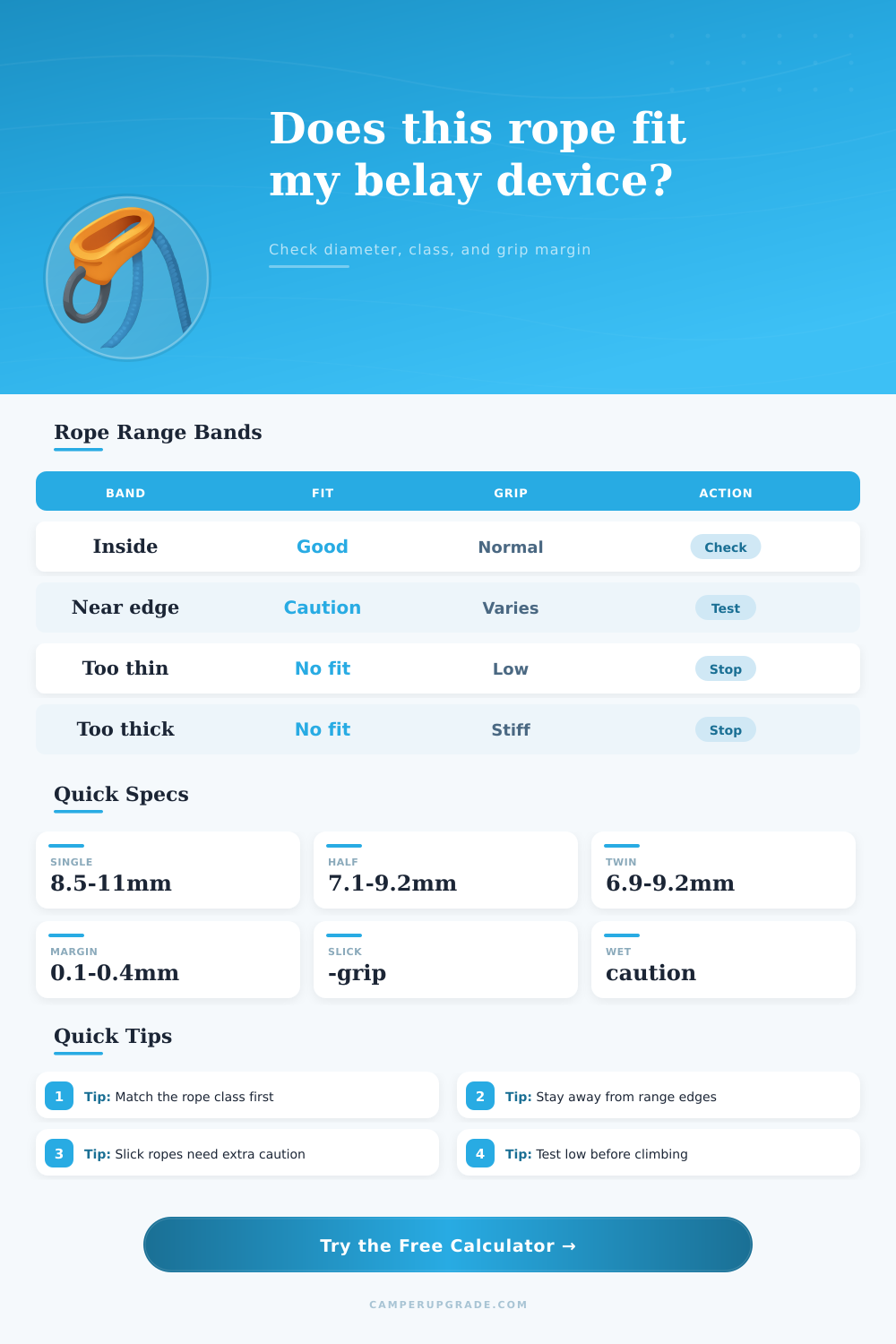
Check rope diameter against single, half, or twin rope device ranges, then estimate grip margin from rope condition, sheath slickness, climber weight, brake-hand friction, device style, and safety margin.
🧗Belay Device Presets
⚙Rope and Device Inputs
This tool cannot certify climbing equipment. Always follow the current device manual, rope label, partner checks, manufacturer warnings, and qualified instruction.
📊Device Spec Grid
📋Belay Device Preset Ranges
| Preset | Style | Single rope | Half / twin rope |
|---|---|---|---|
| Petzl GRIGRI | Cam assisted | 8.5 to 11.0 mm | Not for half or twin ropes |
| Petzl GRIGRI+ | Cam assisted | 8.5 to 11.0 mm | Not for half or twin ropes |
| Petzl Reverso | Manual tube / guide | 8.5 to 11.0 mm | Half 7.1 to 9.2 mm, twin 6.9 to 9.2 mm |
| Black Diamond ATC-Guide | Manual tube / guide | 8.1 to 11.0 mm | Listed broad 8.1 to 11.0 mm range |
| Black Diamond ATC Alpine Guide | Manual tube / guide | 6.9 to 9.0 mm | Alpine range 6.9 to 9.0 mm |
| Black Diamond ATC-XP | Manual tube | 7.7 to 11.0 mm | Listed broad 7.7 to 11.0 mm range |
| Mammut Smart 2.0 | Passive assisted | 8.7 to 10.5 mm | Not for half or twin ropes |
| Edelrid Mega Jul | Assisted manual | 7.8 to 10.0 mm | Use manual for class-specific limits |
| DMM Pivot | Manual tube / guide | 8.7 to 11.0 mm | Half/twin 7.3 to 9.2 mm |
| CT Click Up+ | Assisted manual | 8.5 to 11.0 mm | Not for half or twin ropes |
| Range position | Meaning | Likely feel | Calculator cue |
|---|---|---|---|
| Below device minimum | Outside listed range | Too little friction | Incompatible |
| Near lower edge | Inside but thin | Fast feed, less bite | Caution band |
| Middle of range | Best planning zone | Balanced handling | Best grip score |
| Near upper edge | Inside but thick | Stiffer feed | Caution band |
| Above device maximum | Outside listed range | Hard to feed or lower | Incompatible |
| Condition | Friction effect | Watch point | Action |
|---|---|---|---|
| Clean and dry | Baseline | Normal handling check | Partner check |
| New dry-treated | Lower friction | Slick sheath | Test low |
| Wet or damp | Unpredictable | Changed handling | Extra caution |
| Icy or muddy | Unreliable | Poor grip and feed | Avoid if possible |
| Old fuzzy sheath | More surface drag | Hidden wear or swelling | Inspect rope |
🧭Rope Class Reference
| Rope class | Typical diameter context | Device check | Caution note |
|---|---|---|---|
| Single rope | Often about 8.5 to 10.5+ mm | Use one strand only in devices approved for single ropes. | Skinny single ropes demand skilled brake control. |
| Half rope | Often about 7.1 to 9.2 mm | Use only with devices approved for half ropes and the route system. | Two-rope technique, clipping, and rappel setup matter. |
| Twin rope | Often about 6.9 to 9.2 mm | Use only with devices approved for twin ropes. | Very thin cords can have low friction in some devices. |
| Static or work rope | Different construction and use case | Do not assume dynamic climbing belay compatibility. | Follow the rope and device manuals exactly. |
💡Belay Compatibility Tips
This calculator is an equipment planning aid only. Climbing involves serious injury or death risk. Get qualified instruction and retire questionable ropes or devices.
Choosing the correct rope for your belay device is a necessary task because the diameter of the rope and the specifications of the device has to be compatible with one another. Beyond the diameter of the rope, you must consider the certification classes of the rope, the condition of the rope, and the frictionally of your brake hand when you are choosing rope for your device. If any of these factor dont appear to be compatible with your desired device, you should not purchase or use the rope with that device.
Therefore, you should always consider these factors before you begin to climb. The calculator provide you with a planning score for your equipment based off the information that you enters into the calculator. You enter information about the dimensions of your belay device and information about your rope.
Choose the Right Rope for Your Belay Device
The calculator calculates the planning score according to the diameter of your rope, the slickness of your rope, the condition of your rope, your weight, and the friction of your brake hand. While this planning score is not a guarantee that the rope and device will work well together, it is a tool that allows you to understand the margin that exist between the rope and the device. Always perform a low-load test on the ground with your rope prior to climbing with that rope.
Rope class are a critical factor in ensuring that the rope that you purchase works with your belay device. Even if the rope has the correct diameter to enter the device, it may be the wrong class of rope. For example, manufacturers create single ropes to work with single rope devices while half ropes and twin ropes has different specifications to work with those types of devices.
If the calculator indicates that your device is not rated for the class of rope that you have selected, you should not use that device with that rope. Always refer to the device’s manual to confirm that the manufacturer have tested the device to work with the class of rope that you intend to use. The condition of the rope can change the friction that is created with the belay device.
A new rope will create different friction levels then an old rope. Additionally, the friction levels will be different if the rope is wet as compared to when it is dry. In cases of icy conditions with ice in the rope, the rope diameter will appear more small to the device.
These factors are accounted for in the calculation of your planning score with the use of multipliers within the calculator. Because the condition of your rope can change the friction levels, many belay devices considers the rope with which you are planning to work to be unsafe if it is close to the safety margin with the device. This is due to the potential for the ropes condition to change in an unexpected manner.
Belay device and rope friction factors are additionally important to the planning score of your device. The weight that you place on the rope will change the friction between the rope and the device. The more the rope weighs, the less margin of safety that will be created with the device.
Friction can also be created in the brake hand of the climber, just as it can with the rope. Cold hands or a less experienced use of a specific belay device will create less friction in the brake hand, which reduces the control of the climber over the rope. These factors is considered when using the calculator.
The purpose of the rope and belay device calculator is to ensure that you consider the diameter, the class, and the condition of the rope. While many individual will purchase the rope and devices that they already have, it is possible that the rope and the device dont work well together. The calculator helps to identify these potential problems with the rope and the device.
Additionally, the calculator will never replace the manufacturer’s instructions for the device, but it can assist in understanding how the device will work with various other ropes and devices. You should of use the calculator to help you make your plans for your climbing endeavors, but always pay attention to the way that your rope moves through the device.