Slope Grade Calculator
Estimate percent grade, slope angle, gain per mile, route-adjusted grade, and a practical difficulty band for trails, ramps, campsites, and driveways.
🗺Trail and Driveway Presets
⚙Slope Inputs
📊Slope Spec Grid
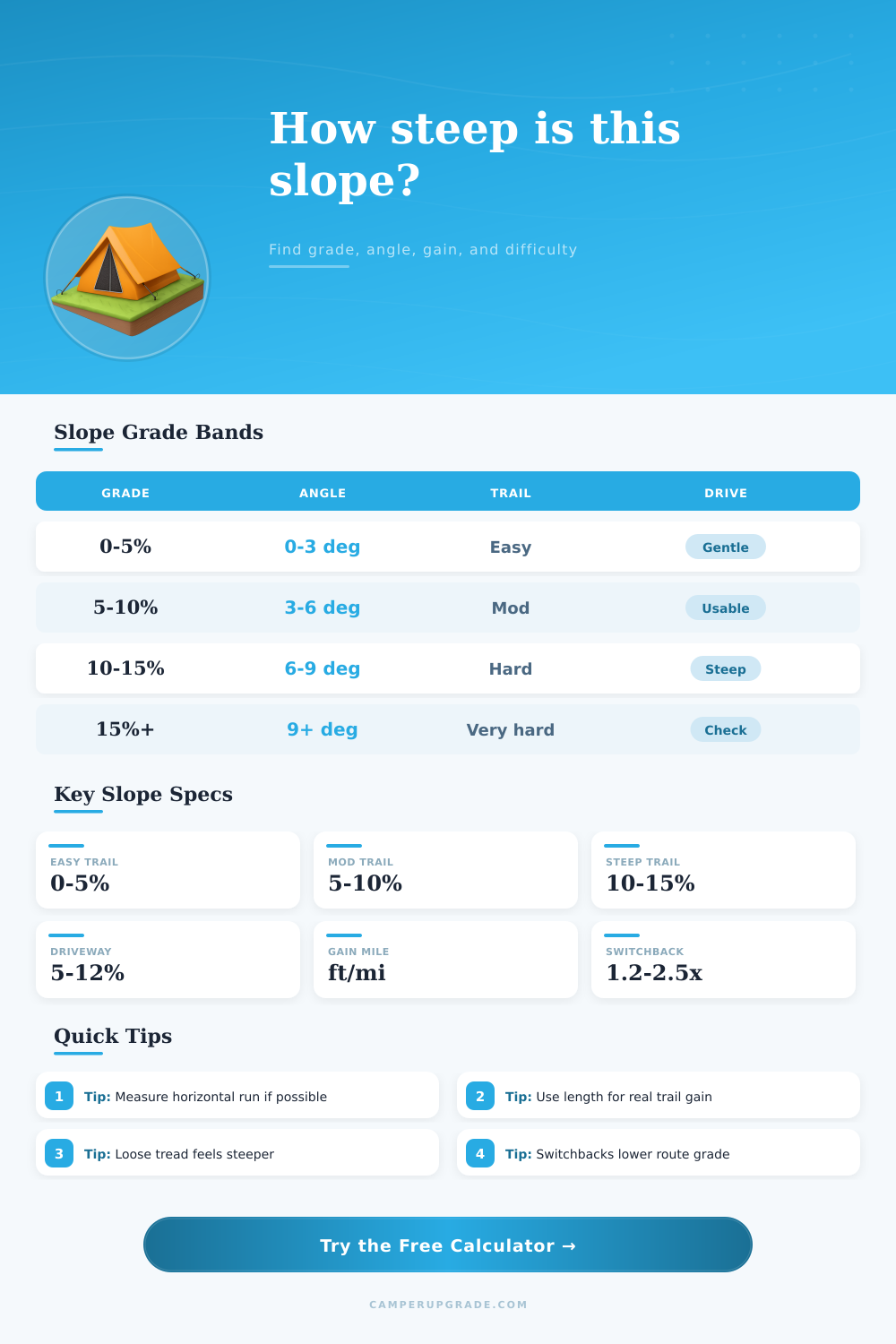
📐Grade, Angle, and Gain Table
| Percent grade | Slope angle | Gain per mile | Typical interpretation |
|---|---|---|---|
| 2% | 1.1° | 106 ft/mi | Nearly flat path, campsite approach, or very gentle driveway. |
| 5% | 2.9° | 264 ft/mi | Noticeable climb that still feels comfortable for most walking routes. |
| 8% | 4.6° | 422 ft/mi | Moderate trail grade and a practical upper target for many durable routes. |
| 10% | 5.7° | 528 ft/mi | Steady climb, harder for cycling, and a driveway grade worth checking. |
| 12% | 6.8° | 634 ft/mi | Steep sustained grade where drainage, traction, and vehicle clearance matter. |
| 15% | 8.5° | 792 ft/mi | Very steep trail segment or driveway ramp; expect braking on descent. |
| 20% | 11.3° | 1,056 ft/mi | Extremely steep for sustained travel and often better broken by turns. |
🛤Surface and Use Adjustment Table
| Surface | Feel factor | Best planning use | Watch point |
|---|---|---|---|
| Paved or concrete | 0.90x | Driveways, ramps, paths, and measured access routes. | Wet traction and low-clearance vehicles can still limit usable grade. |
| Packed gravel or hard dirt | 1.00x | Driveway approaches, campground roads, and firm hiking routes. | Loose marbles on top can raise braking risk on descents. |
| Maintained trail | 1.05x | General hiking trails with modest roots, steps, and water bars. | Short pitches can feel harder than the average grade suggests. |
| Rocky roots and steps | 1.18x | Mountain trails, natural stone tread, and uneven foot placement. | Use the adjusted band when estimating effort and descent control. |
| Loose gravel, sand, or scree | 1.30x | Unpaved climbs, desert washes, and loose driveway shoulders. | Traction loss can make moderate grades behave like steep ones. |
| Mud, snow, or slick tread | 1.45x | Wet trails, thawing slopes, snowy approaches, and muddy campsites. | Angle alone is not enough; surface grip becomes the limiting factor. |
↪Switchback Factor Table
| Switchback factor | Route meaning | Grade effect | Planning note |
|---|---|---|---|
| 1.00x | Direct up-slope line | No grade reduction | Good for short ramps and measured driveway runs. |
| 1.15x | Slight bend or shallow curve | About 13% lower route grade | Useful when a path has gentle alignment changes. |
| 1.35x | Moderate switchbacks | About 26% lower route grade | Common trail design assumption for softening a sustained climb. |
| 1.60x | Frequent switchbacks | About 38% lower route grade | Can keep a hillside walkable without forcing a straight pitch. |
| 2.00x | Long contouring route | About 50% lower route grade | Best where distance is acceptable and erosion control matters. |
| 2.50x | Very gentle traverse | About 60% lower route grade | Useful for access paths, bikes, hand carts, or low-effort approaches. |
📝Measurement Tips
Percent grade uses horizontal run, not the sloped tape distance. If you only know slope length, the calculator checks it against rise and estimates a practical measured-grade comparison.
A clean 10% concrete driveway and a 10% loose trail do not feel the same. Surface factor and descent mode help flag traction, braking, and effort risk.
This calculator is a planning tool. Local trail standards, driveway codes, drainage design, accessibility requirements, vehicle manuals, and site conditions can set stricter limits.
Slope grades is a measurement of the steepness of a slope. Slope grade is important in that the measurement will allow an individual to plan the routes or the surface that will be used. While it may be visible that a hill are steep, the distance, the surfaces of that slope, and the use that will be made of that slope will determine the grade of that slope.
The grade of the slope will change depending on the type of movement that is to be made along that slope; walking, driving, or the movement of a large vehicles. The horizontal run are the measurement of slope grade. The horizontal run is the flatter distance that is measured across the slope.
How to Measure Slope Grade
You can see the horizontal run on a map of the area, but it can also be measured with a level tape measure. The slope length is a different measurement of slope grade. The slope length is the distance along the ground of the slope.
The slope length will always be a more longer measurement than the horizontal run. Many individuals will only have access to the slope length of a given area. However, the slope grade calculator can use the slope length to calculate the slope grade.
Additionally, if the horizontal run and the slope length are entered into the calculator, that calculator will reveal the difference between the direct distance of the slope and the route that will be used; the route that might include switchbacks. The surface condition will change the grade of the slope that is experienced by an individual. A ten percent grade may be easy to traverse on a driveway with paved surfaces, but the same slope percentage might be difficult for an individual to traverse on a trail with loose gravels.
The surface factor allow for the slope grade to be adjusted upward if the surface is known to be loose or slick. The reason for adjusting the slope factor up is to account for the fact that an individual will lose purchase on a trail with loose surface. Additionally, descent mode can be used within the calculator, as well; descent mode will account for the fact that an individual will be slide down the slope when using descent mode.
Switchbacks can be used to modify the grade of a slope. Switchbacks will not change the total rise of a slope, but they will change the horizontal distance that must be travelled. By increasing the horizontal distance travelled, the grade of the slope will be reduced.
The switchback factor can be entered into the calculator to determine how the reduction in slope grade will impact the slope; this factor is useful for individuals to decide whether to incorporate switchbacks into a trail or not. The tables that are provided will allow individuals to translate the slope grade to a decision. For instance, the tables will show the percentage grade of a slope that is considered difficult.
Additionally, a difficulty band for the slope will be provided. This difficulty band is calculated as a combination of the surface factor and the mode of travel; it will show an individual the grade in a single factor instead of two separate factors. There are several factor in the real world that can complicate the calculation of slope grade; soil type and vegetation, for instance.
The type of soil will impact the amount of water that remains on the slope. Vegetation will impact the stability of the tread of an individual that is travelling on that slope. Additionally, local codes might exist regarding the maximum grade of a slope for driveways.
These codes may also relate to the type of drainage feature that are required along that driveway. While these factors are outside of the scope of the slope grade calculator, providing these factors will provide an individual with a starting point in relation to these complicating factors. Individuals should measure the horizontal run of a slope; this measurement is essential to the calculation of slope grade.
Additionally, the surface condition of that slope should be noted; this factor will again impact slope grade calculation. Furthermore, individuals should test different switchback assumptions for a slope; this will allow individuals to better understand the impact that switchbacks will have on slope grade. After these three factors are entered into the calculator, the calculator will reveal whether the grade of the slope is to be considered within a comfortable range of grade or whether it is within a difficult range.
If the slope is within a difficult range, an individual will have to redesign that slope or the surface of that slope; however, the calculations will allow an individual to understand the steepness of that slope, as opposed to having to guess at the steepness of that slope. Actually, individuals should measure the horizontal run of a slope; this measurement is essential to the calculation of slope grade. Additionally, the surface condition of that slope should be noted; this factor will again impact slope grade calculation.
Furthermore, individuals should test different switchback assumptions for a slope; this will allow individuals to better understand the impact that switchbacks will have on slope grade. After these three factors are entered into the calculator, the calculator will reveal whether the grade of the slope is to be considered within a comfortable range of grade or whether it is within a difficult range. If the slope is within a difficult range, an individual will have to redesign that slope or the surface of that slope; however, the calculations will allow an individual to understand the steepness of that slope, as opposed to having to guess at the steepness of that slope.