Wind Speed Beaufort Calculator
Convert wind speed and gusts into Beaufort force, gust factor, shelter risk, and a practical action band for tents, awnings, water crossings, paddling, trails, and camp setup.
🏕Wind Condition Presets
⚙Wind, Exposure, Shelter, and Activity Inputs
This calculator is a planning aid, not an official warning product. Use local weather alerts, land manager instructions, marine forecasts, and equipment limits for final decisions.
📌Wind Planning Spec Grid
📊Beaufort and Camping Reference Tables
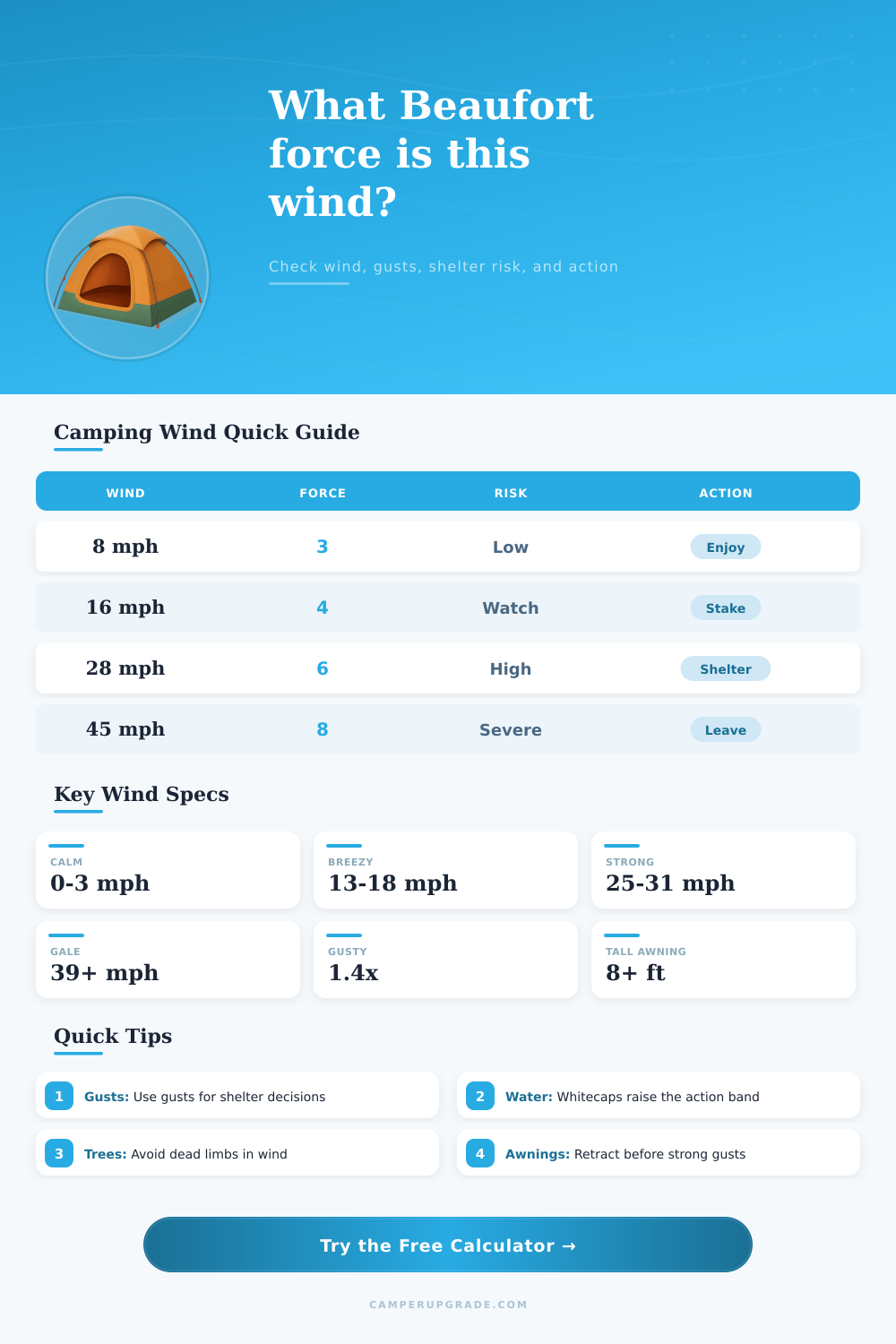
| Force | Wind Name | mph Range | Camp Meaning |
|---|---|---|---|
| 0 | Calm | 0-0 | Smoke rises nearly vertical |
| 1 | Light air | 1-3 | Smoke drifts, leaves quiet |
| 2 | Light breeze | 4-7 | Leaves rustle, tent fabric moves |
| 3 | Gentle breeze | 8-12 | Flags extend, light chop begins |
| 4 | Moderate breeze | 13-18 | Dust, loose paper, awnings tug |
| 5 | Fresh breeze | 19-24 | Small trees sway, tents strain |
| 6 | Strong breeze | 25-31 | Large branches move, shelter risk rises |
| 7 | Near gale | 32-38 | Walking exposed ridges gets difficult |
| 8 | Gale | 39-46 | Twigs break, unsafe for many shelters |
| 9+ | Strong gale+ | 47+ | Damage risk; seek robust shelter |
| Units | To mph | Example | Use |
|---|---|---|---|
| mph | x 1.000 | 20 mph = 20 mph | Common U.S. forecasts |
| km/h | x 0.621 | 30 km/h = 18.6 mph | International forecasts |
| knots | x 1.151 | 15 kt = 17.3 mph | Marine forecasts |
| m/s | x 2.237 | 8 m/s = 17.9 mph | Weather stations |
| gust factor | gust / wind | 30 / 20 = 1.5x | Shows variability |
| Action Band | Typical Trigger | Camp Action | Water Action |
|---|---|---|---|
| Enjoy | Low wind and low gusts | Normal pitch and checks | Normal shoreline caution |
| Stake | Breezy or gusty | Use all guy lines, secure loose gear | Watch direction and return path |
| Limit | Fresh breeze or exposed site | Lower profile, skip marginal awnings | Avoid small craft if unsure |
| Shelter | Strong breeze, trees, or whitecaps | Move site, retract awning, avoid trees | Stay off exposed water |
| Leave | Gale, severe gusts, damaged trees | Use vehicle or hard shelter | Cancel small-craft activity |
| Outdoor Setup | Low Concern | Caution | High Concern |
|---|---|---|---|
| Backpacking tent | 0-18 mph | 19-31 mph | 32+ mph |
| Large family tent | 0-12 mph | 13-24 mph | 25+ mph |
| RV awning | 0-12 mph | 13-18 mph | 19+ mph |
| Shade canopy | 0-12 mph | 13-18 mph | 19+ mph |
| Paddling | 0-10 mph | 11-18 mph | 19+ mph |
🧭Exposure, Water, and Activity Risk Tables
| Exposure | Risk Add | Why It Matters | Planning Note |
|---|---|---|---|
| Sheltered valley | 0 | Terrain blocks much wind | Still check gusts above camp |
| Partly exposed | 1 | Wind funnels through openings | Angle shelter to shed wind |
| Open field or beach | 2 | No windbreak for fabric or gear | Use lower profile setup |
| Ridge or bluff | 3 | Wind accelerates over terrain | Expect stronger gusts than forecast |
| Water Surface | Risk Add | Observation | Activity Note |
|---|---|---|---|
| No water | 0 | Land use only | Base action on shelter |
| Ripples only | 0 | Light texture | Monitor wind direction |
| Small waves | 1 | Choppy open stretches | Stay near protected shore |
| Whitecaps | 2 | Breaking wave tops | Cancel casual paddling |
| Spray or streaks | 3 | Rough water and blown spray | Use land-based plans |
💡Wind Safety Calculation Tips
Wind speed is another significant factors for those who enjoy being outside. Wind speed can make or remove the opportunities for activities like camping and paddling. While the weather forecast may provide information regarding the wind speed that will exist on the day of the activity, that number dont necessarily provide information regarding the effect that the wind will have upon the specific locations of the shelter or specific body of water that is to be visited.
Thus, the individual must translate wind speed into conditions that can be understood as to how the wind will affect the environment in which the individual will be spending there time. One of the tools that can be used to translate the wind speed that is forecasted for a specific location is the Beaufort scale. The Beaufort scale assign different force numbers to different types of conditions caused by the wind.
What Wind Speed Means for Outdoor Activities
For instance, Force 3 indicates that the wind is playing with the leaves in the trees and creating small waves on the water’s surface, while Force 6 indicate that the wind is moving large branches in the trees and making walking against the wind difficult. In addition to the force number that is provided for the wind speed, the gusts of that wind can be factored in as well. Gusts of wind are short bursts of wind that have twice the speed of the average wind speed for that location.
The force of the winds gusts can be important in determining the effect upon the fabric, poles, and awnings of the shelter. Thus, each factor of the Beaufort scale can provide insight into the effect that the wind will have upon the specific environment. The exposure to the wind is another determining factor for the effect of the wind.
For instance, valleys will contain less exposure to the wind than hills or beaches. Wind speeds feel manageably near trees, but can become problematic for those who are exposed to the wind and have no objects to act as a barrier against that wind. Dead tree limb can become a problem in high winds as they may fall against the exposed individual.
Finally, the water’s surface can also provide information regarding the strength of the wind, as white caps on the water indicate strong wind that may act against small boats. Finally, the type of activity that one perform will impact the impact of the wind. For instance, the RV awning may have different limits than a backpacking tent for camping, or paddling against the wind may be more problematic than hiking on a wooded trail.
The height of the shelter can also have an impact upon exposure to the wind. The higher the shelter, the more exposure to the wind that the shelter will experience. Though each of these factors is not a replacement for heeding the weather alert for the weather event, they can help to provide an understanding of the effect that the wind will have upon the individuals environment.
The calculator will perform the calculations necessary for determining each of these factors after the individual inputs their wind speed, their gust speed, their level of exposure to the wind, the height of their shelter, the condition of the trees in the area, the condition of the water’s surface, and the type of activity that they will be performing. The calculator will provide the Beaufort force for the sustained wind speed, the Beaufort force for the gusts, the gust factor, the shelter risk score, and an action band. Each action band will provide suggestion for the individual regarding actions that they should take relative to the wind and their planned activities.
Additionally, tables on the webpage will provide the Beaufort force numbers and actions for each force number. Many individuals will make mistake in determining the effect of the wind upon themselves and their plans. One of the most common mistake is to only consider the average wind speed for the area, but to not consider the effect of gusts or exposure to the wind.
For instance, an average wind speed of 15 mph may be manageable, but if the gusts reach 30 mph, or if the individual plans to set up camp on a bluff with no trees for shelter, the wind may be dangerous for that individual. Another common mistake is to consider only the presence of trees for shelter, but not to consider whether those trees have dead limbs that may fall against the individual in strong winds. Though the wind does not change the limbs of the trees, the wind will move those limbs if they are exposed to the wind.
Further decisions regarding the impact of the wind will incorporate a consideration of the time. For instance, if the individual knows that the strongest gusts will occur during the evening, they can adjust their plan to retract the awning or to secure the shelter before those gusts occur. Similarly, if the individual knows that they will be on the water, they may be able to prevent any plans for paddling from turning into a rescue by observing the water before leaving the shore.
Thus, while the calculator provides an indication of the impact of the wind upon the individual, the individual must also pay attention to the details of the wind (especially gusts) and their activity to turn the wind speed into a tool that can be utilized by the individual.