Battery Depth of Discharge Calculator
Estimate battery depth of discharge, usable watt-hours, runtime, and likely cycle-life band from battery capacity, SOC window, chemistry, reserve, load, planned runtime, and temperature.
🔋Battery Presets
Presets are planning examples. Use the label on your battery or power station for the final watt-hour or amp-hour number.
⚙Capacity and Use Inputs
Battery Discharge Results
📊Chemistry Planning Grid
🔎Battery Chemistry Reference
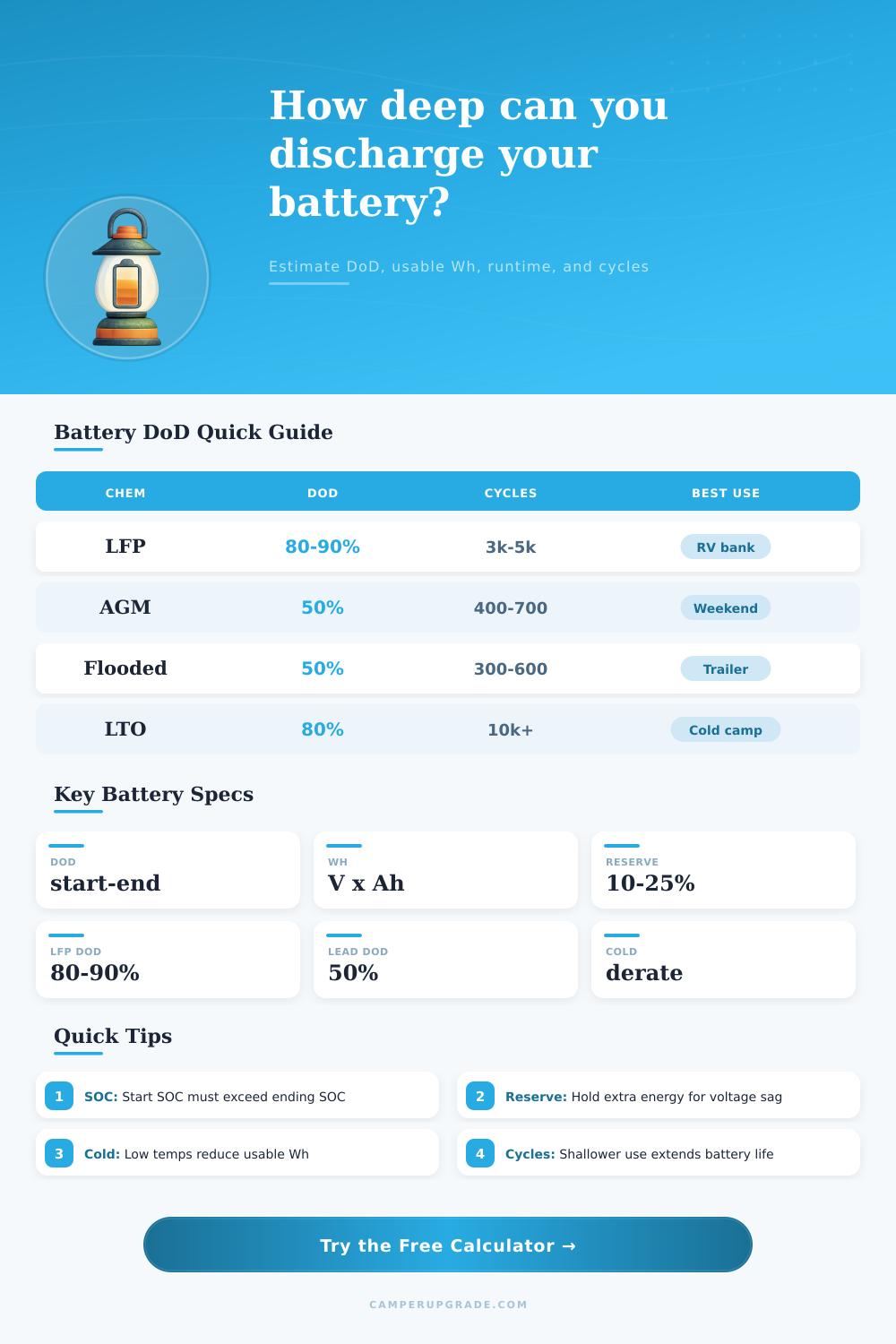
| Chemistry | Typical planning DoD | Cycle-life band | Temperature note |
|---|---|---|---|
| LiFePO4 | 80-90% for many RV house banks | 3000-5000 cycles near 80% DoD | Discharge is usually good in cold; charging below freezing needs protection. |
| AGM lead acid | About 50% for longer service life | 400-700 cycles near 50% DoD | Cold reduces available capacity and voltage holds lower under load. |
| Flooded lead acid | About 50% with full recharge soon after use | 300-600 cycles near 50% DoD | Cold and partial-state operation can reduce practical capacity. |
| Gel lead acid | 40-50% for conservative camper use | 500-1000 cycles near 50% DoD | Use gentle charge settings and avoid repeated deep discharge. |
| Lithium-ion NMC | 70-80% for portable stations | 800-1500 cycles near 80% DoD | Heat matters; avoid storing full in hot vehicles when possible. |
| Lithium titanate | 80% or more in many specialty packs | 10000-20000 cycles near 80% DoD | Excellent cold-weather behavior compared with most chemistries. |
⏱Runtime and Energy Examples
| Battery setup | Usable window | 80 W load | 200 W load |
|---|---|---|---|
| 100Ah 12.8V LiFePO4, 80% DoD | 1024 Wh before reserve and losses | About 11-12 hours after losses | About 4-5 hours after losses |
| 100Ah 12V AGM, 50% DoD | 600 Wh before reserve and losses | About 6-7 hours after losses | About 2-3 hours after losses |
| 200Ah 12.8V LiFePO4, 80% DoD | 2048 Wh before reserve and losses | About 23 hours after losses | About 9 hours after losses |
| Portable 1000 Wh NMC station, 75% DoD | 750 Wh before reserve and losses | About 8 hours after losses | About 3 hours after losses |
📘Depth of Discharge and Cycle-Life Bands
| DoD range | Lead acid planning | Lithium planning | Best use case |
|---|---|---|---|
| 20-30% | Very gentle use, high cycle count | Very gentle use, long service life | Short overnight loads or storage buffer. |
| 40-50% | Common long-life target | Conservative daily cycling | Weekend RV use, CPAP, lighting, small fridge. |
| 70-80% | Deep for lead acid | Common LiFePO4 and NMC planning range | Solar-supported camper bank or portable power station. |
| 90-100% | Avoid as a regular plan | Possible on some packs, harder on cycle life | Emergency capacity or occasional extended runtime. |
🧭Practical Tips
The depths of discharge for a battery is the amount of stored energy that a person use from a battery before they stop using it or start to charge it again. The depth of discharge is a measurement of how much energy the users remove from the battery. If a person use a large depth of discharge from the battery, then the user is using more of the stored energy from the battery.
However, if a person use such a deep depth of discharge from the battery, the battery will degrade more quickly over time. However, if a person use a shallow depth of discharge from the battery, then the user is using less of the stored energy from the battery. Furthermore, using a shallow depth of discharge will allow the battery to last for a longer period of time over time.
Depth of Discharge and Battery Life
Thus, because every use of the battery remove some of the energy from the battery, every use of the battery also has an effect upon the total number of cycles that the battery can experience before it must be replace. The chemistry of the battery can influence how the depth of discharge affect the battery. For instance, lead acid batteries is very sensitive to the depth of discharge for their batteries, and, therefore, many individual limit the depth of discharge for their lead acid batteries to 50%.
In contrast, lithium iron phosphate batteries is different in that they can handle deep depths of discharge without suffering the same level of battery degradation as the lead acid batteries. Thus, battery chemistry influence the depth of discharge that people use for the batteries. The temperature at which the battery is operating can also impact the amount of energy that the battery can provide to the devices that are using that energy.
Batteries provide less energy at cold temperatures then they do at warm temperatures, and the cold temperatures can lead to voltage sag for the battery. Thus, if a person is calculating the energy that a battery will provide for the devices that use that energy, that person should account for the effect of temperature upon that battery. Furthermore, that person should also provide for a reserve percentage of energy within the battery system.
The reserve percentage is the amount of energy that is left within the battery so that the battery system has “breathing room” for issues like meter drift or power surges in small devices. The load that is connected to the battery can also impact the battery system. For instance, loads can be devices like a cycling fridge, which does not use a constant amount of wattage, or loads can be devices like a medical device, which may use a steady amount of wattage over many hours of operation.
Thus, in battery systems, people should use the measured average wattage of the load rather than the wattage that is label on the device. By using the measured average wattage, people can calculate whether or not the depth of discharge that they plan to use for their battery will provide enough energy for those devices to function for the length of time that they require. The choice of the depth of discharge that people use with the battery will impact the cycle-life of the battery.
Cycle-life is the number of times that the battery can be charged and discharged before it must be replace. If the depth of discharge that is used is shallow, then the cycle-life of the battery will increase; the shallow depth of discharge put less stress upon the battery. However, deep depths of discharge provide more energy for the devices that use it from the battery, but cycle-life decrease with deeper depths of discharge.
Thus, there is a trade-off between deeper depths of discharge for energy now vs. Cycle-life for later. When sizing a battery system, people should not size it for the largest possible load for that battery system. Sizing the battery for the largest possible load will result in a battery system that is larger and is heavier than is needed for the majority of the days that the devices are to be used.
Instead, people should enter the actual load for the battery systems into a battery calculator, as well as enter the depth of discharge that the person is willing to use for those batteries. If the calculated capacity of the battery is not large enough to supply the energy required by the devices that are to be used, then there are three option. First, more battery capacity can be purchased.
Second, people can reduce the daily load for the devices. Third, the depth of discharge can be increased to allow the battery to last for more cycles over time. Thus, the chemistry of the battery and the climate in which the battery is to be used should also be accounted for.