LED Light Runtime Calculator
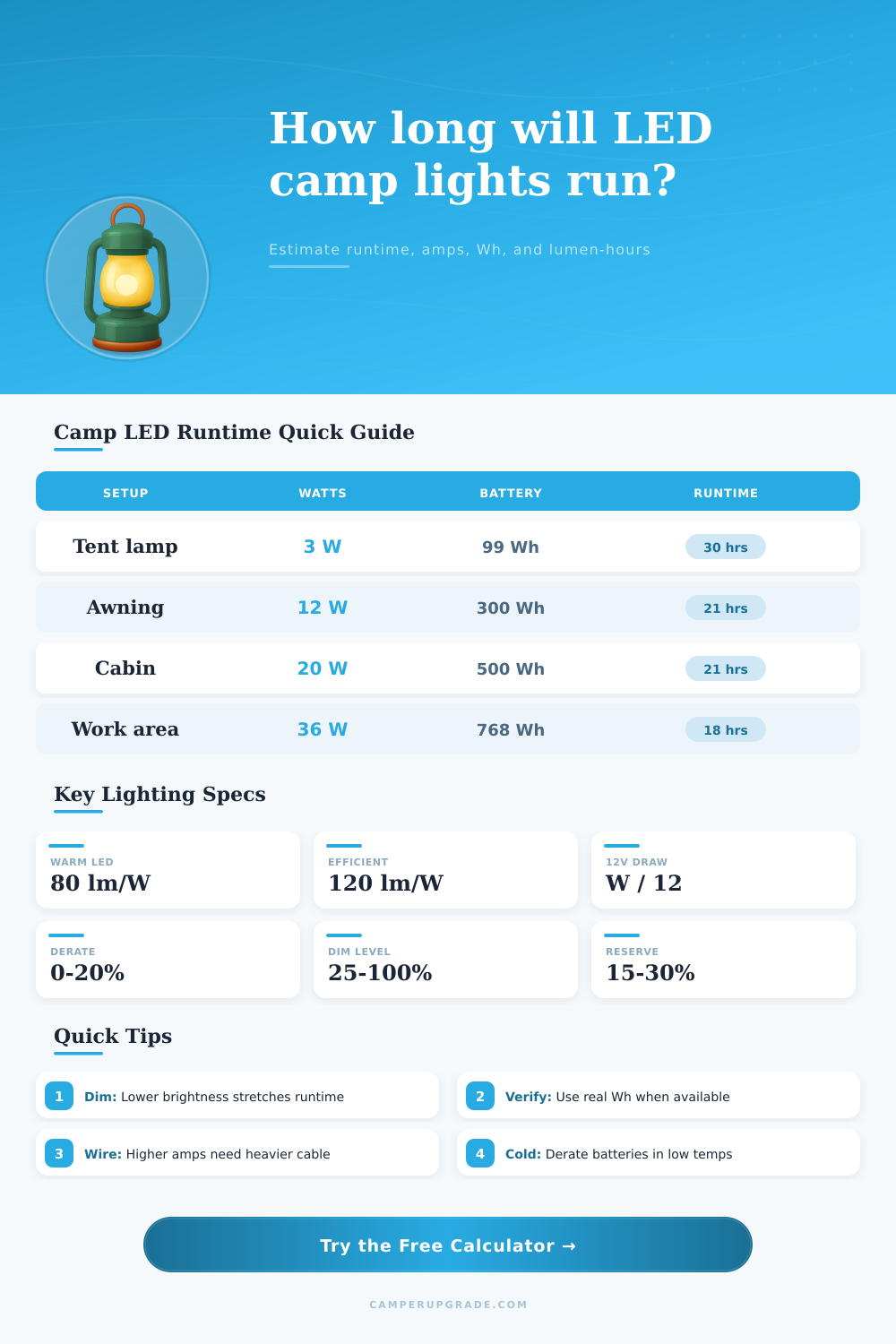
Estimate how long camp lights will run from battery watt-hours, amp-hours, voltage, brightness, driver efficiency, duty cycle, and temperature derating.
🏕Camp lighting presets
Presets set realistic planning values, then calculate automatically. Adjust any field for your actual light label or battery spec.
💡Light and battery inputs
Lighting runtime estimate
🔋LED and battery spec grid
📊Reference tables
| LED type | Typical watts | Typical lumens | Efficiency |
|---|---|---|---|
| USB tent light | 1 to 3 W | 80 to 250 lm | 60 to 90 lm/W |
| Compact lantern | 4 to 8 W | 300 to 800 lm | 75 to 120 lm/W |
| 12 V strip section | 8 to 18 W | 700 to 1800 lm | 80 to 140 lm/W |
| Work or flood light | 18 to 50 W | 1500 to 5000 lm | 80 to 130 lm/W |
| Battery label | Nominal Wh | Good reserve | Usable Wh |
|---|---|---|---|
| 10,000 mAh USB bank | 37 Wh | 20% | 30 Wh |
| 12 V 25 Ah AGM | 300 Wh | 50% | 150 Wh |
| 12.8 V 50 Ah LiFePO4 | 640 Wh | 20% | 512 Wh |
| 12.8 V 100 Ah LiFePO4 | 1280 Wh | 20% | 1024 Wh |
| Brightness | Power factor | Lumen factor | Use case |
|---|---|---|---|
| 25% | 0.25x | 0.25x | Sleep-ready tent light |
| 50% | 0.50x | 0.50x | General camp glow |
| 75% | 0.75x | 0.75x | Cooking and sorting gear |
| 100% | 1.00x | 1.00x | Work light or full output |
| Temperature | LiFePO4 derate | Lead-acid derate | Planning note |
|---|---|---|---|
| 70°F / 21°C | 0 to 5% | 0 to 5% | Baseline capacity |
| 40°F / 4°C | 5 to 10% | 10 to 20% | Add modest margin |
| 20°F / -7°C | 10 to 20% | 25 to 40% | Expect shorter nights |
| 0°F / -18°C | 20 to 35% | 40 to 60% | Warm the battery if possible |
When planning a trip into the woods for several night, it’s important to determine for how long the lights will last on the battery before the battery loses it’s charge. Many camping trips includes LED lanterns or LED strips to illuminate the camping area, but few people will calculate exactly for how long the lights will lasts on the battery. The length of time that the LED lights will last on the battery will depend on several variable.
These variables include the brightness of the lights, the number of hours that the lights are on each night, and the energy that the battery can provide. Additionally, the temperature at which the lights will be use and the margin in which the battery reserves its energy will impact the amount of energy that the battery can provide to the lights. Although LED lights are energy efficient, this efficiency remain true only in considering the entire lighting system.
How Long Will LED Lights Last on a Battery
A lantern that is rated at six watts of light output will draw more energy from the battery if it is on full brightness than if the lantern is on half brightness. The LED lights will decrease the amount of energy that is drawn from the battery as the brightness of the lights are decreased. For these reason, it is important to consider the brightness of the LED lights in formulating a plan for how long the lights will last on the battery.
Additionally, there are calculators that will allow users to enter the wattage of the lights that are to be used, the number of light fixture, the dimming level of the lights, and the battery capacity. The calculator will also allow for adjustments for the energy that is lost by the drivers that control the lights and the effect that the temperature has upon the brightness of the lights. One of the variables that those who are planning camping trips often overlook is the effect that the temperature of the environment will have upon the battery.
At temperatures near freezing, the battery will provide less energy to the lights then it will if the temperature of the camping area is at room temperature. Lead acid batteries loses more energy at cold temperatures than do lithium batteries. Users are encouraged to use the temperature derate field in the calculator in order to ensure that the camping trip will have enough light during the nights while camping.
Another factor that campers often ignore is the energy that is lost by the drivers that control the energy of the lights. Each converter or dimmer will lose some of the energy from the battery to heat. For these reasons, the efficiency field in the calculator should be set to less than 100%.
Additionally, other factors that will influence the length of time that the LED lights will provide light for campers include the duty cycle of the lights and the number of hour that those lights are to be used each night. For instance, individuals may only wish to use the lights while moving around the camping area and then use the less bright lights after dinner. Because the calculator calculates the energy use based on the number of hours that the lights are on, entering such a schedule into the calculator will provide a different result than if the camping trip simply use the lights each night for a set number of hours.
Additionally, the concept of lumen-hours can be used to make decisions about how to best use the light that is provide by the battery. If the total lumen-hours of light that the battery can provide is known, then decisions can be made about whether the individual wants to use two bright lights and one dim light, for instance, or if they prefer to use one lantern that can be moved throughout the camping area rather than using multiple lights that remain in one location at all times. Tables are included in the planning guide that can help individuals decide on the wattage and luminance of the lights that are to be used while camping.
These tables provides information regarding the number of watt-hours that can be provided by batteries of different sizes once the battery reserve has been accounted for. These tables will help individuals understand the tradeoffs between different type of camping lights. For instance, a large battery will allow individuals to have more hours of light of a specific brightness than a small battery, but the large battery will also be more weightily and costly.
Additionally, running the LED lights at a lower brightness will allow for the same number of hours of light to be provided by a smaller battery than will be provided by the same battery if it is running at higher brightness. In each of these instances, though, the brightness of the camping area will be change. One of the mistake that many individuals make when formulating a camping plan is to rely upon the label of the battery to determine the total amount of energy that the battery will contain.
For example, a battery labeled as having a 25 amp-hour capacity at 12 volts will not contain the same amount of energy as a 300 watt-hour battery pack. Additionally, the voltage of the battery must be taken into consideration. Additionally, the energy that is provide by the battery must be multiplied by the number of volts of the battery to determine the total energy in watt-hours that the battery contains.
However, this energy provided can be further reduced if the battery must reserve some of that energy for operating the lights (known as the battery reserve), and again according to the temperature that the battery reaches. Once these factors have been accounted for, the number of watt-hours that is left represents the total energy that is available to the LED lights during the camping trip. The battery calculator will automatically calculate each of these unit so that the individual isnt required to manually calculate them.
Finally, the goal in creating such a lighting plan is to determine which lighting option will work best for the individual based off the requirements for the camping trip. Short camping trips will require fewer LED lights and less brightness than camping trips that last for longer periods of time and may require the use of lights for work to be done in the camping area. In each instance, though, individuals can formulate a plan that will meet their need prior to the first night of camping.
Such a plan will ensure that they have enough light during the camping trip when the temperature drops and when the battery is used to power other camping equipment.